
“Great communication and follow up.”
T
terry i
Loan Officer at NMLS# 17022
Video Transcript
00:00
What if the strategy you're counting on to save you money
00:03
Actually ends up costing you more.
00:06
Think about that for a second.
00:07
If you're sitting on the sidelines right now waiting for rates to drop, Home prices have come down.
00:13
Or waiting until you have a larger down payment.
00:16
I have one question for you.
00:18
What if waiting?
00:20
It's the most expensive decision you make.
00:23
My name is Michael Thayer. I'm a mortgage advisor based in Nashville, Tennessee, serving clients nationwide. And over the years, I've had countless conversations with buyers who are all waiting for the same thing. A better rate, a lower price, a more affordable payment. And on the surface.
00:38
That all sounds logical.
00:40
But here's the question.
00:41
Nobody seems to be asking.
00:44
What if?
00:46
Everyone else.
00:47
is waiting.
00:49
For the exact same thing you're waiting for.
00:52
Because… If millions of buyers are sitting on the sidelines, waiting for the same signal, What happens?
00:59
When that signal finally arrives.
01:01
There's more buyers hitting the market. That means more competition.
01:06
More pressure on home prices, and potentially less affordability than you expected.
01:12
And if you're wondering, what's driving all this, take a look at the resources on this page. One explains the supply problem that most buyers never see or realize. The other explains why people waiting for rates to drop may be the real story.
01:27
But… Help explaining why waiting.
01:32
can be more expensive than it appears. That's exactly why I created this page. It's all based on a study from First American Title that looked at buyers who purchased in 3 completely different markets.
01:44
One bought at the peak of 2006, one bought during the recovery in 2014, and one bought during the pandemic boom in 2019.
01:52
Three very different markets. Yet, the lesson remains remarkably similar. The people who got into the market built wealth. The people who waited, sat on the sidelines, often paid more than they expected.
02:07
Now, I want to take that idea one step further, looking forward from today. I put together side-by-side examples down below using a $400,000, $800,000, and $1.2 million purchase comparison.
02:18
And here's what's fascinating.
02:20
Whether you're buying a $400,000 home or a $1.2 million home, the price doesn't matter. The longer you wait, the math doesn't really change.
02:30
The amount of your down payment gets bigger.
02:32
The payment increases, the opportunity costs you more the longer you wait.
02:38
But… The lesson stays the same.
02:42
Many buyers are waiting for lower rates, because they believe it will make homes more affordable. But, when you understand the history, the facts, you will realize waiting for a lower rate doesn't save you as much money as you think.
02:57
The increased home prices often erase any savings you were hoping to see from a low rate.
03:02
And what if increased competition?
03:04
Offsets the benefit of waiting as well.
03:07
And what if buying now and refinancing later was actually putting you in a stronger financial position?
03:14
Most people expect waiting to buy will save them money. History shows the opposite. This isn't about opinions. It's not the headlines. It's not predictions. It's just the numbers here, people. Let's dive into this page, call me with questions, we'll talk to you soon.
Are you considering holding off on buying and waiting for the “perfect” market conditions? History has shown us that waiting often costs more than taking action.
Whether it’s first-time buying or finding the right-sized home, the key is time in the market, not timing the market. Here are three powerful examples of how buyers who jumped in ended up miles ahead while those who waited missed out.
➡️ In deciding whether to rent or own, it’s important to remember the wealth-building power of equity accumulation.
➡️ Even homeowners who bought at the height of the housing boom in 2006 have gained $169,000 in equity, while renters lost $229,000 in wealth over that period.
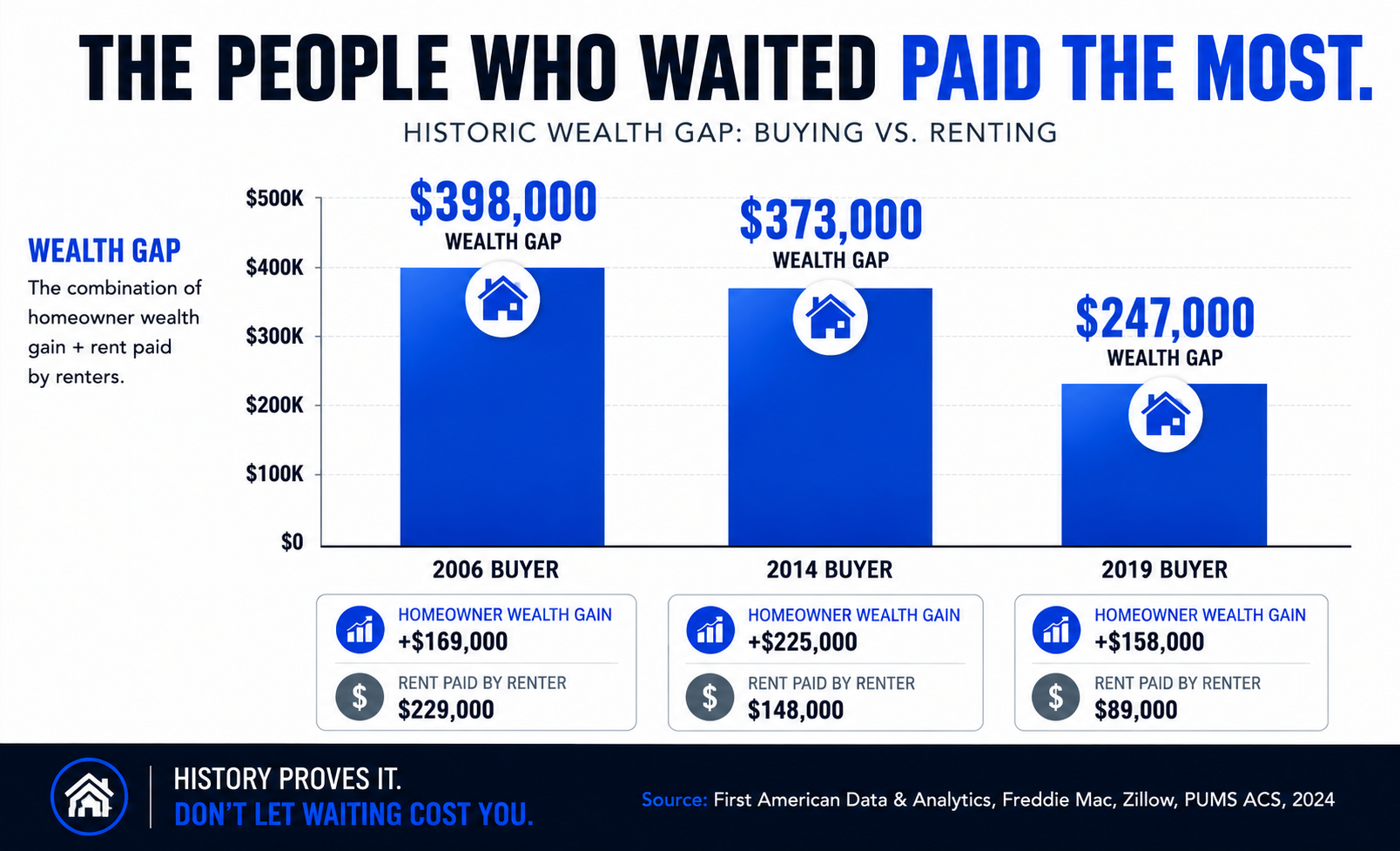
Chart comparing the financial impact of buying versus renting after the 2006, 2014, and 2019 housing markets. Homeowners gained equity and appreciation while renters accumulated housing expenses, creating wealth gaps of $398,000, $373,000, and $247,000, respectively. Source: First American Data & Analytics.
➡️ 2006 Buyer → +$169K Wealth Created
➡️ 2014 Buyer → +$225K Wealth Created
➡️ 2019 Buyer → +$158K Wealth Created
Different markets. Same outcome.
The people who waited paid the most.
The people waiting for the "perfect time" consistently missed years of appreciation, equity growth, and wealth accumulation.
History doesn't guarantee future results, but it does show one thing:
The examples above are history.
Your numbers are different.
Source: First American Link to article
What Could Waiting Cost You? Personalized homebuyer cost of waiting analysis that compares buying now versus waiting for lower mortgage rates. Discover how future home price increases, changing interest rates, refinancing opportunities, and market competition may affect affordability, monthly payments, and long-term financial outcomes.
Every buyer's situation is different.
Before you make a decision based on headlines or predictions, let's compare your options side-by-side.
➡️ Buy now
➡️ Wait
➡️ Buy now and refinance later
Schedule Your 15-Minute Strategy Call
Best regards,
Michael Thayer, CMPS, CMA
NMLS #173264
Housing affordability presentation explaining why home prices remain resilient despite higher mortgage rates. The graphic highlights that there are 63% fewer homes for sale than in 2007 and explores the housing supply shortage, buyer demand, inventory constraints, affordability challenges, and why many experts believe limited housing inventory is changing today's real estate market. Learn how supply and demand affect home prices, competition, mortgage rates, and homebuyer opportunities.
Real estate market infographic showing a home with the headline "Everyone's Watching Rates. The People Waiting Are the Story." The presentation explores how millions of buyers are waiting on the sidelines for lower mortgage rates, why pent-up demand could increase competition when rates decline, and how housing supply, affordability, inventory shortages, and buyer behavior may influence future home prices and market conditions.
“Great communication and follow up.”
“Not only is Michael extremely knowledgeable, it seems he has the heart of a teacher. While the subject is extremely complex, he was able to educate me on the key aspects of the process and to make me feel comfortable that I understood what I was taking in.”
“loan was approaved in record time. responsive and flexible.”
“Michael Thayer is one of the best in Nashville, if not one of the best in the nation. Professional, honest and on time every time.”
“Michael's communication regarding every phase of the loan process was absolutely phenomenal and the transaction even closed a whole week early! I was super impressed. Everything was exceptionally well done! Thank you so much.”
“Thanks Michael”
“The team at Guild were attentive and proactive throughout the homebuying process, making for a stress-free purchase for us as first-time home buyers.”
“We really enjoyed working with Guild Mortgage. Everyone was so knowledgeable, kind, professional, and patient. It is clear that the entire team cares about their work and making sure their customers have a great experience.”
“Transaction went smoothly and Michael kept all parties informed of progress.”