Mortgage Pre-Approval Document Checklist: Income, Assets, Identification and Supporting Documents
One of the most common questions buyers have during the mortgage process is:
“What documents will I need for pre-approval?”
The answer depends on your financial situation, income structure, employment type, assets, and financing program. Some buyers may need very little documentation, while others, especially self-employed borrowers or buyers with more complex financial situations, may require additional documentation throughout underwriting.
This page is designed to simplify the process and serve as a general reference for many of the documents commonly requested during pre-approval and underwriting.
After submitting your application, you can securely upload your documentation directly through the application portal.
If you prefer to email your documents instead, simply let our team know, and we’ll send you a secure, encrypted email link to reply to with your documentation attached.
Our goal is to make the process as simple, secure, and convenient as possible while helping guide you every step of the way.
Documents Commonly Required During Pre-Approval — Core Strategy and Decision Context
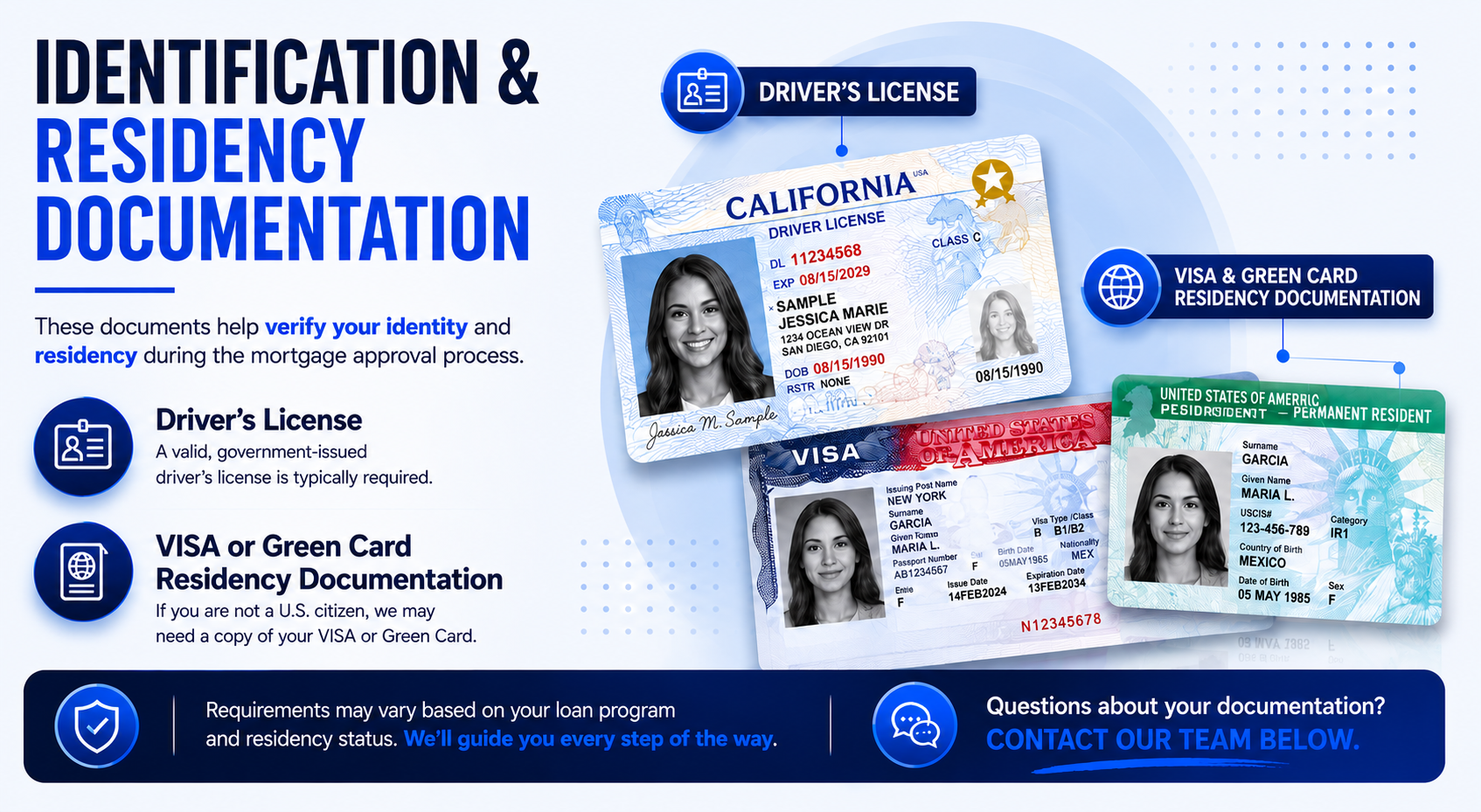
Documents Commonly Required During Pre-Approval — Core Strategy and Decision Context
Mortgage Pre — How the Process Works in Practice
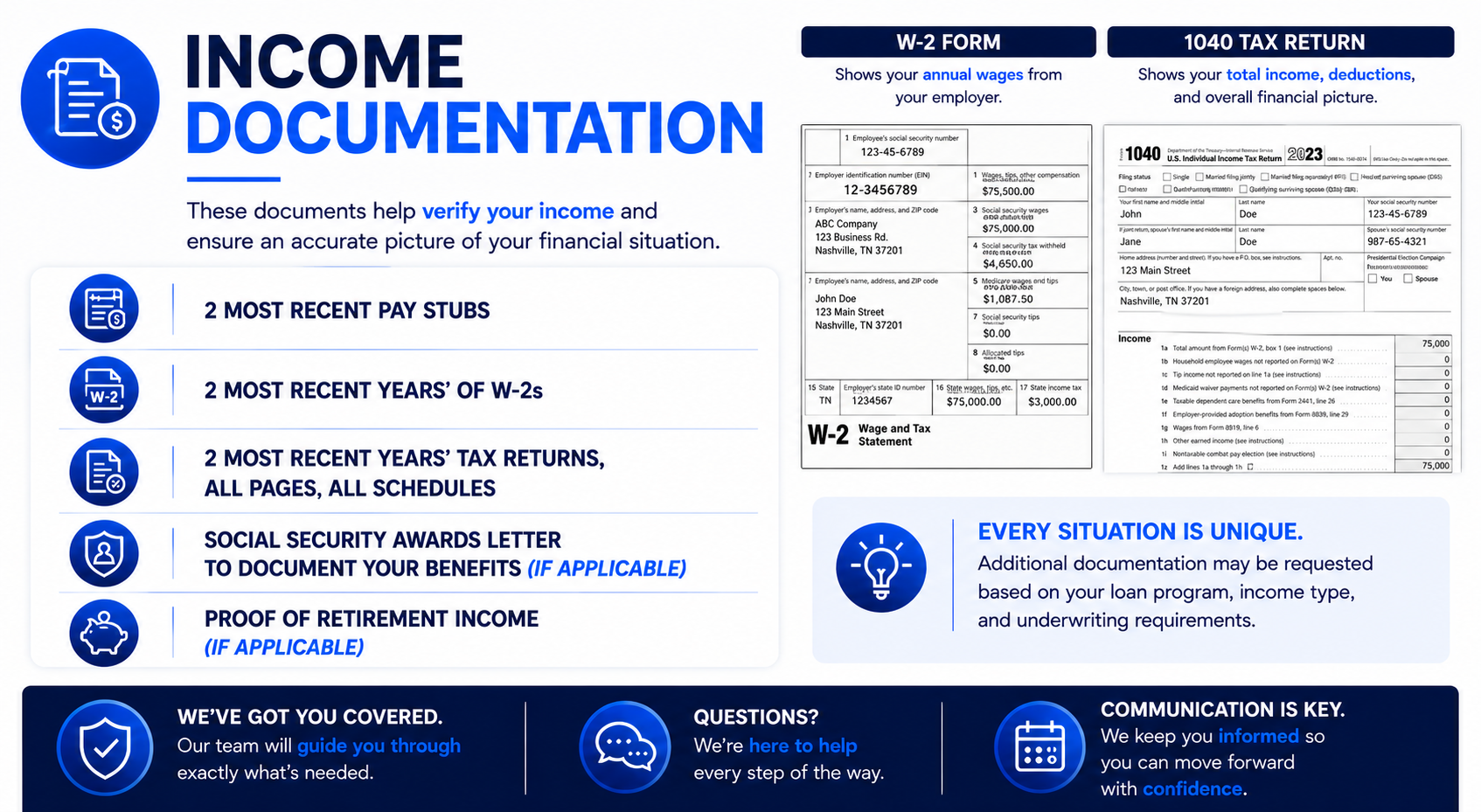
Mortgage Pre — How the Process Works in Practice
Mortgage Pre — Who This Resource Helps and Why
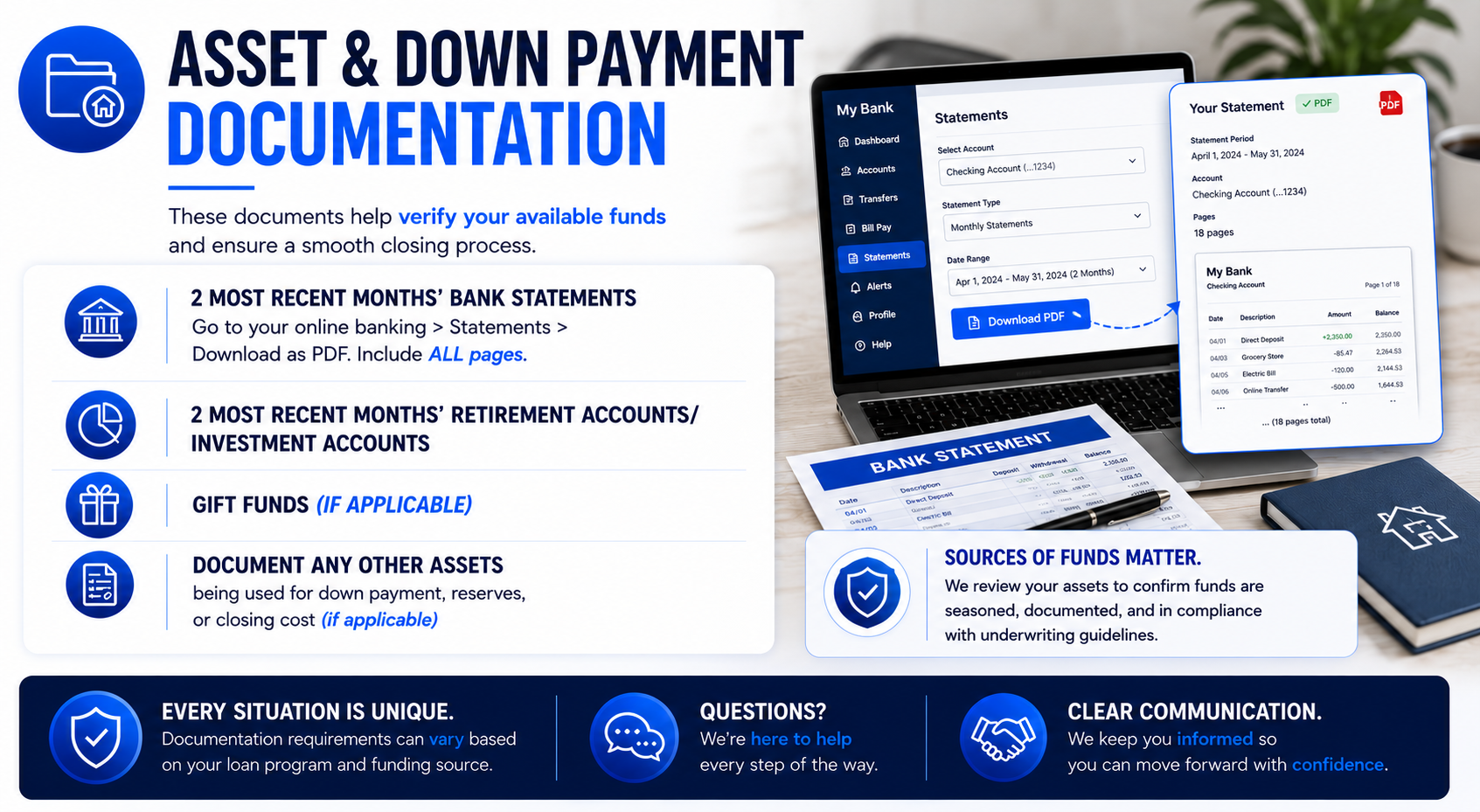
Mortgage Pre — Who This Resource Helps and Why
➡️ If Own Other Real Estate (House/Condo or Raw Land)... Please Complete This Section.
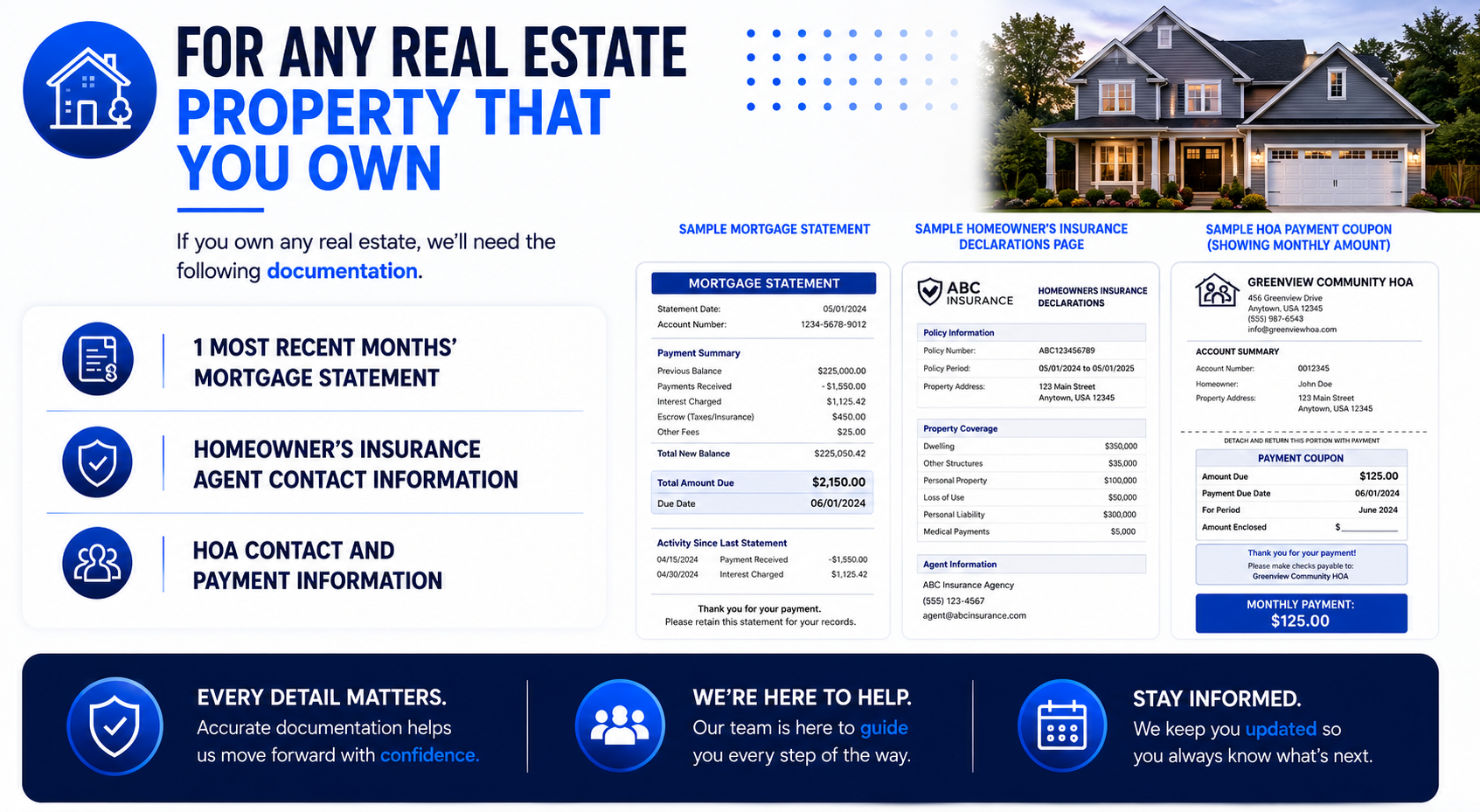
➡️ If Own Other Real Estate (House/Condo or Raw Land)... Please Complete This Section.
➡️ If You Are Self-Employed... Please Complete This Section.
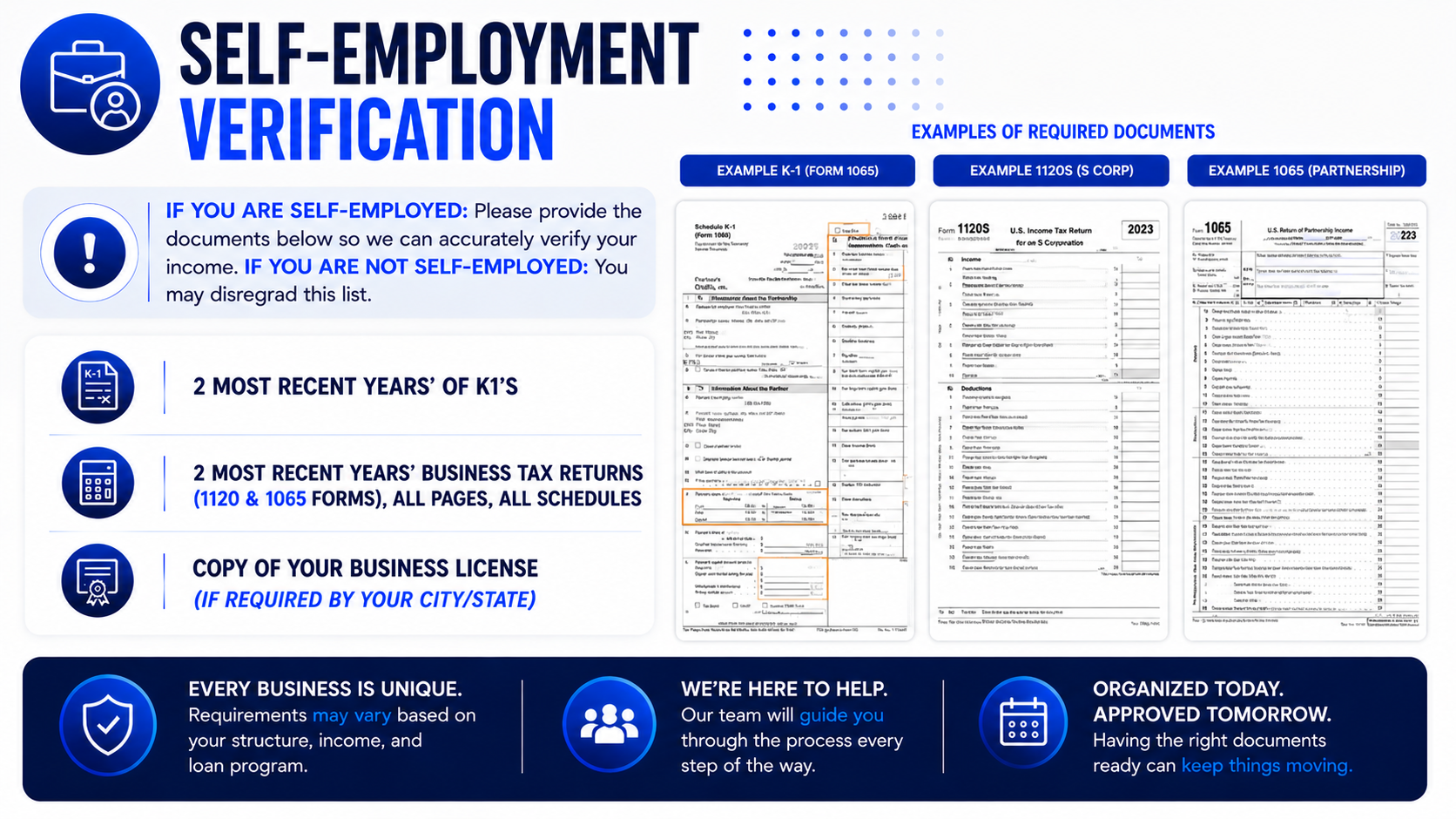
➡️ If You Are Self-Employed... Please Complete This Section.
➡️ If You Are Using A VA Loan Or Receiving Military Income... Please Complete This Section.
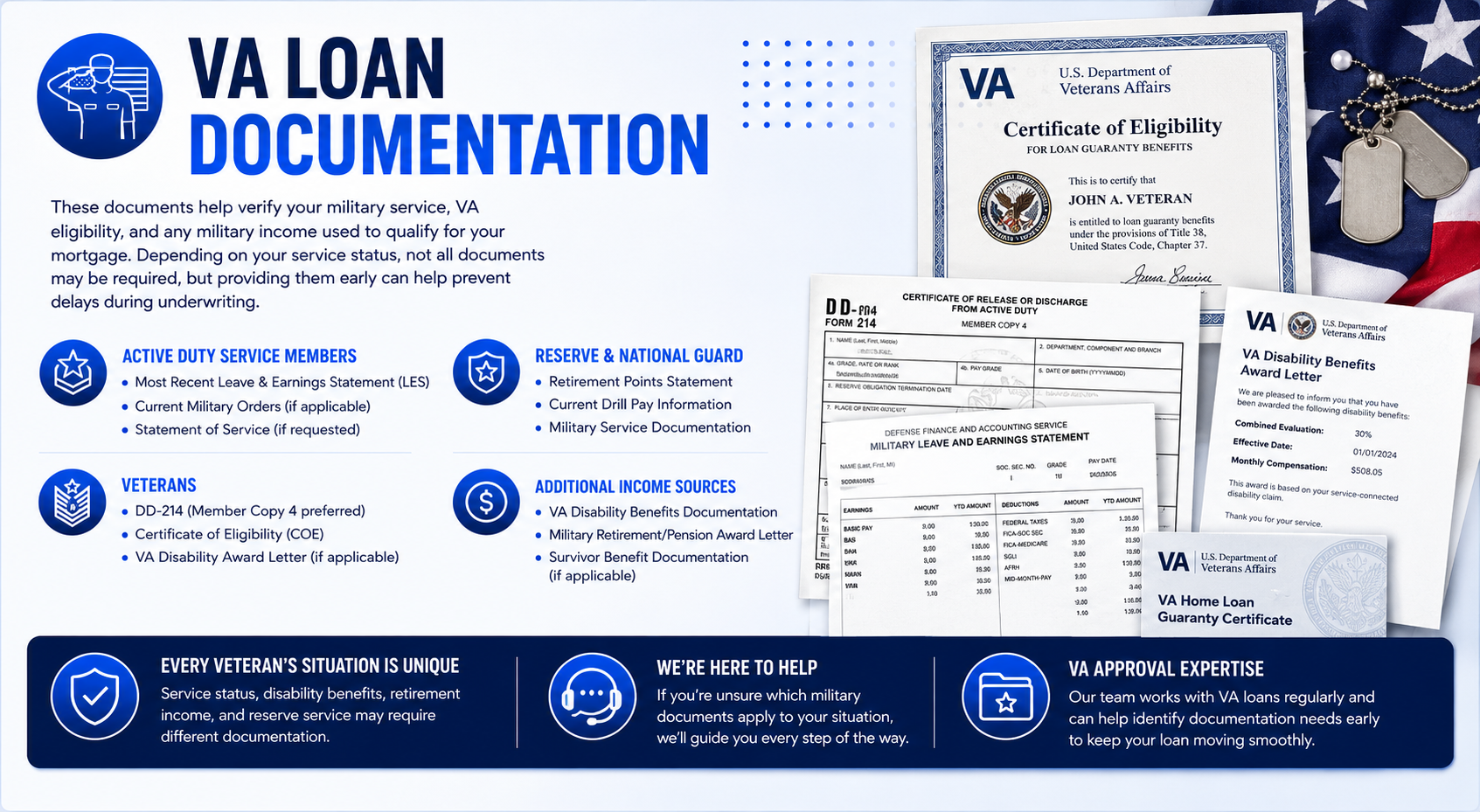
➡️ If You Are Using A VA Loan Or Receiving Military Income... Please Complete This Section.
➡️ After Underwritings Initial Review, They May Request Additional Documentation Like:
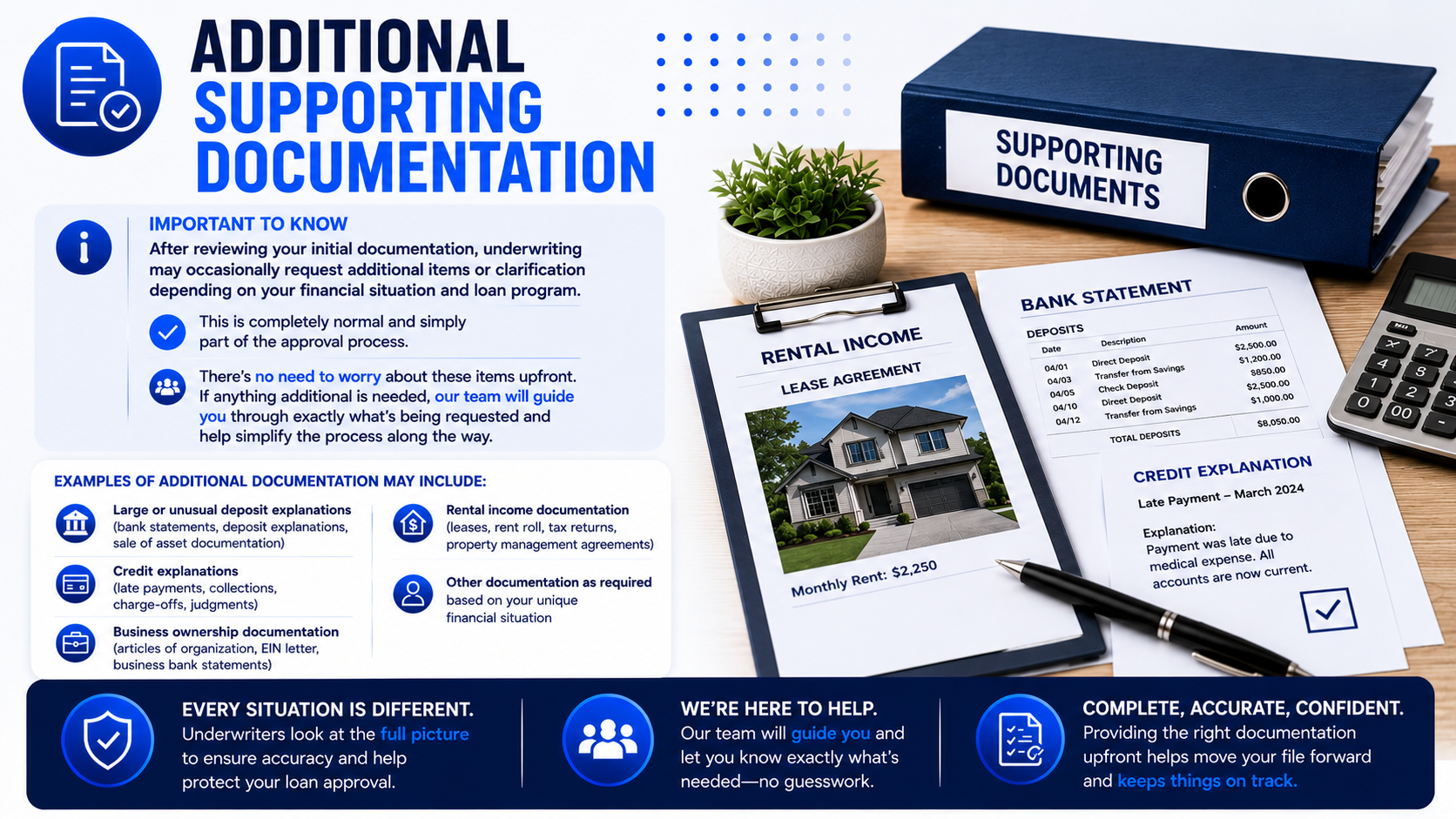
➡️ After Underwritings Initial Review, They May Request Additional Documentation Like:
Important To Know
Every loan scenario is different.
Some buyers may only need a few basic items, while others may require additional documentation depending on their income structure, assets, employment history, financing program, or underwriting requirements.
Many documentation requests are completely normal and simply part of the process of verifying the information needed to complete the approval process successfully.
Our team will help guide you through exactly what’s needed for your specific situation.
➡️ Questions About Your Documentation? Contact Our Team Here
Questions About Your Documentation?
The mortgage process can sometimes feel overwhelming, especially when different documentation requests arise throughout underwriting and final approval. Many of these requests are completely normal and simply part of verifying the information needed to complete the approval process successfully.
Our goal is to simplify the process, explain what’s needed, and ensure you feel informed and confident every step of the way.
If you ever have questions about requested documents, underwriting conditions, timelines, or what to expect next, our team is here to help guide you through the process with clarity and communication.
➡️ Contact Our Team With Questions Here
Best regards,
Michael Thayer, CMPS, CMA
NMLS #173264
Planet Home Lending, NMLS #17022
Explore Buyer & Seller Resources & Next Steps
+ −Market Timing vs. Market Strategy: When Is the Right Time to Buy... And More Importantly, Why?
Calculators & Loan Programs Questions Answered: Mortgage Programs & Financing Calculator
Smart Financing Strategies to Lower Your Monthly Mortgage Payment: Smart Mortgage Strategies & Financing Hacks
Homebuying Roadmap: Your Mortgage GPS
Moving To Middle Tennessee: Moving To Middle Tennessee Resource Center
Search Open Houses: View All Middle Tennessee Open Houses
Main Resource Hub: Buyers, Sellers, Realtors, and Builders Resources and Strategies
Additional Information & Reference Guides
+ −Welcome Video Transcript
+ −Video Transcript
00:00
Hey everyone, Michael Thayer here again. One of the biggest frustrations buyers have during the mortgage process? It's not the paperwork, it's the uncertainty.
00:08
Not knowing what's coming next, not knowing what documents might be needed, and wondering whether you're about to spend the next few weeks chasing your paperwork. That's exactly why we created this page: one of the most common questions we hear after someone submits their application is, "What documents are you actually going to need from me?"
00:25
The good news is that the process is usually much simpler than most people expect. This page is designed to show you the most common documents that may be requested. What those documents look like, and why they may be needed.
00:37
And the number one thing to keep in mind, not every document on this page will apply to you. Every borrower is different. Every income source is different. Every loan scenario is different. That's why you're gonna see some of these items throughout the page, if applicable.
00:52
The one tip I can give you that's gonna save a tremendous amount of time and frustration is, whenever possible, avoid sending mobile screenshots of your financial docs, and avoid sending links to your online banking. Instead.
01:04
Download the actual PDFs from your statement section directly from your financial institution. That helps the underwriting review everything correctly and keeps your loan moving forward without unnecessary delays.
01:15
And then once your application is submitted, you'll be able to securely upload these documents through your online borrower portal. And if you prefer, you can send… we can send you a secure, encrypted email link instead.
01:25
At the end of the day, our goal is simple. Less confusion, less stress, fewer surprises, and a smoother mortgage experience from application to close. So take a look at these examples below, and as always, if you have any questions along the way, my team and I are here to help every step of the way. Reach out or schedule a call. Talk to you soon.
Documents Commonly Required During Pre-Approval — Core Strategy and Decision Context Image Overview
+ −What this image communicates
The visible message in “Documents Commonly Required During Pre-Approval — Core Strategy and Decision Context” directs attention to homebuying decision framework on “Mortgage Pre-Approval Document Checklist: Income, Assets, Identification and Supporting Documents.” The image functions as a central strategy: it should state the main tension clearly and show which decision should be made before secondary details distract from it. That gives the reader a specific reason to slow down before acting. The image organizes “Documents Commonly Required During Pre-Approval” as a working checklist rather than a promise that every file will require the same items. It groups the records or questions a reader should anticipate, shows where an exception may add work, and provides a way to notice missing information before a deadline. The visible list is a preparation tool; the final request still comes from the responsible reviewer or program.
Why it belongs on this page
The preapproval checklist separates the standard borrower file from conditional documentation for other real estate, self-employment, military income, and later underwriting requests. The central strategy role of “Documents Commonly Required During Pre-Approval” is the reason this image belongs at this point in “Mortgage Pre-Approval Document Checklist: Income, Assets, Identification and Supporting Documents.”
How a reader can use it
Use “Documents Commonly Required During Pre-Approval” for its stated central strategy job on “Mortgage Pre-Approval Document Checklist: Income, Assets, Identification and Supporting Documents.” Name the desired outcome, identify the constraint that could block it, and decide which evidence would change the answer. The working notes for this panel should record the desired result, the assumption carrying the most risk, the fact that would disprove it, and the decision that must be made first. That record lets the reader turn a broad housing question into a smaller set of facts, tradeoffs, and next actions without asking this image to answer a different stage of the decision.
What still must be verified
The explanation around “Documents Commonly Required During Pre-Approval” must remain inside the evidence available for this page. The image provides education, not a loan decision, property valuation, legal conclusion, tax result, inspection finding, insurance commitment, or guarantee of future market performance. The “Documents Commonly Required During Pre-Approval — Core Strategy and Decision Context” visual supports a better-informed conversation, while the actual decision remains tied to current evidence and the people authorized to interpret it. On “Mortgage Pre-Approval Document Checklist: Income, Assets, Identification and Supporting Documents,” that safeguard applies specifically to the central strategy role assigned to “Documents Commonly Required During Pre-Approval.”
Mortgage Pre — How the Process Works in Practice Image Overview
+ −What this image communicates
“Mortgage Pre — How the Process Works in Practice” establishes the visual entry point for this part of “Mortgage Pre-Approval Document Checklist: Income, Assets, Identification and Supporting Documents.” Its working sequence framing helps the reader understand how to show the order of operations, the handoff between people, and the checkpoint that determines whether the next step is ready. The decision underneath the graphic is how goals, payment comfort, cash needs, property fit, timing, risk, and professional responsibilities come together. The visual presents “Mortgage Pre” as a sequence with dependencies. Its order matters: one confirmed input creates the next task, and an unresolved item can stop the file, listing, or purchase from advancing. By turning the process into visible stages, the graphic lets a reader identify the current position, the next handoff, and the deadline or evidence that controls progress.
Why it belongs on this page
Its seven images should reduce surprises by showing why different income and asset structures create different proof requirements. The working sequence role of “Mortgage Pre” is the reason this image belongs at this point in “Mortgage Pre-Approval Document Checklist: Income, Assets, Identification and Supporting Documents.”
How a reader can use it
Use “Mortgage Pre” for its stated working sequence job on “Mortgage Pre-Approval Document Checklist: Income, Assets, Identification and Supporting Documents.” Read the visual from the first confirmed fact through the next action, noting dependencies, deadlines, and the owner of each task. The working notes for this panel should record the starting condition, each dependent step, the responsible person, the handoff document, the deadline, and the condition required to advance. That record lets the reader turn a broad housing question into a smaller set of facts, tradeoffs, and next actions without asking this image to answer a different stage of the decision.
What still must be verified
“Mortgage Pre” organizes the working sequence part of the decision; it does not settle the rest. The image provides education, not a loan decision, property valuation, legal conclusion, tax result, inspection finding, insurance commitment, or guarantee of future market performance. The responsible next step after “Mortgage Pre — How the Process Works in Practice” is to obtain the current document or finding that governs the issue and reconcile any difference before proceeding. On “Mortgage Pre-Approval Document Checklist: Income, Assets, Identification and Supporting Documents,” that safeguard applies specifically to the working sequence role assigned to “Mortgage Pre.”
Mortgage Pre — Who This Resource Helps and Why Image Overview
+ −What this image communicates
“Mortgage Pre — Who This Resource Helps and Why” is not a decorative break in “Mortgage Pre-Approval Document Checklist: Income, Assets, Identification and Supporting Documents.” It is the page's reader and use-case map, designed to explain who benefits, what problem each person is trying to solve, and why the same information may lead to different questions. That framing matters because the reader is evaluating how goals, payment comfort, cash needs, property fit, timing, risk, and professional responsibilities come together. The image frames “Mortgage Pre” as a question that cannot be answered responsibly from a slogan. Its visual emphasis is an invitation to test the premise against the reader's actual property, finances, timing, and goals. That question-led design is useful because it creates a pause between interest and action and makes the missing evidence easier to name.
Why it belongs on this page
The list is preparatory; the loan program, application, business structure, ownership, property, and underwriter determine the final document request. The reader and use-case map role of “Mortgage Pre” is the reason this image belongs at this point in “Mortgage Pre-Approval Document Checklist: Income, Assets, Identification and Supporting Documents.”
How a reader can use it
Use “Mortgage Pre” for its stated reader and use-case map job on “Mortgage Pre-Approval Document Checklist: Income, Assets, Identification and Supporting Documents.” Match the graphic to the reader's role, current stage, pressure, and decision authority before applying its guidance. The working notes for this panel should record who the guidance is for, the reader's current stage, the decision they control, the problem they need solved, and when a specialist must take over. That record lets the reader turn a broad housing question into a smaller set of facts, tradeoffs, and next actions without asking this image to answer a different stage of the decision.
What still must be verified
The image provides education, not a loan decision, property valuation, legal conclusion, tax result, inspection finding, insurance commitment, or guarantee of future market performance. “Mortgage Pre — Who This Resource Helps and Why” should therefore be treated as a reader and use-case map, not as transaction evidence by itself. Current documents, responsible sources, and the professionals accountable for the relevant decision must control when they differ from the illustration. On “Mortgage Pre-Approval Document Checklist: Income, Assets, Identification and Supporting Documents,” that safeguard applies specifically to the reader and use-case map role assigned to “Mortgage Pre.”
➡️ If Own Other Real Estate (House/Condo or Raw Land)... Please Complete This Section. Image Overview
+ −What this image communicates
On “Mortgage Pre-Approval Document Checklist: Income, Assets, Identification and Supporting Documents,” the “➡️ If Own Other Real Estate (House/Condo or Raw Land)... Please Complete This Section.” visual isolates one decision from a larger housing conversation. As a primary visual message, it is meant to make one topic recognizable at a glance and give the reader a clear entry point into the deeper explanation on the page. The subject belongs to homebuying decision framework, where the useful question is how goals, payment comfort, cash needs, property fit, timing, risk, and professional responsibilities come together. The image makes “➡️ If Own Other Real Estate (House/Condo or Raw Land)... Please Complete This Section.” the dominant visual message and gives the reader a defined entry point into the page's argument. The wording identifies what deserves attention first; the surrounding design establishes whether the reader is looking at a claim, a choice, a sequence, or a practical resource. That distinction determines what evidence should be gathered before the message is applied.
Why it belongs on this page
The preapproval checklist separates the standard borrower file from conditional documentation for other real estate, self-employment, military income, and later underwriting requests. The primary visual message role of “➡️ If Own Other Real Estate (House/Condo or Raw Land)... Please Complete This Section.” is the reason this image belongs at this point in “Mortgage Pre-Approval Document Checklist: Income, Assets, Identification and Supporting Documents.”
How a reader can use it
Use “➡️ If Own Other Real Estate (House/Condo or Raw Land)... Please Complete This Section.” for its stated primary visual message job on “Mortgage Pre-Approval Document Checklist: Income, Assets, Identification and Supporting Documents.” Identify the claim, chart, comparison, process, property feature, or strategy shown and connect it to the exact decision the page addresses. The working notes for this panel should record the literal claim or comparison shown, the page fact it supports, the source behind that fact, and the decision the reader should make next. That record lets the reader turn a broad housing question into a smaller set of facts, tradeoffs, and next actions without asking this image to answer a different stage of the decision.
What still must be verified
The image is valuable because it frames the right issue, not because it proves the answer. The image provides education, not a loan decision, property valuation, legal conclusion, tax result, inspection finding, insurance commitment, or guarantee of future market performance. “➡️ If Own Other Real Estate (House/Condo or Raw Land)... Please Complete This Section.” remains educational until the current borrower, property, market, and transaction evidence supports a specific conclusion. On “Mortgage Pre-Approval Document Checklist: Income, Assets, Identification and Supporting Documents,” that safeguard applies specifically to the primary visual message role assigned to “➡️ If Own Other Real Estate (House/Condo or Raw Land)... Please Complete This Section..”
➡️ If You Are Self-Employed... Please Complete This Section. Image Overview
+ −What this image communicates
“➡️ If You Are Self-Employed... Please Complete This Section.” establishes the visual entry point for this part of “Mortgage Pre-Approval Document Checklist: Income, Assets, Identification and Supporting Documents.” Its primary visual message framing helps the reader understand how to make one topic recognizable at a glance and give the reader a clear entry point into the deeper explanation on the page. The decision underneath the graphic is how goals, payment comfort, cash needs, property fit, timing, risk, and professional responsibilities come together. The image makes “➡️ If You Are Self-Employed... Please Complete This Section.” the dominant visual message and gives the reader a defined entry point into the page's argument. The wording identifies what deserves attention first; the surrounding design establishes whether the reader is looking at a claim, a choice, a sequence, or a practical resource. That distinction determines what evidence should be gathered before the message is applied.
Why it belongs on this page
Its seven images should reduce surprises by showing why different income and asset structures create different proof requirements. The primary visual message role of “➡️ If You Are Self-Employed... Please Complete This Section.” is the reason this image belongs at this point in “Mortgage Pre-Approval Document Checklist: Income, Assets, Identification and Supporting Documents.”
The exact story carried by this graphic
The self-employed section represents a different proof-of-income path from the wage-earner checklist. A business owner may need personal and business tax returns, applicable K-1s or corporate returns, a year-to-date profit-and-loss statement, a balance sheet, business bank statements, proof of ownership, and explanations for one-time expenses or declining revenue. The exact request depends on business structure, ownership percentage, income history, loan program, and the underwriter's findings. The image's practical benefit is preventing a borrower from treating gross deposits or a single tax-return figure as qualifying income. It directs the reader to assemble a consistent business story early enough for the lender to calculate stable, usable income and resolve document conflicts before a purchase deadline.
How a reader can use it
Use “➡️ If You Are Self-Employed... Please Complete This Section.” for its stated primary visual message job on “Mortgage Pre-Approval Document Checklist: Income, Assets, Identification and Supporting Documents.” Identify the claim, chart, comparison, process, property feature, or strategy shown and connect it to the exact decision the page addresses. The working notes for this panel should record the literal claim or comparison shown, the page fact it supports, the source behind that fact, and the decision the reader should make next. That record lets the reader turn a broad housing question into a smaller set of facts, tradeoffs, and next actions without asking this image to answer a different stage of the decision.
What still must be verified
The explanation around “➡️ If You Are Self-Employed... Please Complete This Section.” must remain inside the evidence available for this page. The image provides education, not a loan decision, property valuation, legal conclusion, tax result, inspection finding, insurance commitment, or guarantee of future market performance. The “➡️ If You Are Self-Employed... Please Complete This Section.” visual supports a better-informed conversation, while the actual decision remains tied to current evidence and the people authorized to interpret it. On “Mortgage Pre-Approval Document Checklist: Income, Assets, Identification and Supporting Documents,” that safeguard applies specifically to the primary visual message role assigned to “➡️ If You Are Self-Employed... Please Complete This Section..”
➡️ If You Are Using A VA Loan Or Receiving Military Income... Please Complete This Section. Image Overview
+ −What this section of the checklist shows
The “➡️ If You Are Using A VA Loan Or Receiving Military Income... Please Complete This Section.” image isolates records that do not appear in a standard civilian wage file. It tells the borrower that military pay, service status, and VA benefit eligibility are related but separate questions. A Leave and Earnings Statement may show basic pay, housing allowance, subsistence allowance, special pay, deductions, and leave status. A Certificate of Eligibility addresses VA entitlement. Orders, a statement of service, or a DD Form 214 document service facts. The visual keeps those lanes visible so one missing record is not mistaken for a failure of the entire preapproval.
Why this image belongs on the preapproval page
On “Mortgage Pre-Approval Document Checklist: Income, Assets, Identification and Supporting Documents,” this panel protects a military borrower from receiving a generic paystub request that does not explain what the lender actually needs. Active-duty income, Guard or Reserve pay, retirement, disability benefits, and allowances can have different continuation and tax treatment. A permanent-change-of-station order can also affect occupancy, timing, and expected income. The benefit is an earlier service-specific review, giving the borrower time to obtain the correct records before an offer or closing deadline makes the gap urgent.
How to use the military-income panel
The borrower should identify current service or veteran status, the income components being used, the expected continuation of each component, the intended occupancy, and whether a VA loan benefit is part of the application. The mortgage professional can then request only the records needed for that scenario and explain how each will be interpreted. If orders, service dates, entitlement, or compensation are changing, the file should record the effective date and the responsible verification source. That process turns the image into a preparation tool rather than a promise that one standard document package fits every service member.
What remains subject to verification
The visual does not determine VA eligibility, entitlement, residual-income compliance, qualifying income, disability-income treatment, occupancy, approval, or the final document list. Current VA guidance, the lender's underwriting, and the borrower's verified application control those findings. No borrower should alter, omit, or delay disclosing a service, income, debt, or occupancy fact to make the checklist appear complete. When an order, duty status, benefit record, or income amount changes, the preapproval must be reviewed again using the updated evidence.
➡️ After Underwritings Initial Review, They May Request Additional Documentation Like: Image Overview
+ −What this image communicates
“➡️ After Underwritings Initial Review, They May Request Additional Documentation Like:” establishes the visual entry point for this part of “Mortgage Pre-Approval Document Checklist: Income, Assets, Identification and Supporting Documents.” Its primary visual message framing helps the reader understand how to make one topic recognizable at a glance and give the reader a clear entry point into the deeper explanation on the page. The decision underneath the graphic is what must happen at this stage, who owns the next action, and which conditions must be resolved before the file can advance. The image organizes “➡️ After Underwritings Initial Review, They May Request Additional Documentation Like:” as a working checklist rather than a promise that every file will require the same items. It groups the records or questions a reader should anticipate, shows where an exception may add work, and provides a way to notice missing information before a deadline. The visible list is a preparation tool; the final request still comes from the responsible reviewer or program.
Why it belongs on this page
The preapproval checklist separates the standard borrower file from conditional documentation for other real estate, self-employment, military income, and later underwriting requests. The primary visual message role of “➡️ After Underwritings Initial Review, They May Request Additional Documentation Like:” is the reason this image belongs at this point in “Mortgage Pre-Approval Document Checklist: Income, Assets, Identification and Supporting Documents.”
How a reader can use it
Use “➡️ After Underwritings Initial Review, They May Request Additional Documentation Like:” for its stated primary visual message job on “Mortgage Pre-Approval Document Checklist: Income, Assets, Identification and Supporting Documents.” Identify the claim, chart, comparison, process, property feature, or strategy shown and connect it to the exact decision the page addresses. The working notes for this panel should record the literal claim or comparison shown, the page fact it supports, the source behind that fact, and the decision the reader should make next. That record lets the reader see the sequence early enough to prevent a missing document or misunderstood responsibility from becoming a closing problem without asking this image to answer a different stage of the decision.
What still must be verified
The final safeguard is verification. A process graphic cannot promise an identical timeline; loan type, borrower documentation, property findings, third parties, contract terms, and underwriting can change the order or timing. A reader should leave “➡️ After Underwritings Initial Review, They May Request Additional Documentation Like:” knowing what to ask and what to gather—not believing that a graphic has already supplied an approval, valuation, legal conclusion, or guaranteed outcome. On “Mortgage Pre-Approval Document Checklist: Income, Assets, Identification and Supporting Documents,” that safeguard applies specifically to the primary visual message role assigned to “➡️ After Underwritings Initial Review, They May Request Additional Documentation Like:.”