Renovation Loans: Buy a Home and Finance the Improvements
What If You Could Buy the Right Home and Finance the Renovations?
What If You Could Buy the Right Home and Finance the Renovations?
Stop Waiting For The Perfect House...
What If The Right Home… Just Needed The Right Vision?
Today’s buyers are struggling to find the “perfect” home.
Maybe the home is in the right neighborhood… but the kitchen is outdated.
Maybe it has the perfect location… but needs another bathroom.
Maybe it checks most of the boxes… but not all.
The reality is, many buyers today are compromising because inventory remains tight in many markets.
But what if the opportunity wasn’t finding a perfect home?
What if you could create it instead?
Sometimes, the best opportunity isn’t finding the perfect house. It’s creating it.
How Renovation Financing Can Help You Buy and Improve the Right Home — Core Strategy and Decision Context
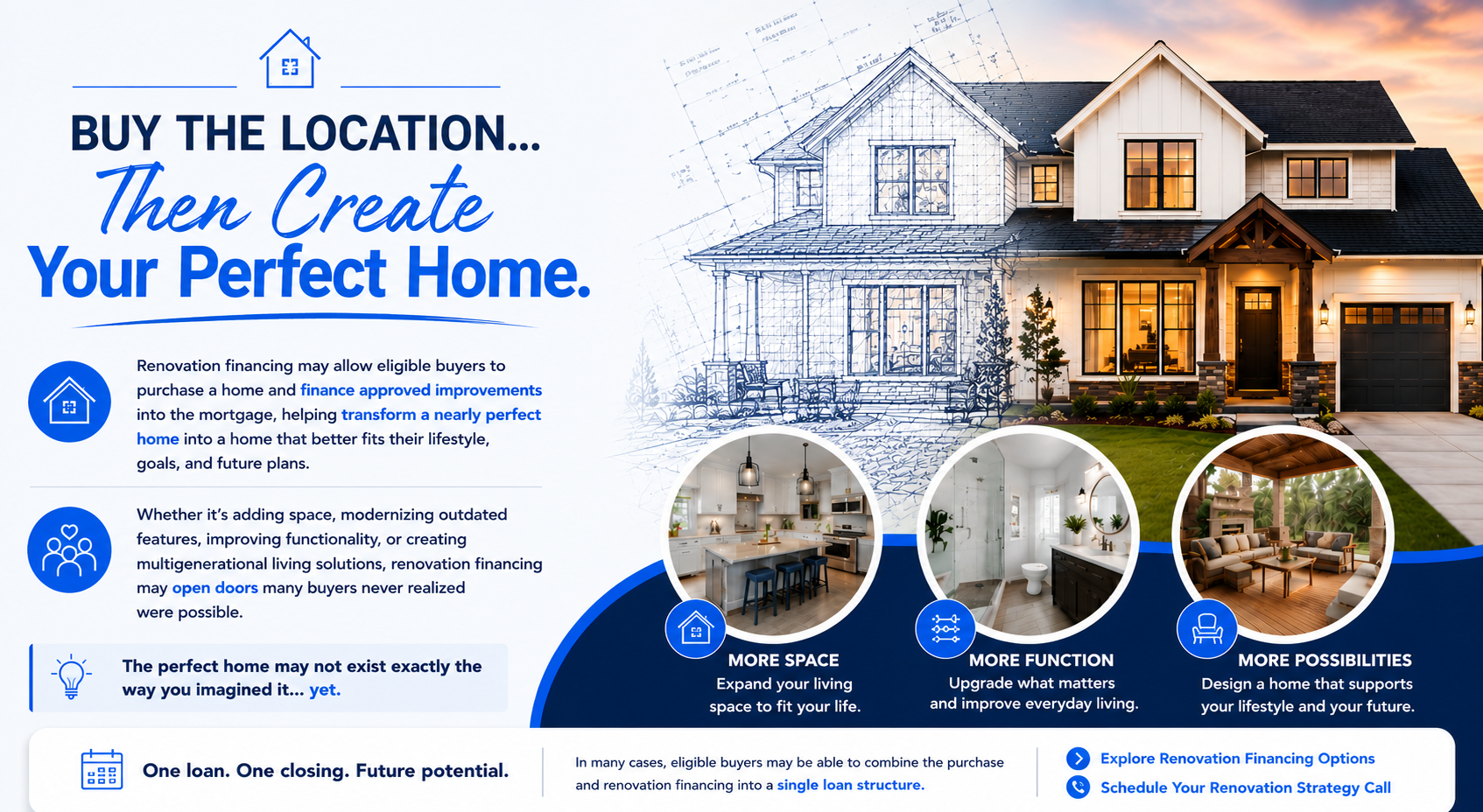
How Renovation Financing Can Help You Buy and Improve the Right Home — Core Strategy and Decision Context
The Perfect Home May Not Exist Exactly The Way You Imagined… Yet.
Stop Waiting For “Perfect”
In today’s market, many buyers are facing the same challenge: the homes they truly love are either:
➡️ Too Expensive
➡️ Too Competitive
➡️ Already Updated And Priced At A Premium
➡️ Or Simply Unavailable
Meanwhile, many homes with incredible potential are often overlooked because buyers only see the home as it exists today.
Sometimes, the better opportunity is buying potential.
Renovation financing may allow buyers to focus on location, school zones, lot size, neighborhoods they love, long-term potential, equity opportunities, and customizing the home around their lifestyle instead of waiting endlessly for the “perfect” house; some buyers are choosing to create it.
Every Renovation Scenario Is Different.
Some buyers want simple cosmetic updates. Others want to completely reimagine how the home functions for their family.
Some renovation programs focus primarily on health, safety, and functional repairs. Others may allow more extensive lifestyle and customization projects.
Renovation Financing Options for Home Improvements and Remodeling Project — How the Process Works in Practice

Renovation Financing Options for Home Improvements and Remodeling Project — How the Process Works in Practice
Lifestyle Renovations vs Functional Improvements
Not all renovation projects are treated the same.
Some renovation financing programs are designed primarily for health, safety, accessibility, and functional improvements to property.
Other renovation options may allow for more extensive lifestyle-focused upgrades and customization projects.
The Type Of Renovation Helps Determine Which Financing Options May Fit Best.
The property, renovation goals, budget, loan type, and borrower qualifications all play a role in structuring the right solution.
Necessary vs. Luxury Renovations: Choosing the Right Renovation Loan — Who This Resource Helps and Why
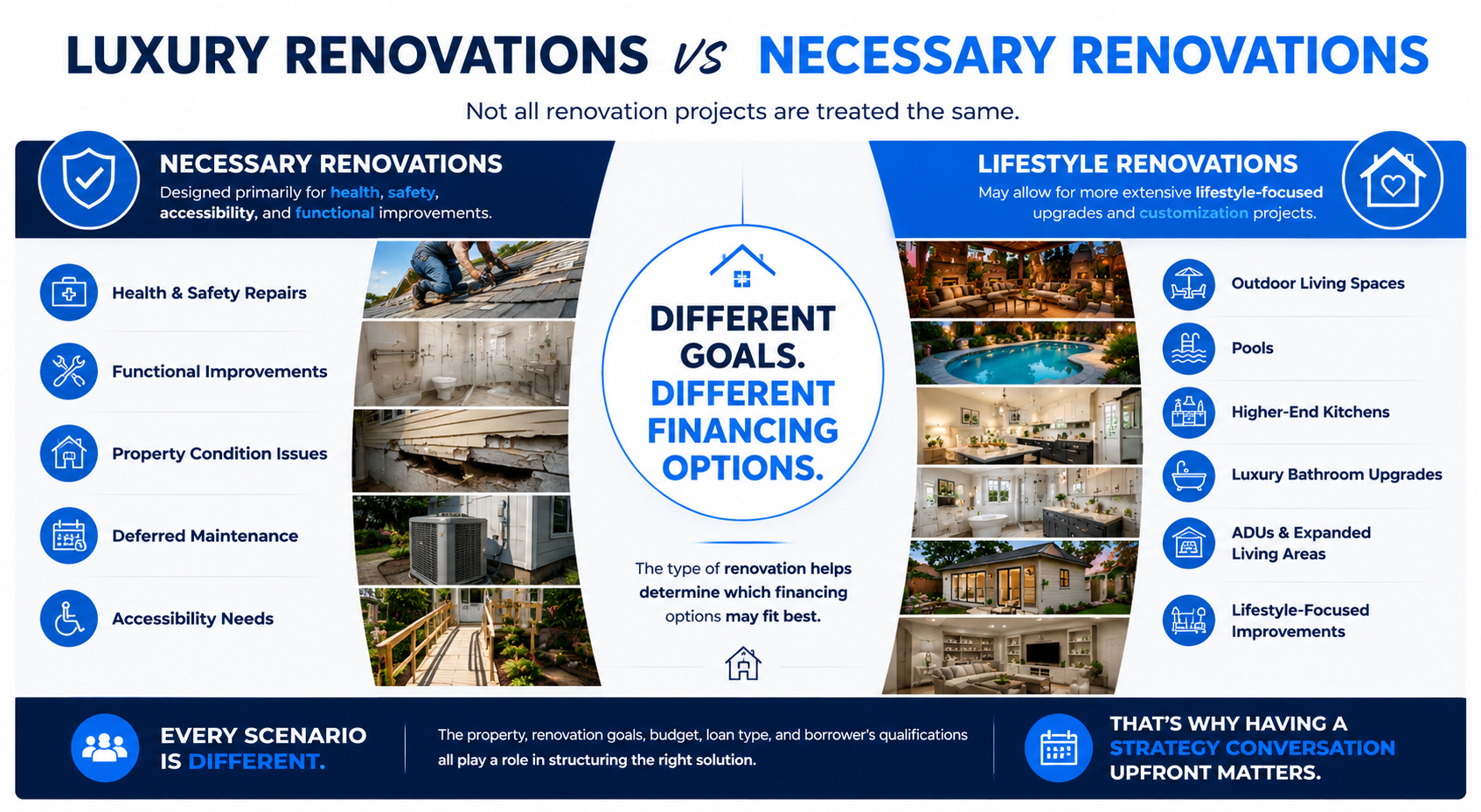
Necessary vs. Luxury Renovations: Choosing the Right Renovation Loan — Who This Resource Helps and Why
One Loan. One Closing. Future Potential.
One of the biggest misconceptions buyers have is assuming renovations always require:
➡️ A Separate Construction Loan
➡️ Credit Cards
➡️ Personal Loans
➡️ A Future Refinance Later
In many cases, eligible buyers may be able to combine the purchase and renovation financing into a single loan structure.
Renovation Loans to Purchase, Improve and Build Future Home Value — Documentation Calculations and Planning Details
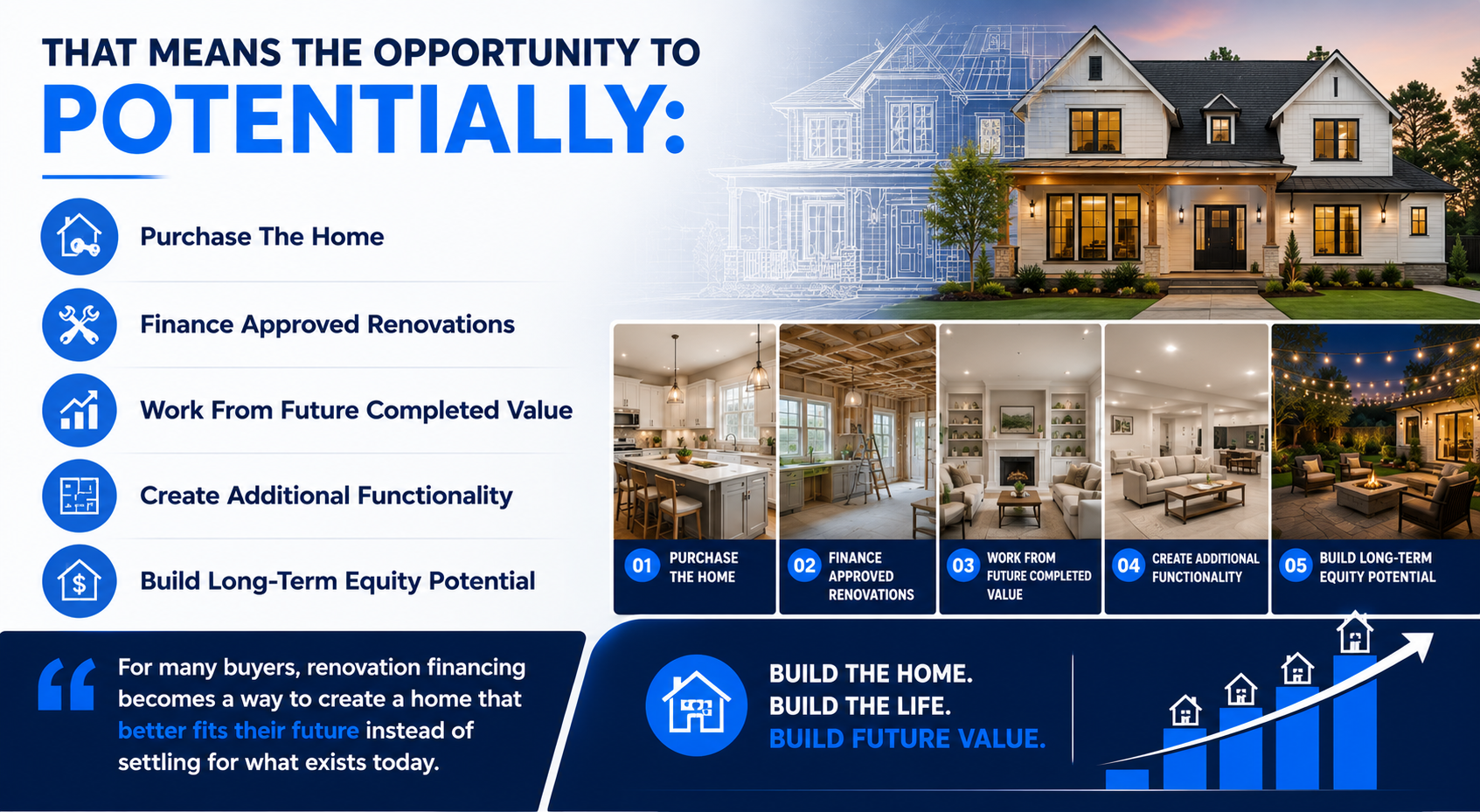
Renovation Loans to Purchase, Improve and Build Future Home Value — Documentation Calculations and Planning Details
Important Things Buyers Should Know
Renovation financing can create incredible opportunities, but planning matters. These programs typically involve additional steps compared to a traditional mortgage process.
Depending on the project, buyers may need:
➡️ Contractor Bids
➡️ Project Plans Or Scope Of Work
➡️ Inspections Or Consultant Reviews
➡️ Longer Closing Timelines
➡️ Program-Specific Guidelines
➡️ Budget Planning & Qualification Review
Every Renovation Scenario Is Unique.
The scope of work, property condition, future appraised value, loan type, contractor documentation, and borrower qualifications all play a role in structuring the financing correctly.
That’s why the goal is not just getting a loan approved.
The Goal Is to Create a Smart Long-Term Strategy.
Every Home Has A Different Story. Every Buyer Has Different Goals.
Real World Renovation Possibilities Because Every Home Has A Different Story
Renovation Loan to Add a Bathroom and Improve Home Functionality — Tradeoffs Limitations and Next Steps
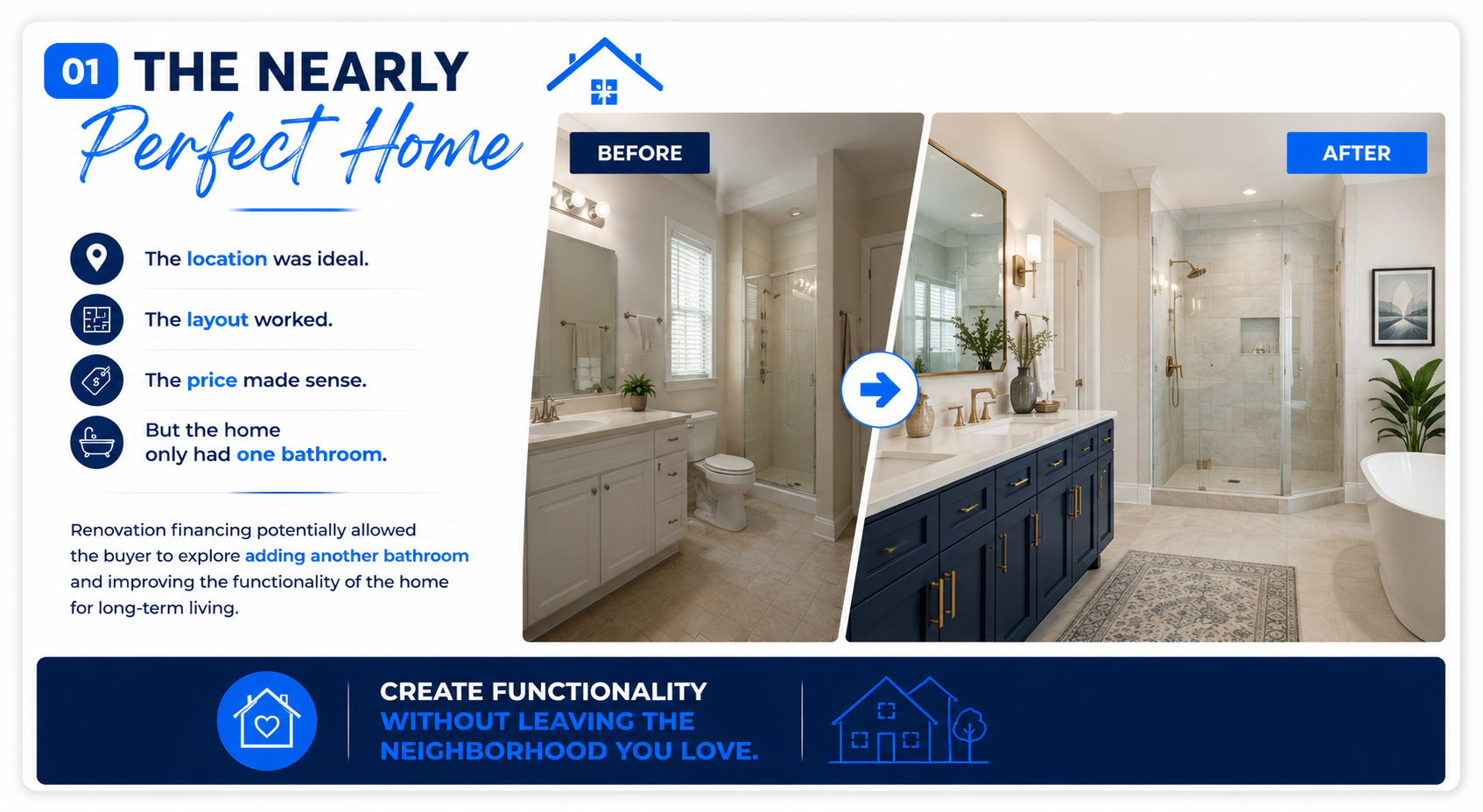
Renovation Loan to Add a Bathroom and Improve Home Functionality — Tradeoffs Limitations and Next Steps
Renovation Loan for a Multigenerational Home and Private In-Law Suite — Local Evidence and Practical Application
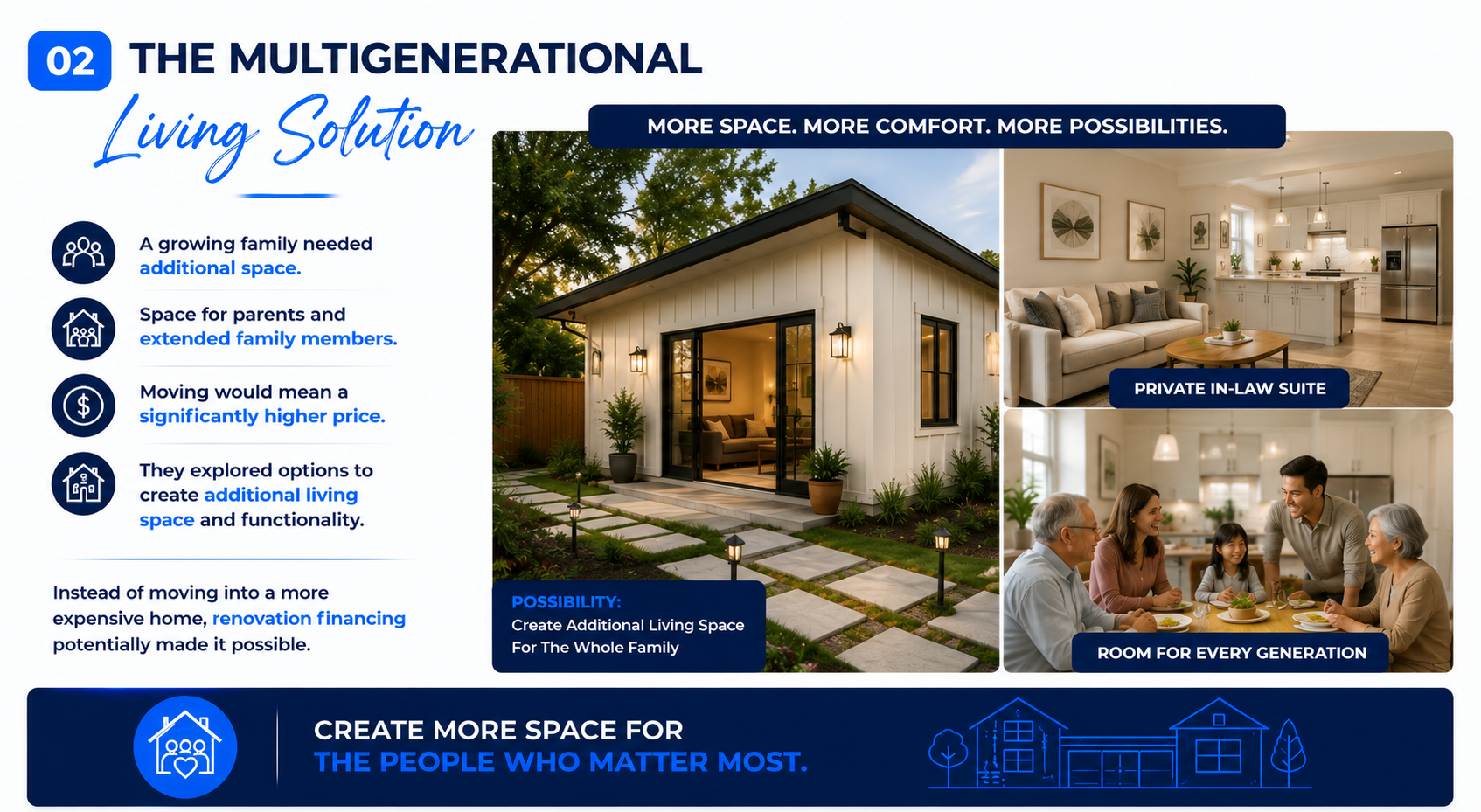
Renovation Loan for a Multigenerational Home and Private In-Law Suite — Local Evidence and Practical Application
Outdoor Living Renovation Financing for Backyard Improvements — Timing Options and Informed Decision Making
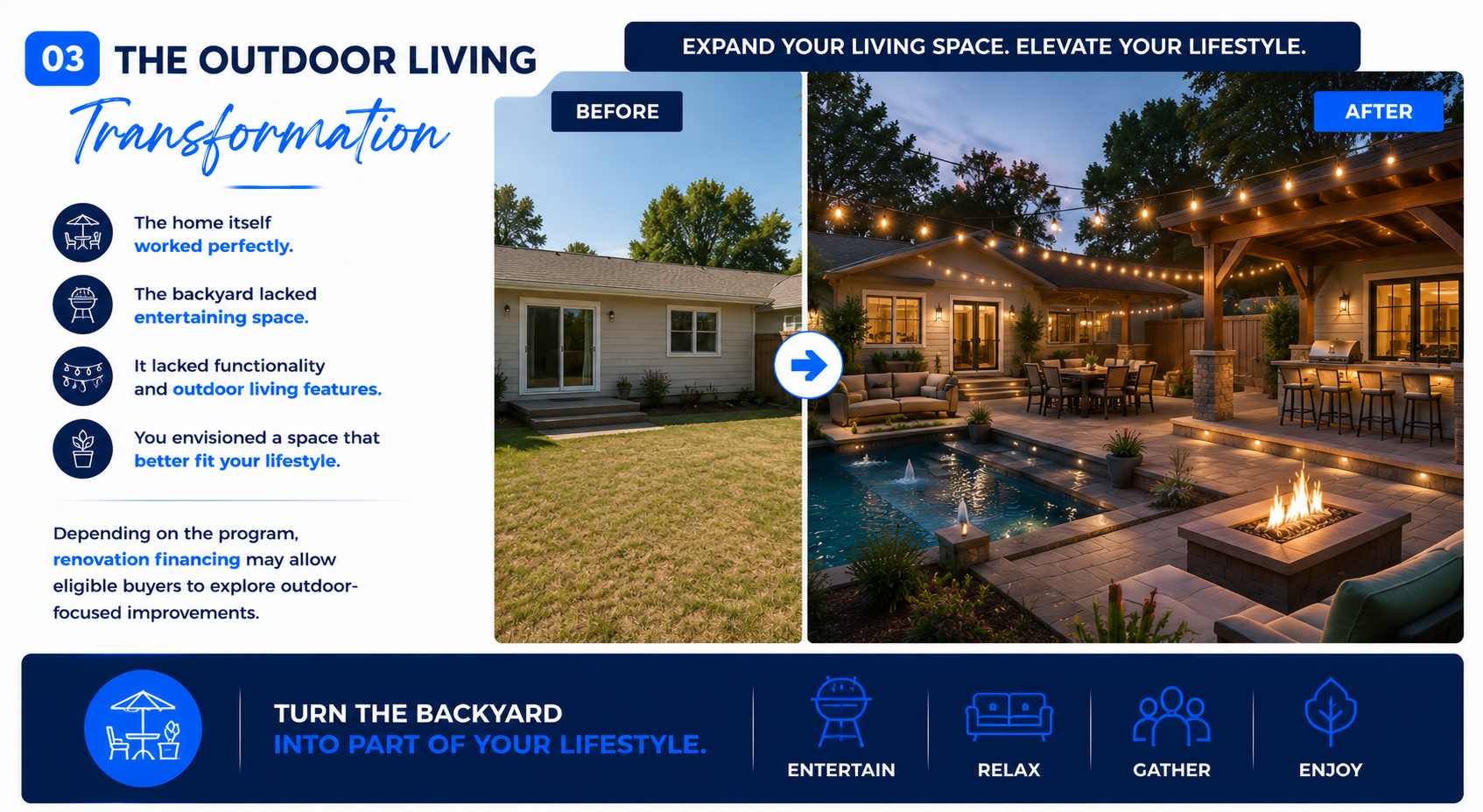
Outdoor Living Renovation Financing for Backyard Improvements — Timing Options and Informed Decision Making
Accessibility Renovation Financing for Safer, More Functional Homes — Property Financing and Professional Coordination
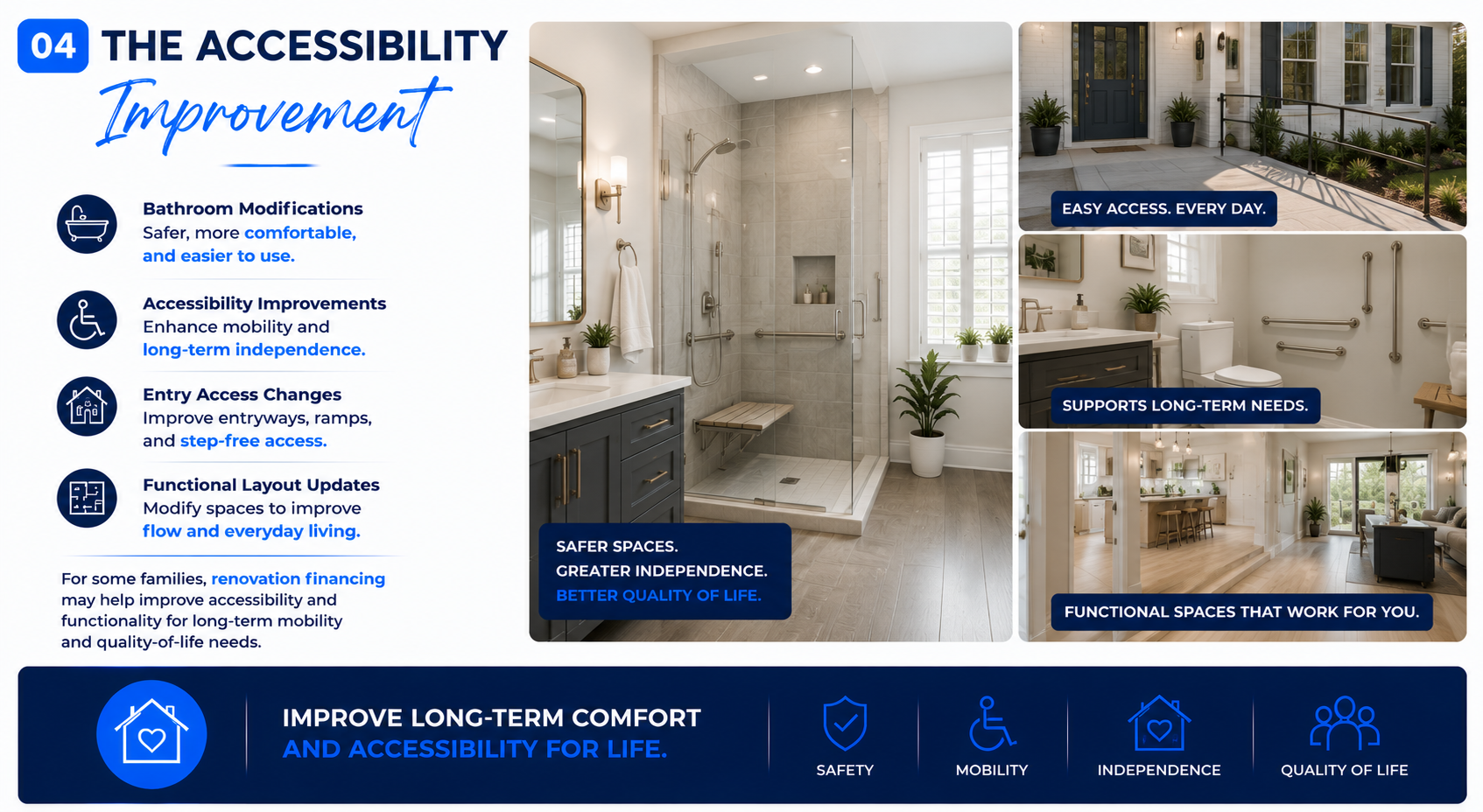
Accessibility Renovation Financing for Safer, More Functional Homes — Property Financing and Professional Coordination
Why This Matters In Today’s Market
Today’s housing market has created difficult decisions for many buyers.
Some buyers feel forced to:
➡️ Compromise On Location
➡️ Compromise On Layout
➡️ Overpay For Turnkey Homes
➡️ ️ Continue Renting
➡️ Delay Their Plans Indefinitely
But There May Be Another Path.
Sometimes the opportunity isn’t finding a perfect home. Sometimes, The Opportunity Is Creating One.
Renovation financing may help eligible buyers unlock possibilities they hadn't previously considered. And in many cases, homes that need work may create opportunities that fully updated homes simply cannot.
You may be closer to the right home than you think.
Renovation Financing Options to Create a More Functional Home — Planning Questions and Verification Standards
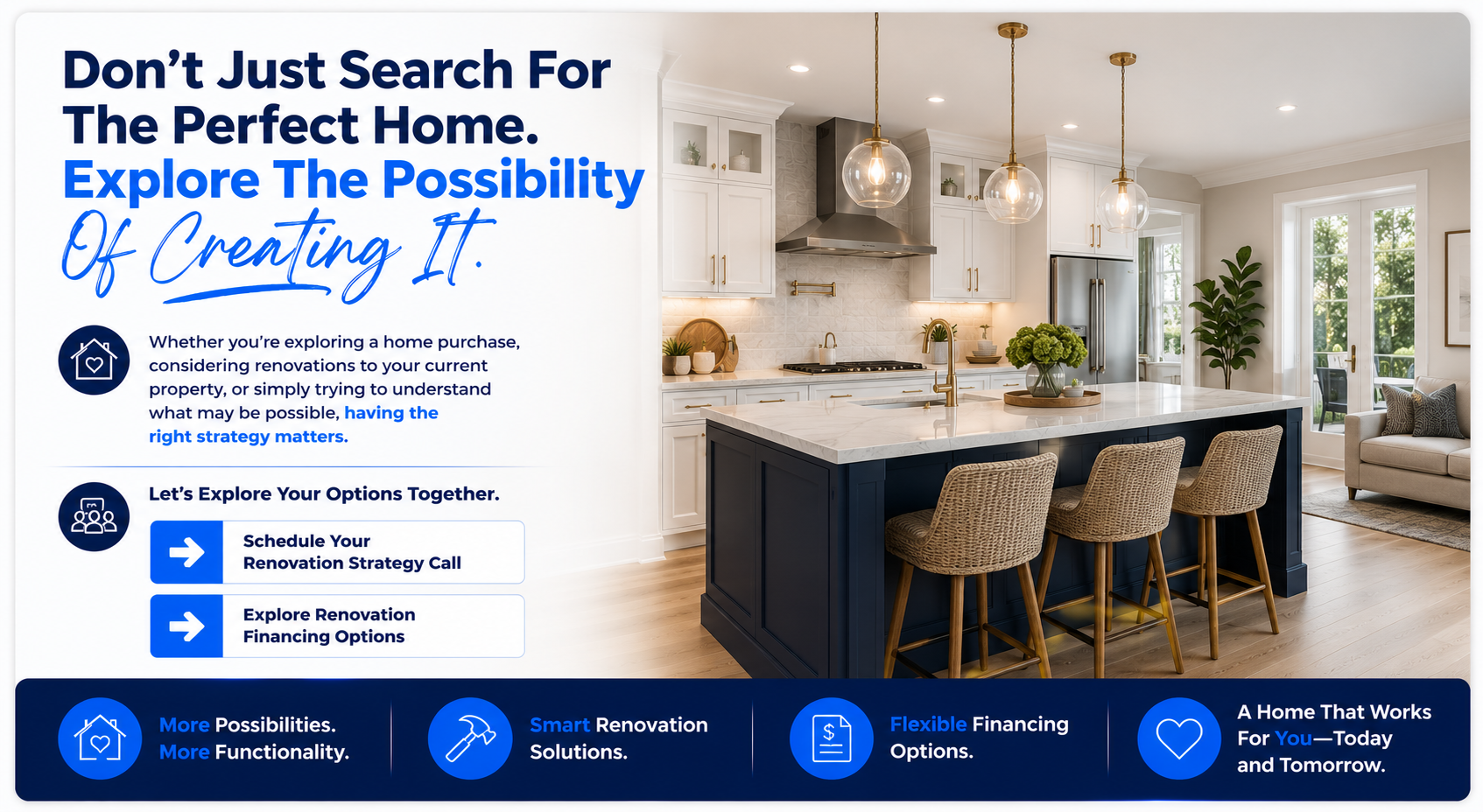
Renovation Financing Options to Create a More Functional Home — Planning Questions and Verification Standards
Not Sure Whether Renovation Financing May Fit Your Situation?
➡️ That’s exactly why scheduling a strategy conversation matters.
Every renovation scenario is different.
The property, renovation goals, budget, loan type, timeline, and long-term plans all help determine which renovation financing options may potentially fit best.
Our goal is to help you better understand what may be possible, which renovation strategies may fit your goals, how financing options may work together, which improvements may potentially qualify, and how to structure a plan around your lifestyle and future needs.
We’re Here To Help You Explore What’s Possible
Whether you’re exploring:
➡️ Purchasing A Home That Needs Updates
➡️ Creating Additional Living Space
➡️ Multigenerational Living Solutions
➡️ Outdoor Living Improvements
➡️ Accessibility Modifications
➡️ Modernizing An Outdated Property
➡️ Expanding Functionality For Long-Term Living
We’re here to help guide you through the process and help you better understand what options may be available for your scenario.
No Pressure. No Obligation. Just A Strategy Conversation.
Sometimes the right opportunity isn’t immediately obvious. That’s why having a conversation up front may help uncover possibilities you haven't previously considered.
Ready To Explore Your Options?
If you’re ready to take the next step, schedule a conversation about your renovation strategy below.
We’ll review your goals, discuss potential financing structures, and help you better understand what may be possible for your situation.
➡️ Submit Your Application Here
➡️ Schedule Your Strategy Call Here
Best regards,
Michael Thayer, CMPS, CMA
NMLS #173264
Planet Home Lending, NMLS #17022
Explore Buyer & Seller Resources & Next Steps
+ −Market Timing vs. Market Strategy: When Is the Right Time to Buy... And More Importantly, Why?
Calculators & Loan Programs Questions Answered: Mortgage Programs & Financing Calculator
Smart Financing Strategies to Lower Your Monthly Mortgage Payment: Smart Mortgage Strategies & Financing Hacks
Homebuying Roadmap: Your Mortgage GPS
Moving To Middle Tennessee: Moving To Middle Tennessee Resource Center
Search Open Houses: View All Middle Tennessee Open Houses
Main Resource Hub: Buyers, Sellers, Realtors, and Builders Resources and Strategies
Additional Information & Reference Guides
+ −Welcome Video Transcript
+ −Video Transcript
00:00
What if the problem isn't that you can't find the right home? What if the problem is that you're only looking at homes for what they are today?
00:09
Instead of… What they could become.
00:13
Today's buyers are frustrated. Inventory's tight; higher home prices mean updated homes are selling at a premium, and many buyers are feeling stuck trying to choose among the right location, the right layout, the right price, and the features they actually want.
00:30
Maybe.
00:31
You found the home in the perfect neighborhood, but the kitchen is outdated.
00:36
Maybe it has the right floor plan, but it needs another bathroom.
00:40
Maybe it checks all the boxes.
00:42
But not all of them.
00:44
But… What if the opportunity wasn't finding the perfect house?
00:50
What if you could create it instead? I'm Michael Thayer, and I'm a mortgage advisor based in Nashville, Tennessee, serving clients nationwide.
00:57
And many buyers today don't realize that renovation financing may potentially allow eligible borrowers to purchase a home and finance in the approved improvements into their mortgage.
01:10
That could mean exploring possibilities such as kitchen remodels, additional bathrooms, outdoor living spaces, multi-generational living solutions, ADUs or in-law suites, accessibility improvements, and functional updates that help the home better fit your lifestyle.
01:29
Sometimes, the best opportunity isn't the fully updated home that everyone else is competing for.
01:36
Sometimes it's the home with the right location and potential.
01:41
That becomes the perfect home.
01:44
May not exactly exist the way you imagine it just yet today.
01:48
So, if you're exploring your options, schedule a strategy call. Let's explore what might be possible for you in your situation. We'll talk to you soon.
How Renovation Financing Can Help You Buy and Improve the Right Home — Core Strategy and Decision Context Image Overview
+ −What this image communicates
“How Renovation Financing Can Help You Buy and Improve the Right Home — Core Strategy and Decision Context” is not a decorative break in “Renovation Loans: Buy a Home and Finance the Improvements.” It is the page's central strategy, designed to state the main tension clearly and show which decision should be made before secondary details distract from it. That framing matters because the reader is evaluating how acquisition, construction scope, budget, contractor work, property value, and the household's intended use fit into one executable plan. The visual centers “How Renovation Financing Can Help You Buy and Improve the Right Home” on a specific housing or listing decision. It connects the visible promise to the property, the people involved, and the transaction sequence instead of leaving the message as abstract marketing. A useful reading separates what can be illustrated now from what still depends on the home's condition, the negotiated terms, verified financing, and current market response.
Why it belongs on this page
The renovation-loan resource explains how purchase financing and eligible improvements can be evaluated together. The central strategy role of “How Renovation Financing Can Help You Buy and Improve the Right Home” is the reason this image belongs at this point in “Renovation Loans: Buy a Home and Finance the Improvements.”
How a reader can use it
Use “How Renovation Financing Can Help You Buy and Improve the Right Home” for its stated central strategy job on “Renovation Loans: Buy a Home and Finance the Improvements.” Name the desired outcome, identify the constraint that could block it, and decide which evidence would change the answer. The working notes for this panel should record the desired result, the assumption carrying the most risk, the fact that would disprove it, and the decision that must be made first. That record lets the reader evaluate the home for what it can responsibly become rather than comparing only its current condition without asking this image to answer a different stage of the decision.
What still must be verified
The final safeguard is verification. The visual does not approve a contractor, scope, permit, budget, draw, appraisal value, completion date, or loan; each depends on the property and current program requirements. A reader should leave “How Renovation Financing Can Help You Buy and Improve the Right Home — Core Strategy and Decision Context” knowing what to ask and what to gather—not believing that a graphic has already supplied an approval, valuation, legal conclusion, or guaranteed outcome. On “Renovation Loans: Buy a Home and Finance the Improvements,” that safeguard applies specifically to the central strategy role assigned to “How Renovation Financing Can Help You Buy and Improve the Right Home.”
Renovation Financing Options for Home Improvements and Remodeling Project — How the Process Works in Practice Image Overview
+ −What this image communicates
The image titled “Renovation Financing Options for Home Improvements and Remodeling Project — How the Process Works in Practice” gives “Renovation Loans: Buy a Home and Finance the Improvements” a focused working sequence. Its communication job is to show the order of operations, the handoff between people, and the checkpoint that determines whether the next step is ready. In this page context, the underlying subject is renovation-financing decision: how acquisition, construction scope, budget, contractor work, property value, and the household's intended use fit into one executable plan. The visual presents “Renovation Financing Options for Home Improvements and Remodeling Project” as a sequence with dependencies. Its order matters: one confirmed input creates the next task, and an unresolved item can stop the file, listing, or purchase from advancing. By turning the process into visible stages, the graphic lets a reader identify the current position, the next handoff, and the deadline or evidence that controls progress.
Why it belongs on this page
Its nine images move through loan concept, process, necessary-versus-luxury work, future value, added bathrooms, multigenerational design, outdoor living, accessibility, and overall function. The working sequence role of “Renovation Financing Options for Home Improvements and Remodeling Project” is the reason this image belongs at this point in “Renovation Loans: Buy a Home and Finance the Improvements.”
How a reader can use it
Use “Renovation Financing Options for Home Improvements and Remodeling Project” for its stated working sequence job on “Renovation Loans: Buy a Home and Finance the Improvements.” Read the visual from the first confirmed fact through the next action, noting dependencies, deadlines, and the owner of each task. The working notes for this panel should record the starting condition, each dependent step, the responsible person, the handoff document, the deadline, and the condition required to advance. That record lets the reader evaluate the home for what it can responsibly become rather than comparing only its current condition without asking this image to answer a different stage of the decision.
What still must be verified
The explanation around “Renovation Financing Options for Home Improvements and Remodeling Project” must remain inside the evidence available for this page. The visual does not approve a contractor, scope, permit, budget, draw, appraisal value, completion date, or loan; each depends on the property and current program requirements. The “Renovation Financing Options for Home Improvements and Remodeling Project — How the Process Works in Practice” visual supports a better-informed conversation, while the actual decision remains tied to current evidence and the people authorized to interpret it. On “Renovation Loans: Buy a Home and Finance the Improvements,” that safeguard applies specifically to the working sequence role assigned to “Renovation Financing Options for Home Improvements and Remodeling Project.”
Necessary vs. Luxury Renovations: Choosing the Right Renovation Loan — Who This Resource Helps and Why Image Overview
+ −What this image communicates
The “Necessary vs. Luxury Renovations: Choosing the Right Renovation Loan — Who This Resource Helps and Why” image turns the central issue on “Renovation Loans: Buy a Home and Finance the Improvements” into a visible reader and use-case map. It is there to explain who benefits, what problem each person is trying to solve, and why the same information may lead to different questions, while the page supplies the evidence and explanation needed to evaluate how acquisition, construction scope, budget, contractor work, property value, and the household's intended use fit into one executable plan. The visual uses a side-by-side comparison to separate “Necessary vs. Luxury Renovations: Choosing the Right Renovation Loan” into alternatives that should not be treated as interchangeable. Its layout asks the reader to compare structure, cost, timing, eligibility, and consequence—not select a winner from one headline number. The comparison is therefore a decision aid, with each column pointing to a different fact that must be confirmed.
Why it belongs on this page
Each panel should connect the pictured improvement to bids, permits, contractor approval, contingency, appraisal, draws, inspections, and the household's actual use of the home. The reader and use-case map role of “Necessary vs. Luxury Renovations: Choosing the Right Renovation Loan” is the reason this image belongs at this point in “Renovation Loans: Buy a Home and Finance the Improvements.”
How a reader can use it
Use “Necessary vs. Luxury Renovations: Choosing the Right Renovation Loan” for its stated reader and use-case map job on “Renovation Loans: Buy a Home and Finance the Improvements.” Match the graphic to the reader's role, current stage, pressure, and decision authority before applying its guidance. The working notes for this panel should record who the guidance is for, the reader's current stage, the decision they control, the problem they need solved, and when a specialist must take over. That record lets the reader evaluate the home for what it can responsibly become rather than comparing only its current condition without asking this image to answer a different stage of the decision.
What still must be verified
Keep the visual in its proper role. The visual does not approve a contractor, scope, permit, budget, draw, appraisal value, completion date, or loan; each depends on the property and current program requirements. If a later disclosure, source update, appraisal, inspection, title item, program rule, or contract term conflicts with “Necessary vs. Luxury Renovations: Choosing the Right Renovation Loan — Who This Resource Helps and Why,” the current controlling evidence takes priority. On “Renovation Loans: Buy a Home and Finance the Improvements,” that safeguard applies specifically to the reader and use-case map role assigned to “Necessary vs. Luxury Renovations: Choosing the Right Renovation Loan.”
Renovation Loans to Purchase, Improve and Build Future Home Value — Documentation Calculations and Planning Details Image Overview
+ −What this image communicates
The image titled “Renovation Loans to Purchase, Improve and Build Future Home Value — Documentation Calculations and Planning Details” gives “Renovation Loans: Buy a Home and Finance the Improvements” a focused evidence and calculation layer. Its communication job is to separate measurable inputs from assumptions and reveal which figures or documents control the comparison. In this page context, the underlying subject is renovation-financing decision: how acquisition, construction scope, budget, contractor work, property value, and the household's intended use fit into one executable plan. The image organizes “Renovation Loans to Purchase, Improve and Build Future Home Value” as a working checklist rather than a promise that every file will require the same items. It groups the records or questions a reader should anticipate, shows where an exception may add work, and provides a way to notice missing information before a deadline. The visible list is a preparation tool; the final request still comes from the responsible reviewer or program.
Why it belongs on this page
The renovation-loan resource explains how purchase financing and eligible improvements can be evaluated together. The evidence and calculation layer role of “Renovation Loans to Purchase, Improve and Build Future Home Value” is the reason this image belongs at this point in “Renovation Loans: Buy a Home and Finance the Improvements.”
The exact story carried by this graphic
This panel links renovation spending with the future usefulness and as-completed value of the home. It should not imply that every improvement returns its cost or that personal preference equals appraised value. The reader needs a documented scope, contractor bid, permit path, contingency, draw schedule, inspection plan, and an appraisal based on the proposed work. The image is useful when it helps a buyer compare the current property plus responsible improvements with the cost and availability of purchasing a home where those features already exist.
How a reader can use it
Use “Renovation Loans to Purchase, Improve and Build Future Home Value” for its stated evidence and calculation layer job on “Renovation Loans: Buy a Home and Finance the Improvements.” Write down every input, source, date, unit, estimate, and unresolved condition before relying on a calculation or side-by-side result. The working notes for this panel should record each number, unit, source, date, estimate, document, calculation method, and unresolved input that could change the comparison. That record lets the reader evaluate the home for what it can responsibly become rather than comparing only its current condition without asking this image to answer a different stage of the decision.
What still must be verified
The boundary is important. The visual does not approve a contractor, scope, permit, budget, draw, appraisal value, completion date, or loan; each depends on the property and current program requirements. The “Renovation Loans to Purchase, Improve and Build Future Home Value — Documentation Calculations and Planning Details” image can improve preparation and questions, but it cannot replace the records, disclosures, findings, approvals, or agreements issued for the actual borrower, property, and transaction. On “Renovation Loans: Buy a Home and Finance the Improvements,” that safeguard applies specifically to the evidence and calculation layer role assigned to “Renovation Loans to Purchase, Improve and Build Future Home Value.”
Renovation Loan to Add a Bathroom and Improve Home Functionality — Tradeoffs Limitations and Next Steps Image Overview
+ −What this image communicates
The visible message in “Renovation Loan to Add a Bathroom and Improve Home Functionality — Tradeoffs Limitations and Next Steps” directs attention to renovation-financing decision on “Renovation Loans: Buy a Home and Finance the Improvements.” The image functions as a tradeoff and limitation view: it should put the benefit beside the cost, condition, risk, or opportunity sacrificed so the decision is not reduced to one attractive feature. That gives the reader a specific reason to slow down before acting. The visual presents “Renovation Loan to Add a Bathroom and Improve Home Functionality” as a sequence with dependencies. Its order matters: one confirmed input creates the next task, and an unresolved item can stop the file, listing, or purchase from advancing. By turning the process into visible stages, the graphic lets a reader identify the current position, the next handoff, and the deadline or evidence that controls progress.
Why it belongs on this page
Its nine images move through loan concept, process, necessary-versus-luxury work, future value, added bathrooms, multigenerational design, outdoor living, accessibility, and overall function. The tradeoff and limitation view role of “Renovation Loan to Add a Bathroom and Improve Home Functionality” is the reason this image belongs at this point in “Renovation Loans: Buy a Home and Finance the Improvements.”
How a reader can use it
Use “Renovation Loan to Add a Bathroom and Improve Home Functionality” for its stated tradeoff and limitation view job on “Renovation Loans: Buy a Home and Finance the Improvements.” Compare the strongest alternative, the downside if an assumption fails, and the fallback available if timing or eligibility changes. The working notes for this panel should record the benefit gained, the cost accepted, the condition attached to it, the strongest alternative, the failure point, and the available fallback. That record lets the reader evaluate the home for what it can responsibly become rather than comparing only its current condition without asking this image to answer a different stage of the decision.
What still must be verified
The boundary is important. The visual does not approve a contractor, scope, permit, budget, draw, appraisal value, completion date, or loan; each depends on the property and current program requirements. The “Renovation Loan to Add a Bathroom and Improve Home Functionality — Tradeoffs Limitations and Next Steps” image can improve preparation and questions, but it cannot replace the records, disclosures, findings, approvals, or agreements issued for the actual borrower, property, and transaction. On “Renovation Loans: Buy a Home and Finance the Improvements,” that safeguard applies specifically to the tradeoff and limitation view role assigned to “Renovation Loan to Add a Bathroom and Improve Home Functionality.”
Renovation Loan for a Multigenerational Home and Private In-Law Suite — Local Evidence and Practical Application Image Overview
+ −What this image communicates
A reader encountering “Renovation Loan for a Multigenerational Home and Private In-Law Suite — Local Evidence and Practical Application” should immediately recognize the renovation-financing decision question inside “Renovation Loans: Buy a Home and Finance the Improvements.” The visual's role is practical application, so it must connect the strategy to a real property, market, household, or professional conversation without overstating what the example proves rather than merely repeat the headline. The visual centers “Renovation Loan for a Multigenerational Home and Private In-Law Suite” on a specific housing or listing decision. It connects the visible promise to the property, the people involved, and the transaction sequence instead of leaving the message as abstract marketing. A useful reading separates what can be illustrated now from what still depends on the home's condition, the negotiated terms, verified financing, and current market response.
Why it belongs on this page
Each panel should connect the pictured improvement to bids, permits, contractor approval, contingency, appraisal, draws, inspections, and the household's actual use of the home. The practical application role of “Renovation Loan for a Multigenerational Home and Private In-Law Suite” is the reason this image belongs at this point in “Renovation Loans: Buy a Home and Finance the Improvements.”
How a reader can use it
Use “Renovation Loan for a Multigenerational Home and Private In-Law Suite” for its stated practical application job on “Renovation Loans: Buy a Home and Finance the Improvements.” Translate the principle into address-level and transaction-level questions, then verify them with the responsible source or professional. The working notes for this panel should record the exact property or household facts, current local evidence, source date, responsible professional, and any condition that prevents the example from transferring unchanged. That record lets the reader evaluate the home for what it can responsibly become rather than comparing only its current condition without asking this image to answer a different stage of the decision.
What still must be verified
The final safeguard is verification. The visual does not approve a contractor, scope, permit, budget, draw, appraisal value, completion date, or loan; each depends on the property and current program requirements. A reader should leave “Renovation Loan for a Multigenerational Home and Private In-Law Suite — Local Evidence and Practical Application” knowing what to ask and what to gather—not believing that a graphic has already supplied an approval, valuation, legal conclusion, or guaranteed outcome. On “Renovation Loans: Buy a Home and Finance the Improvements,” that safeguard applies specifically to the practical application role assigned to “Renovation Loan for a Multigenerational Home and Private In-Law Suite.”
Outdoor Living Renovation Financing for Backyard Improvements — Timing Options and Informed Decision Making Image Overview
+ −What this image communicates
The image titled “Outdoor Living Renovation Financing for Backyard Improvements — Timing Options and Informed Decision Making” gives “Renovation Loans: Buy a Home and Finance the Improvements” a focused timing and option map. Its communication job is to show how acting now, waiting, or changing sequence affects choice, leverage, carrying cost, and exposure to future conditions. In this page context, the underlying subject is renovation-financing decision: how acquisition, construction scope, budget, contractor work, property value, and the household's intended use fit into one executable plan. The image makes “Outdoor Living Renovation Financing for Backyard Improvements” the dominant visual message and gives the reader a defined entry point into the page's argument. The wording identifies what deserves attention first; the surrounding design establishes whether the reader is looking at a claim, a choice, a sequence, or a practical resource. That distinction determines what evidence should be gathered before the message is applied.
Why it belongs on this page
The renovation-loan resource explains how purchase financing and eligible improvements can be evaluated together. The timing and option map role of “Outdoor Living Renovation Financing for Backyard Improvements” is the reason this image belongs at this point in “Renovation Loans: Buy a Home and Finance the Improvements.”
How a reader can use it
Use “Outdoor Living Renovation Financing for Backyard Improvements” for its stated timing and option map job on “Renovation Loans: Buy a Home and Finance the Improvements.” Compare decision dates, expiration points, contract milestones, and the consequence of delay instead of assuming more time is always safer. The working notes for this panel should record decision dates, expiration points, contract milestones, carrying periods, lock or approval windows, and what changes if action is delayed. That record lets the reader evaluate the home for what it can responsibly become rather than comparing only its current condition without asking this image to answer a different stage of the decision.
What still must be verified
The visual does not approve a contractor, scope, permit, budget, draw, appraisal value, completion date, or loan; each depends on the property and current program requirements. “Outdoor Living Renovation Financing for Backyard Improvements — Timing Options and Informed Decision Making” should therefore be treated as a timing and option map, not as transaction evidence by itself. Current documents, responsible sources, and the professionals accountable for the relevant decision must control when they differ from the illustration. On “Renovation Loans: Buy a Home and Finance the Improvements,” that safeguard applies specifically to the timing and option map role assigned to “Outdoor Living Renovation Financing for Backyard Improvements.”
Accessibility Renovation Financing for Safer, More Functional Homes — Property Financing and Professional Coordination Image Overview
+ −What this image communicates
“Accessibility Renovation Financing for Safer, More Functional Homes — Property Financing and Professional Coordination” is not a decorative break in “Renovation Loans: Buy a Home and Finance the Improvements.” It is the page's team-coordination map, designed to make responsibilities visible across the borrower, seller, real estate professional, mortgage team, contractor, attorney, insurer, appraiser, or settlement provider. That framing matters because the reader is evaluating how acquisition, construction scope, budget, contractor work, property value, and the household's intended use fit into one executable plan. The visual centers “Accessibility Renovation Financing for Safer, More Functional Homes” on a specific housing or listing decision. It connects the visible promise to the property, the people involved, and the transaction sequence instead of leaving the message as abstract marketing. A useful reading separates what can be illustrated now from what still depends on the home's condition, the negotiated terms, verified financing, and current market response.
Why it belongs on this page
Its nine images move through loan concept, process, necessary-versus-luxury work, future value, added bathrooms, multigenerational design, outdoor living, accessibility, and overall function. The team-coordination map role of “Accessibility Renovation Financing for Safer, More Functional Homes” is the reason this image belongs at this point in “Renovation Loans: Buy a Home and Finance the Improvements.”
How a reader can use it
Use “Accessibility Renovation Financing for Safer, More Functional Homes” for its stated team-coordination map job on “Renovation Loans: Buy a Home and Finance the Improvements.” Assign the next deliverable, deadline, controlling document, and escalation path so no participant assumes another person handled it. The working notes for this panel should record every participant's deliverable, due date, controlling document, confirmation method, dependency, and escalation path. That record lets the reader evaluate the home for what it can responsibly become rather than comparing only its current condition without asking this image to answer a different stage of the decision.
What still must be verified
The visual does not approve a contractor, scope, permit, budget, draw, appraisal value, completion date, or loan; each depends on the property and current program requirements. “Accessibility Renovation Financing for Safer, More Functional Homes — Property Financing and Professional Coordination” should therefore be treated as a team-coordination map, not as transaction evidence by itself. Current documents, responsible sources, and the professionals accountable for the relevant decision must control when they differ from the illustration. On “Renovation Loans: Buy a Home and Finance the Improvements,” that safeguard applies specifically to the team-coordination map role assigned to “Accessibility Renovation Financing for Safer, More Functional Homes.”
Renovation Financing Options to Create a More Functional Home — Planning Questions and Verification Standards Image Overview
+ −What this image communicates
A reader encountering “Renovation Financing Options to Create a More Functional Home — Planning Questions and Verification Standards” should immediately recognize the renovation-financing decision question inside “Renovation Loans: Buy a Home and Finance the Improvements.” The visual's role is decision-question framework, so it must convert the visual into the few questions that expose fit, evidence gaps, timing pressure, and the most useful next conversation rather than merely repeat the headline. The image organizes “Renovation Financing Options to Create a More Functional Home” as a working checklist rather than a promise that every file will require the same items. It groups the records or questions a reader should anticipate, shows where an exception may add work, and provides a way to notice missing information before a deadline. The visible list is a preparation tool; the final request still comes from the responsible reviewer or program.
Why it belongs on this page
Each panel should connect the pictured improvement to bids, permits, contractor approval, contingency, appraisal, draws, inspections, and the household's actual use of the home. The decision-question framework role of “Renovation Financing Options to Create a More Functional Home” is the reason this image belongs at this point in “Renovation Loans: Buy a Home and Finance the Improvements.”
How a reader can use it
Use “Renovation Financing Options to Create a More Functional Home” for its stated decision-question framework job on “Renovation Loans: Buy a Home and Finance the Improvements.” Answer the questions with current documents and responsible sources rather than relying on the image as proof. The working notes for this panel should record the question being answered, the evidence required, the source responsible for it, the deadline, and the next question created by the answer. That record lets the reader evaluate the home for what it can responsibly become rather than comparing only its current condition without asking this image to answer a different stage of the decision.
What still must be verified
The visual does not approve a contractor, scope, permit, budget, draw, appraisal value, completion date, or loan; each depends on the property and current program requirements. “Renovation Financing Options to Create a More Functional Home — Planning Questions and Verification Standards” should therefore be treated as a decision-question framework, not as transaction evidence by itself. Current documents, responsible sources, and the professionals accountable for the relevant decision must control when they differ from the illustration. On “Renovation Loans: Buy a Home and Finance the Improvements,” that safeguard applies specifically to the decision-question framework role assigned to “Renovation Financing Options to Create a More Functional Home.”