Townhouse vs. Condo: What’s the Difference?
What Every Homebuyer Needs to Know Before You Make an Offer
They may look almost identical from the outside, but the financing is completely different.
You might walk through two homes in the same neighborhood that have the same floor plan, the same price, and even the same exterior appearance.
One is legally a townhouse... The other is legally a condominium (condo).
To most buyers, they look exactly the same... To a mortgage lender, they are not.
Understanding the difference before you make an offer can save you time, money, and unnecessary surprises during the loan process.
Understanding the Difference Between a Townhouse and a Condominium — Core Strategy and Decision Context
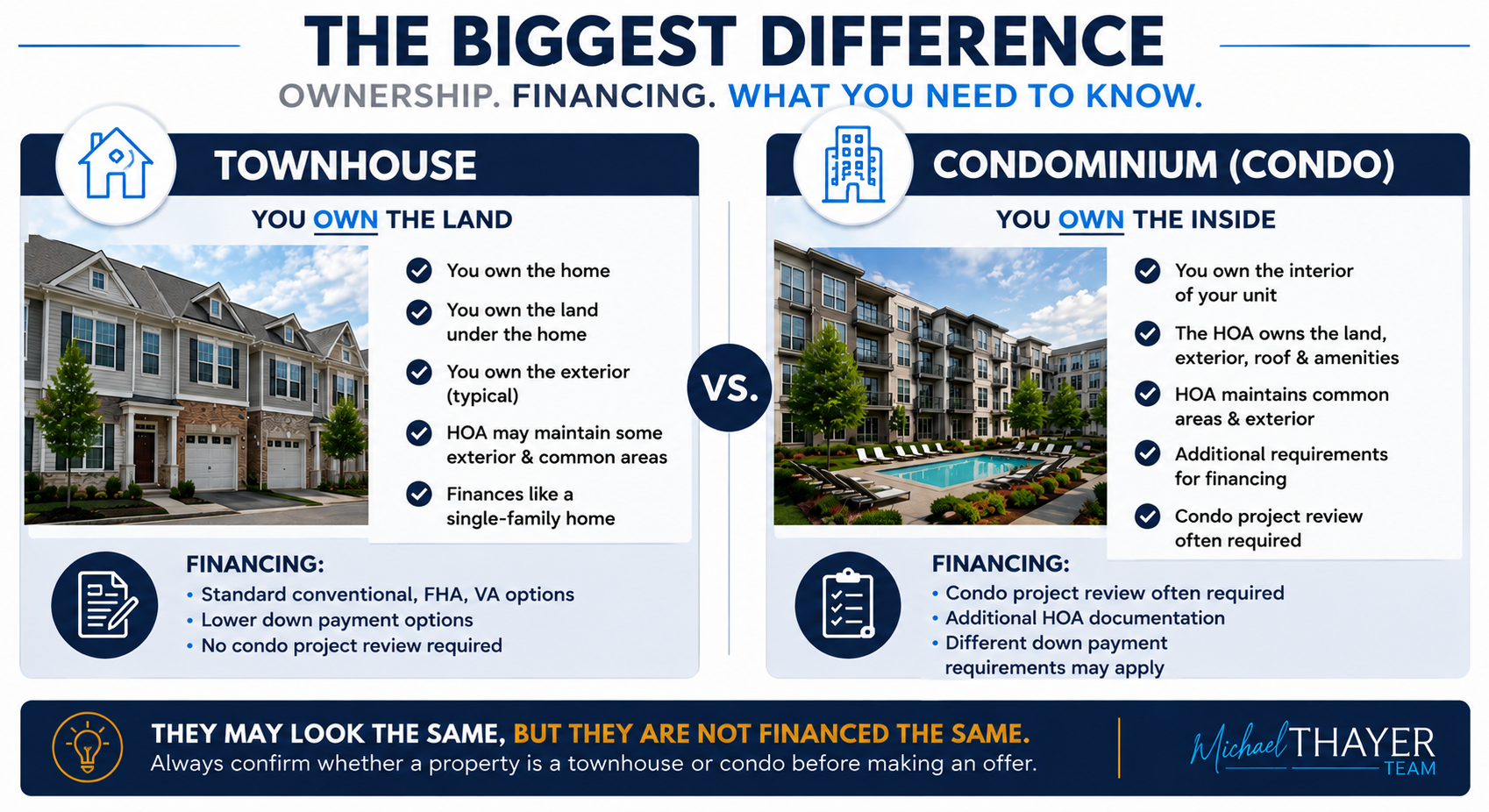
Understanding the Difference Between a Townhouse and a Condominium — Core Strategy and Decision Context
Understanding the Difference Between a Townhouse and a Condominium — How the Process Works in Practice
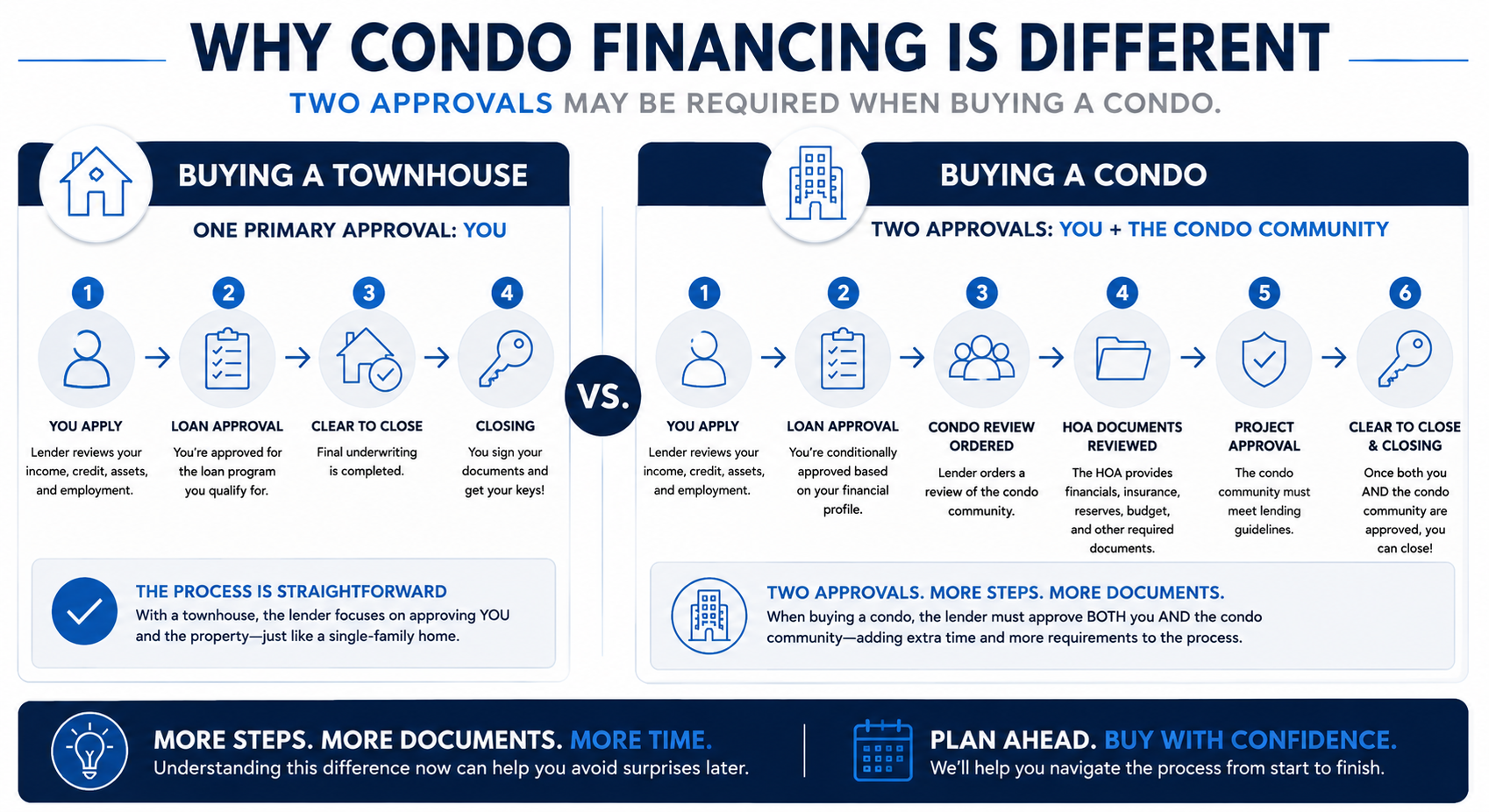
Understanding the Difference Between a Townhouse and a Condominium — How the Process Works in Practice
What Is a Non-Warrantable Condo?
A non-warrantable condo is a condominium project that does not meet one or more conventional lending guidelines.
That does not necessarily mean it's a bad property. It simply means financing may require a different loan program. Common reasons include:
➡️ High investor ownership
➡️ One owner owns too many units
➡️ Active litigation
➡️ HOA controlled by the developer
➡️ Inadequate reserve funds
➡️ Significant delinquent HOA dues
➡️ Too much commercial space
➡️ Other project-specific issues
Does That Mean You Can't Buy It?
Absolutely not.
This is where many buyers receive incomplete information.
Some lenders simply say:
➡️ "We can't finance it."
In reality, financing options may still exist.
Depending on the property and your financial situation, portfolio loan programs or other financing solutions may be available for some non-warrantable condo projects.
The key is identifying those options before you get too far into the buying process.
Why Condo Financing Is Different — Who This Resource Helps and Why
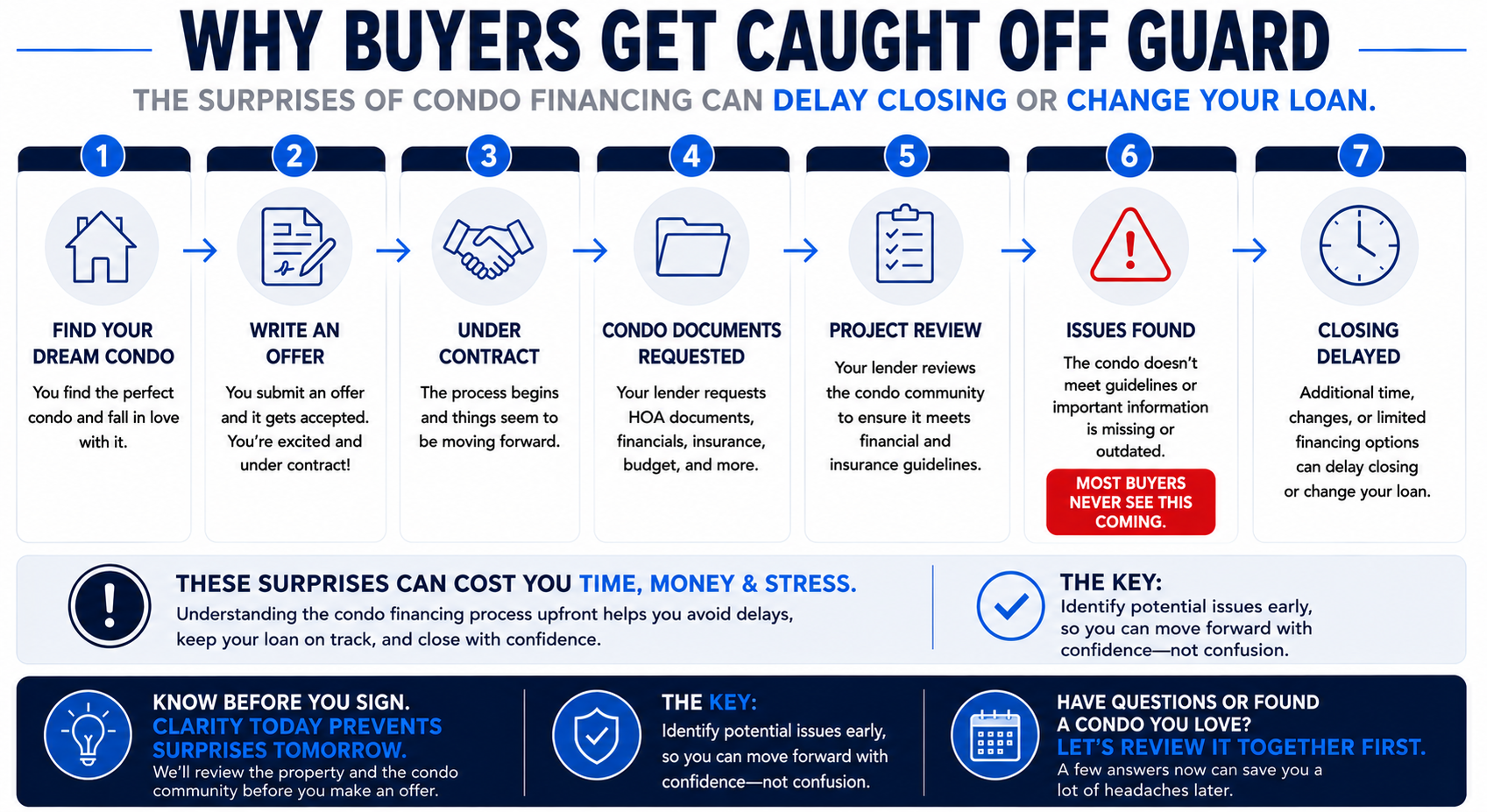
Why Condo Financing Is Different — Who This Resource Helps and Why
Before You Make an Offer
Before falling in love with any townhouse or condo, ask these questions:
✅ Is this legally a townhouse or a condominium?
✅ If it's a condo, is the project warrantable?
✅ Will a condo review be required?
✅ What financing programs are available?
✅ How much down payment will be required?
✅ Are there any known lending restrictions?
Getting these answers upfront can save weeks of frustration later.
Quick Comparison — Documentation Calculations and Planning Details
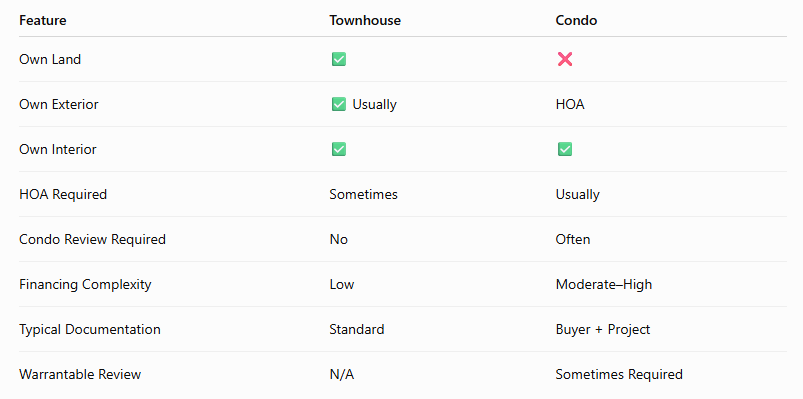
Quick Comparison — Documentation Calculations and Planning Details
The Bottom Line
Most buyers assume that if two homes look alike, they'll be financed the same way.
That's simply not true.
A townhouse and a condominium may appear almost identical, but the ownership structure, financing requirements, and approval process can be very different.
The earlier you understand those differences, the smoother your home-buying experience will be.
Our goal is to help you identify potential financing challenges before you make an offer—so you can shop with confidence, avoid unnecessary surprises, and choose the financing strategy that's right for you.
Have More Questions About Condo Financing?
Condominium financing is one of the most misunderstood areas of home buying, and every project is different.
To help buyers and Realtors better understand the process, we've created a growing library of answers to the most common questions we receive about condo financing, warrantable and non-warrantable condos, down payment requirements, FHA and VA financing, HOA reviews, and much more.
Ready to Find Out What's Best for You?
Whether you're considering a townhouse, a warrantable condo, or a non-warrantable condo, we're here to help you understand your options before you commit to a property.
Let's make sure you fall in love with the right home and the right financing strategy.
➡️ Schedule Your Home Buying Strategy Session
➡️ Have a Property in Mind? Let's Review The Following Before You Make an Offer
- Available financing options
- Down payment requirements
- Whether a condo review is likely to be required
- The financing strategy that best fits your goals
Still Have Questions? Let's Review the Property Together.
Buying a townhouse or condominium doesn't have to be confusing.
Whether you're looking at a brand-new development, an older condo community, or you're not even sure what type of property you're considering, we're happy to help.
Before you make an offer, we can review:
✅ Whether it's legally a townhouse or condominium
✅ Available financing options
✅ Estimated down payment requirements
✅ Whether a condo review is likely
✅ Potential issues that could delay financing
✅ The best loan strategy for your situation
Sometimes, a 10-minute conversation before you write an offer can save weeks of frustration later.
➡️ Schedule a Home Buying Strategy Session
Best regards,
Michael Thayer, CMPS, CMA
NMLS #173264
Planet Home Lending, NMLS #17022
Explore Buyer & Seller Resources & Next Steps
+ −Market Timing vs. Market Strategy: When Is the Right Time to Buy... And More Importantly, Why?
Calculators & Loan Programs Questions Answered: Mortgage Programs & Financing Calculator
Smart Financing Strategies to Lower Your Monthly Mortgage Payment: Smart Mortgage Strategies & Financing Hacks
Homebuying Roadmap: Your Mortgage GPS
Moving To Middle Tennessee: Moving To Middle Tennessee Resource Center
Search Open Houses: View All Middle Tennessee Open Houses
Main Resource Hub: Buyers, Sellers, Realtors, and Builders Resources and Strategies
Additional Information & Reference Guides
+ −Understanding the Difference Between a Townhouse and a Condominium — Core Strategy and Decision Context Image Overview
+ −What this image communicates
“Understanding the Difference Between a Townhouse and a Condominium — Core Strategy and Decision Context” is not a decorative break in “Townhouse vs. Condo: What’s the Difference.” It is the page's central strategy, designed to state the main tension clearly and show which decision should be made before secondary details distract from it. That framing matters because the reader is evaluating how goals, payment comfort, cash needs, property fit, timing, risk, and professional responsibilities come together. The visual uses a side-by-side comparison to separate “Understanding the Difference Between a Townhouse and a Condominium” into alternatives that should not be treated as interchangeable. Its layout asks the reader to compare structure, cost, timing, eligibility, and consequence—not select a winner from one headline number. The comparison is therefore a decision aid, with each column pointing to a different fact that must be confirmed.
Why it belongs on this page
This page helps a buyer distinguish a townhouse's physical form from a condominium's ownership structure. The central strategy role of “Understanding the Difference Between a Townhouse and a Condominium” is the reason this image belongs at this point in “Townhouse vs. Condo: What’s the Difference?.”
How a reader can use it
Use “Understanding the Difference Between a Townhouse and a Condominium” for its stated central strategy job on “Townhouse vs. Condo: What’s the Difference.” Name the desired outcome, identify the constraint that could block it, and decide which evidence would change the answer. The working notes for this panel should record the desired result, the assumption carrying the most risk, the fact that would disprove it, and the decision that must be made first. That record lets the reader turn a broad housing question into a smaller set of facts, tradeoffs, and next actions without asking this image to answer a different stage of the decision.
What still must be verified
The boundary is important. The image provides education, not a loan decision, property valuation, legal conclusion, tax result, inspection finding, insurance commitment, or guarantee of future market performance. The “Understanding the Difference Between a Townhouse and a Condominium — Core Strategy and Decision Context” image can improve preparation and questions, but it cannot replace the records, disclosures, findings, approvals, or agreements issued for the actual borrower, property, and transaction. On “Townhouse vs. Condo: What’s the Difference?,” that safeguard applies specifically to the central strategy role assigned to “Understanding the Difference Between a Townhouse and a Condominium.”
Understanding the Difference Between a Townhouse and a Condominium — How the Process Works in Practice Image Overview
+ −What the process image distinguishes
“Understanding the Difference Between a Townhouse and a Condominium — How the Process Works in Practice” begins after a buyer identifies a specific property. The image should move the reader from appearance to legal structure: determine what the deed describes, identify what is individually owned and what is common, review the declaration and bylaws, then connect those findings to insurance, maintenance, association obligations, and lender project review. A row of attached homes can be organized as fee-simple townhouses or as condominiums, so the building's shape cannot answer the ownership question.
Why the sequence matters on this page
On “Townhouse vs. Condo: What’s the Difference,” the process protects the buyer from treating two labels as complete definitions. Association budgets, reserves, insurance, litigation, special assessments, rental concentration, commercial space, and owner-occupancy may affect condominium financing. Roof, exterior, yard, parking, shared-wall, pet, rental, and renovation responsibilities affect the ownership experience. The image benefits the reader by showing that financing review and lifestyle review happen together but answer different questions.
How to use the process before an offer
Ask for the deed or legal description, association documents, current budget, reserve information, insurance evidence, pending-assessment information, rules, and the lender's required questionnaire. Confirm which components the master policy covers and which require an individual policy. Record unresolved items and who will answer them before the applicable contract deadline. The buyer can then compare the property with the strongest alternative using the same payment, cash, maintenance, restriction, and risk assumptions instead of choosing by exterior style or monthly dues alone.
What the image cannot decide
The process graphic does not determine legal ownership, project eligibility, association financial health, insurance sufficiency, property condition, market value, tax treatment, or loan approval. Those findings come from the recorded documents, association records, insurance professionals, inspection, appraisal, title work, legal guidance where needed, and the lender's current review. If the project, master policy, budget, assessment, litigation, or borrower scenario changes, the buyer should reopen the comparison rather than rely on an earlier answer.
Why Condo Financing Is Different — Who This Resource Helps and Why Image Overview
+ −What this image communicates
The purpose of “Why Condo Financing Is Different — Who This Resource Helps and Why” is to organize one part of “Townhouse vs. Condo: What’s the Difference” around a reader and use-case map. It helps the reader understand how to explain who benefits, what problem each person is trying to solve, and why the same information may lead to different questions and keeps the discussion centered on whether the loan structure fits the borrower's documented finances, property, occupancy, cash plan, and longer-term goals. The image frames “Why Condo Financing Is Different” as a question that cannot be answered responsibly from a slogan. Its visual emphasis is an invitation to test the premise against the reader's actual property, finances, timing, and goals. That question-led design is useful because it creates a pause between interest and action and makes the missing evidence easier to name.
Why it belongs on this page
The images divide that decision into definitions, financing review, intended audience, and a final side-by-side comparison. The reader and use-case map role of “Why Condo Financing Is Different” is the reason this image belongs at this point in “Townhouse vs. Condo: What’s the Difference?.”
How a reader can use it
Use “Why Condo Financing Is Different” for its stated reader and use-case map job on “Townhouse vs. Condo: What’s the Difference.” Match the graphic to the reader's role, current stage, pressure, and decision authority before applying its guidance. The working notes for this panel should record who the guidance is for, the reader's current stage, the decision they control, the problem they need solved, and when a specialist must take over. That record lets the reader compare the complete financing structure instead of choosing by rate or down payment alone without asking this image to answer a different stage of the decision.
What still must be verified
“Why Condo Financing Is Different” organizes the reader and use-case map part of the decision; it does not settle the rest. The image is educational and cannot establish eligibility, approval, pricing, appraisal acceptability, or the final terms shown on loan disclosures. The responsible next step after “Why Condo Financing Is Different — Who This Resource Helps and Why” is to obtain the current document or finding that governs the issue and reconcile any difference before proceeding. On “Townhouse vs. Condo: What’s the Difference?,” that safeguard applies specifically to the reader and use-case map role assigned to “Why Condo Financing Is Different.”
Quick Comparison — Documentation Calculations and Planning Details Image Overview
+ −What this image communicates
“Quick Comparison — Documentation Calculations and Planning Details” is not a decorative break in “Townhouse vs. Condo: What’s the Difference.” It is the page's evidence and calculation layer, designed to separate measurable inputs from assumptions and reveal which figures or documents control the comparison. That framing matters because the reader is evaluating how goals, payment comfort, cash needs, property fit, timing, risk, and professional responsibilities come together. The visual uses a side-by-side comparison to separate “Quick Comparison” into alternatives that should not be treated as interchangeable. Its layout asks the reader to compare structure, cost, timing, eligibility, and consequence—not select a winner from one headline number. The comparison is therefore a decision aid, with each column pointing to a different fact that must be confirmed.
Why it belongs on this page
This page helps a buyer distinguish a townhouse's physical form from a condominium's ownership structure. The evidence and calculation layer role of “Quick Comparison” is the reason this image belongs at this point in “Townhouse vs. Condo: What’s the Difference?.”
How a reader can use it
Use “Quick Comparison” for its stated evidence and calculation layer job on “Townhouse vs. Condo: What’s the Difference.” Write down every input, source, date, unit, estimate, and unresolved condition before relying on a calculation or side-by-side result. The working notes for this panel should record each number, unit, source, date, estimate, document, calculation method, and unresolved input that could change the comparison. That record lets the reader turn a broad housing question into a smaller set of facts, tradeoffs, and next actions without asking this image to answer a different stage of the decision.
What still must be verified
“Quick Comparison” organizes the evidence and calculation layer part of the decision; it does not settle the rest. The image provides education, not a loan decision, property valuation, legal conclusion, tax result, inspection finding, insurance commitment, or guarantee of future market performance. The responsible next step after “Quick Comparison — Documentation Calculations and Planning Details” is to obtain the current document or finding that governs the issue and reconcile any difference before proceeding. On “Townhouse vs. Condo: What’s the Difference?,” that safeguard applies specifically to the evidence and calculation layer role assigned to “Quick Comparison.”