Cost Of Waiting
Why Waiting to Buy Could Be Costing You Wealth: A Simple Truth for First-Time and Right-Size Home Buyers
Are you considering holding off on buying and waiting for the “perfect” market conditions? History has shown us that waiting often costs more than taking action.
Whether it’s first-time buying or finding the right-sized home, the key is time in the market, not timing the market. Here are three powerful examples of how buyers who jumped in ended up miles ahead while those who waited missed out.
KEY POINTS
➡️ In deciding whether to rent or own, it’s important to remember the wealth-building power of equity accumulation.
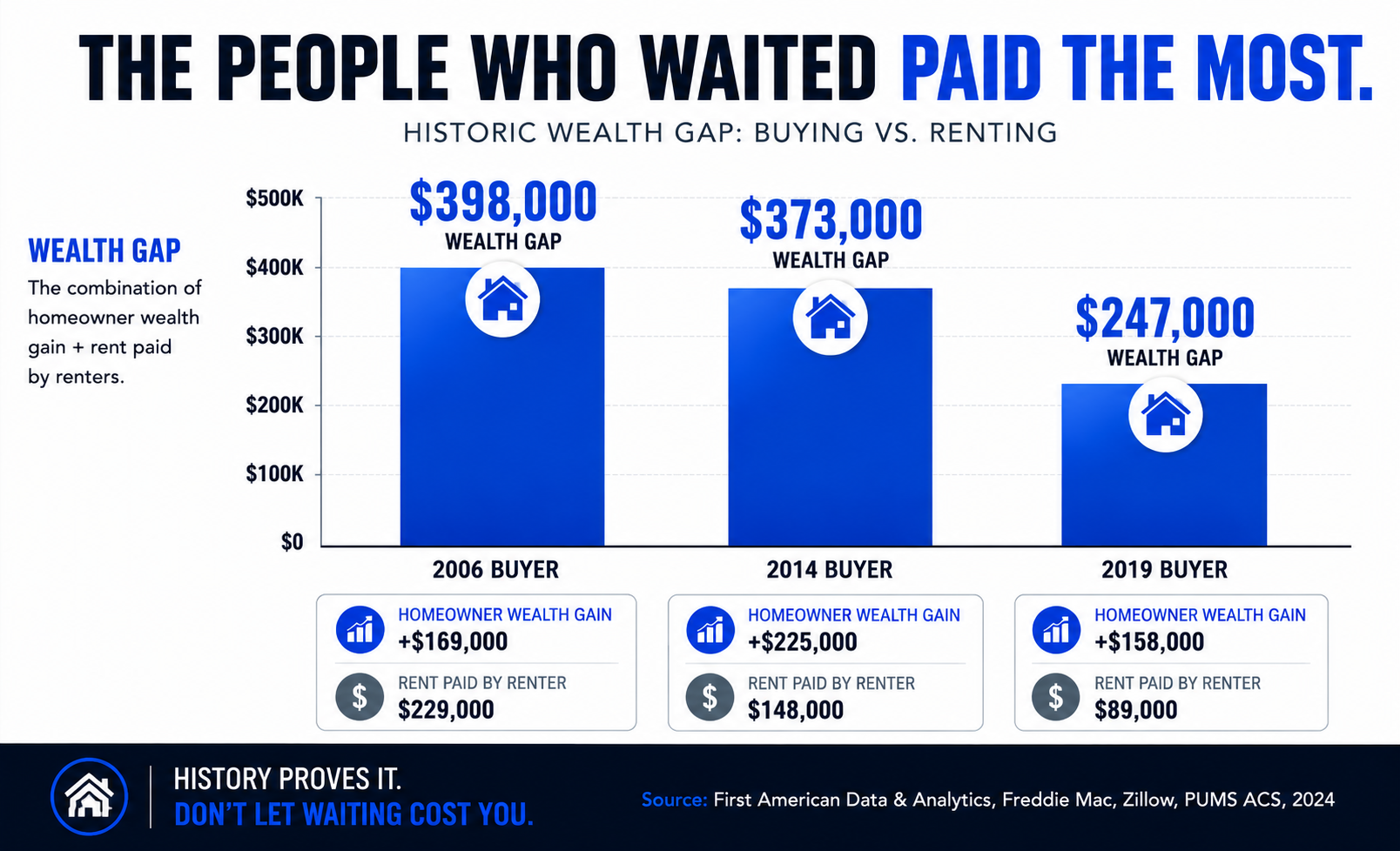
➡️ Even homeowners who bought at the height of the housing boom in 2006 have gained $169,000 in equity, while renters lost $229,000 in wealth over that period.
Cost Of Waiting — Core Strategy and Decision Context
Cost Of Waiting — Core Strategy and Decision Context
What History Shows
➡️ 2006 Buyer → +$169K Wealth Created
➡️ 2014 Buyer → +$225K Wealth Created
➡️ 2019 Buyer → +$158K Wealth Created
Different markets. Same outcome.
The people who waited paid the most.
The Real Takeaway
The people waiting for the "perfect time" consistently missed years of appreciation, equity growth, and wealth accumulation.
History doesn't guarantee future results, but it does show one thing:
Waiting Has A Cost
The examples above are history.
Your numbers are different.
Source: First American Link to article
Before You Wait, See The Numbers
Every buyer's situation is different.
Before you make a decision based on headlines or predictions, let's compare your options side-by-side.
➡️ Buy now
➡️ Wait
➡️ Buy now and refinance later
Get Your Personalized Cost of Waiting Analysis
Schedule Your 15-Minute Strategy Call
Best regards,
Michael Thayer, CMPS, CMA
NMLS #173264
Planet Home Lending, NMLS #17022
Explore Buyer & Seller Resources & Next Steps
+ −Market Timing vs. Market Strategy: When Is the Right Time to Buy... And More Importantly, Why?
Calculators & Loan Programs Questions Answered: Mortgage Programs & Financing Calculator
Smart Financing Strategies to Lower Your Monthly Mortgage Payment: Smart Mortgage Strategies & Financing Hacks
Homebuying Roadmap: Your Mortgage GPS
Moving To Middle Tennessee: Moving To Middle Tennessee Resource Center
Search Open Houses: View All Middle Tennessee Open Houses
Main Resource Hub: Buyers, Sellers, Realtors, and Builders Resources and Strategies
Additional Information & Reference Guides
+ −Video Transcript
+ −00:00
What if the strategy you're counting on to save you money
00:03
Actually ends up costing you more.
00:06
Think about that for a second.
00:07
If you're sitting on the sidelines right now waiting for rates to drop, Home prices have come down.
00:13
Or waiting until you have a larger down payment.
00:16
I have one question for you.
00:18
What if waiting?
00:20
It's the most expensive decision you make.
00:23
My name is Michael Thayer. I'm a mortgage advisor based in Nashville, Tennessee, serving clients nationwide. And over the years, I've had countless conversations with buyers who are all waiting for the same thing. A better rate, a lower price, a more affordable payment. And on the surface.
00:38
That all sounds logical.
00:40
But here's the question.
00:41
Nobody seems to be asking.
00:44
What if?
00:46
Everyone else.
00:47
is waiting.
00:49
For the exact same thing you're waiting for.
00:52
Because… If millions of buyers are sitting on the sidelines, waiting for the same signal, What happens?
00:59
When that signal finally arrives.
01:01
There's more buyers hitting the market. That means more competition.
01:06
More pressure on home prices, and potentially less affordability than you expected.
01:12
And if you're wondering, what's driving all this, take a look at the resources on this page. One explains the supply problem that most buyers never see or realize. The other explains why people waiting for rates to drop may be the real story.
01:27
But… Help explaining why waiting.
01:32
can be more expensive than it appears. That's exactly why I created this page. It's all based on a study from First American Title that looked at buyers who purchased in 3 completely different markets.
01:44
One bought at the peak of 2006, one bought during the recovery in 2014, and one bought during the pandemic boom in 2019.
01:52
Three very different markets. Yet, the lesson remains remarkably similar. The people who got into the market built wealth. The people who waited, sat on the sidelines, often paid more than they expected.
02:07
Now, I want to take that idea one step further, looking forward from today. I put together side-by-side examples down below using a $400,000, $800,000, and $1.2 million purchase comparison.
02:18
And here's what's fascinating.
02:20
Whether you're buying a $400,000 home or a $1.2 million home, the price doesn't matter. The longer you wait, the math doesn't really change.
02:30
The amount of your down payment gets bigger.
02:32
The payment increases, the opportunity costs you more the longer you wait.
02:38
But… The lesson stays the same.
02:42
Many buyers are waiting for lower rates, because they believe it will make homes more affordable. But, when you understand the history, the facts, you will realize waiting for a lower rate doesn't save you as much money as you think.
02:57
The increased home prices often erase any savings you were hoping to see from a low rate.
03:02
And what if increased competition?
03:04
Offsets the benefit of waiting as well.
03:07
And what if buying now and refinancing later was actually putting you in a stronger financial position?
03:14
Most people expect waiting to buy will save them money. History shows the opposite. This isn't about opinions. It's not the headlines. It's not predictions. It's just the numbers here, people. Let's dive into this page, call me with questions, we'll talk to you soon.
Cost Of Waiting — Core Strategy and Decision Context Image Overview
+ −What this image communicates
On “Cost Of Waiting,” the “Cost Of Waiting — Core Strategy and Decision Context” visual isolates one decision from a larger housing conversation. As a central strategy, it is meant to state the main tension clearly and show which decision should be made before secondary details distract from it. The subject belongs to housing-market evidence, where the useful question is what the chart or comparison says about supply, demand, prices, rates, equity, leverage, or competition at the geography and period actually measured. The image makes “Cost Of Waiting” the dominant visual message and gives the reader a defined entry point into the page's argument. The wording identifies what deserves attention first; the surrounding design establishes whether the reader is looking at a claim, a choice, a sequence, or a practical resource. That distinction determines what evidence should be gathered before the message is applied.
Why it belongs on this page
The Cost of Waiting page frames delay as an economic choice with more than one moving part. The image should help readers compare potential changes in price, rate, rent, payment, savings, inventory, competition, and life timing over a defined period. The correct use is scenario analysis with clearly labeled assumptions; the graphic cannot know future rates, appreciation, income, or the value of waiting to one household. The central strategy role of “Cost Of Waiting” is the reason this image belongs at this point in “Cost Of Waiting.”
How a reader can use it
Use “Cost Of Waiting” for its stated central strategy job on “Cost Of Waiting.” Name the desired outcome, identify the constraint that could block it, and decide which evidence would change the answer. The working notes for this panel should record the desired result, the assumption carrying the most risk, the fact that would disprove it, and the decision that must be made first. That record lets the reader use market context to improve timing and negotiation questions without converting a broad statistic into a property-level prediction without asking this image to answer a different stage of the decision.
What still must be verified
The image is valuable because it frames the right issue, not because it proves the answer. National or regional data cannot establish a specific home's value, condition, future appreciation, market time, offer activity, or the result of waiting. “Cost Of Waiting — Core Strategy and Decision Context” remains educational until the current borrower, property, market, and transaction evidence supports a specific conclusion. On “Cost Of Waiting,” that safeguard applies specifically to the central strategy role assigned to “Cost Of Waiting.”