No-Payment Bridge Loan vs Sell My House For Cash Companies
Buy Your Next Home Before Selling Your Current Home
Most homeowners assume the equity in their current home is unavailable until the house sells.
It doesn’t have to work that way.
A No-Payment, No-Upfront Cost Bridge Loan can give you access to available home equity before your current home sells, helping you create the cash needed for your next move without waiting for two transactions to line up perfectly.
What If You Didn’t Have to Wait?
Your equity is locked inside your current home.
Our No-Payment, No-Upfront-Cost Bridge Loan can help you access that equity before the house sells, giving you the flexibility to buy your next home first.
That may mean:
- More buying power.
- A stronger, non-contingent offer.
- Less pressure trying to perfectly coordinate two closings.
And unlike some “Sell My House for Cash” alternatives, you still have the opportunity to sell your home on the open market.
Five Ways a No-Payment Bridge Loan Can Fund the Next Move
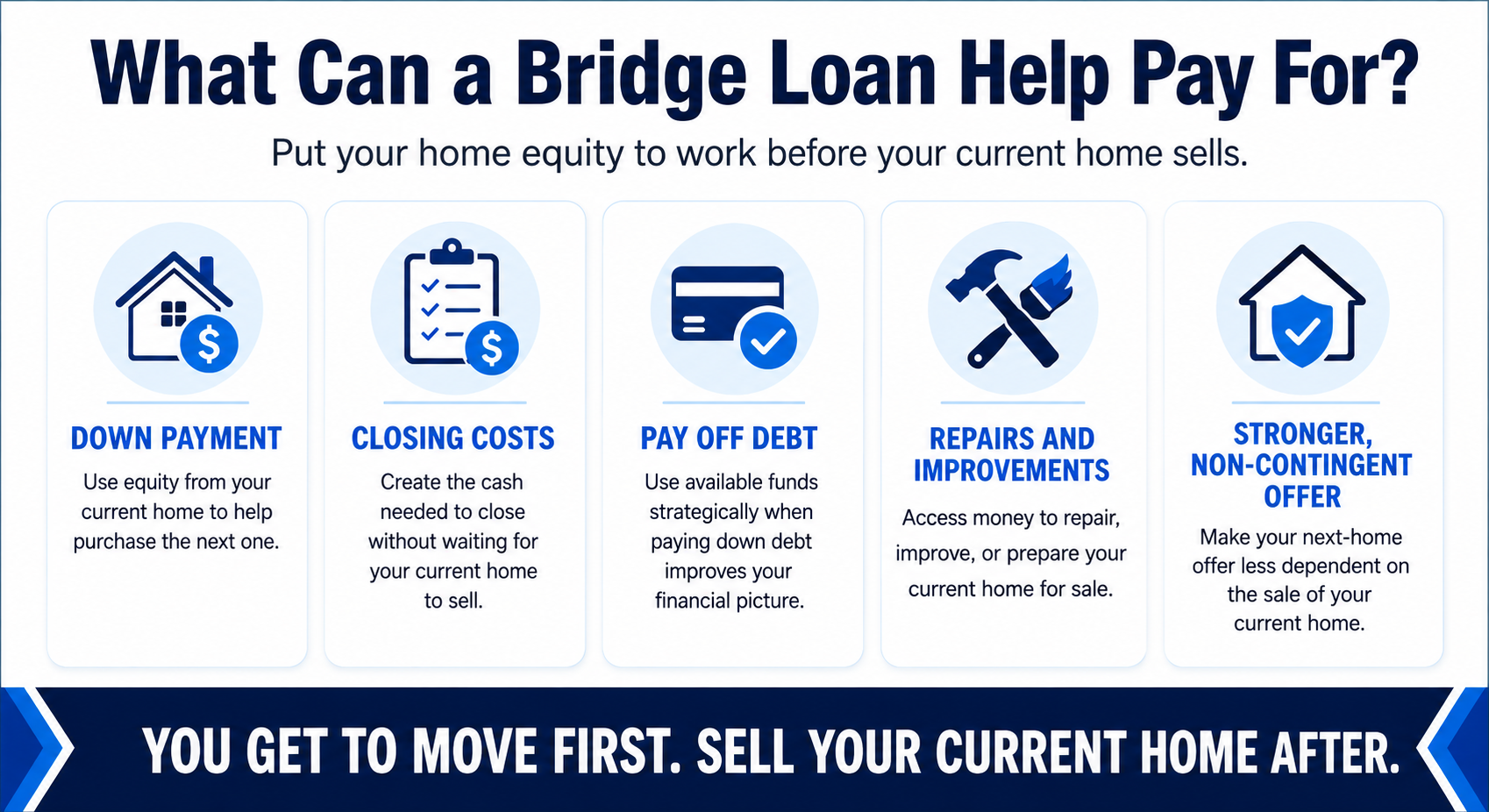
Five Ways a No-Payment Bridge Loan Can Fund the Next Move
Existing Mortgage Versus Second-Lien No-Payment Bridge Loan Options
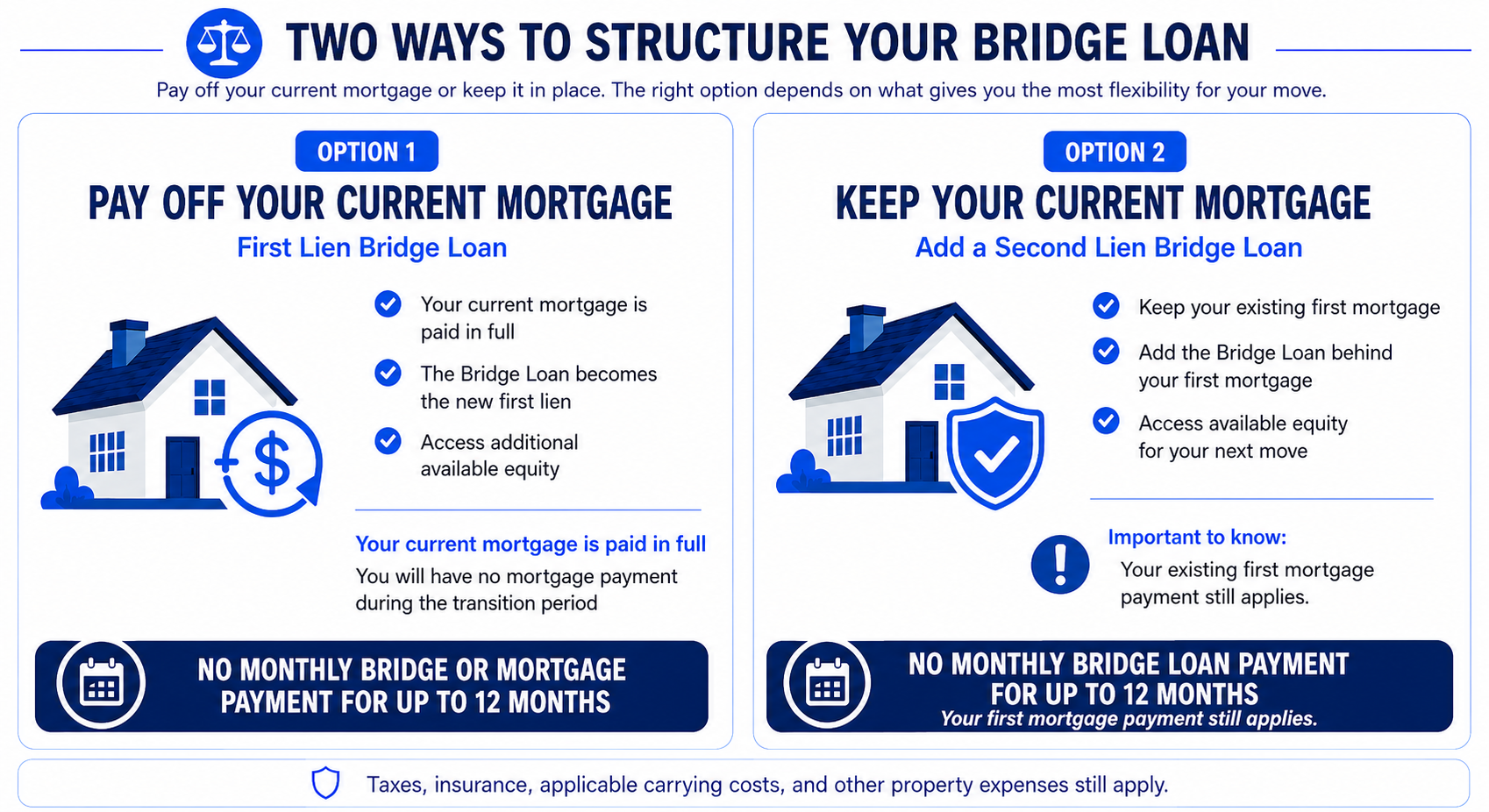
Existing Mortgage Versus Second-Lien No-Payment Bridge Loan Options
No-Payment Bridge Loan Fee Compared With Cash-Buyer Sale Costs
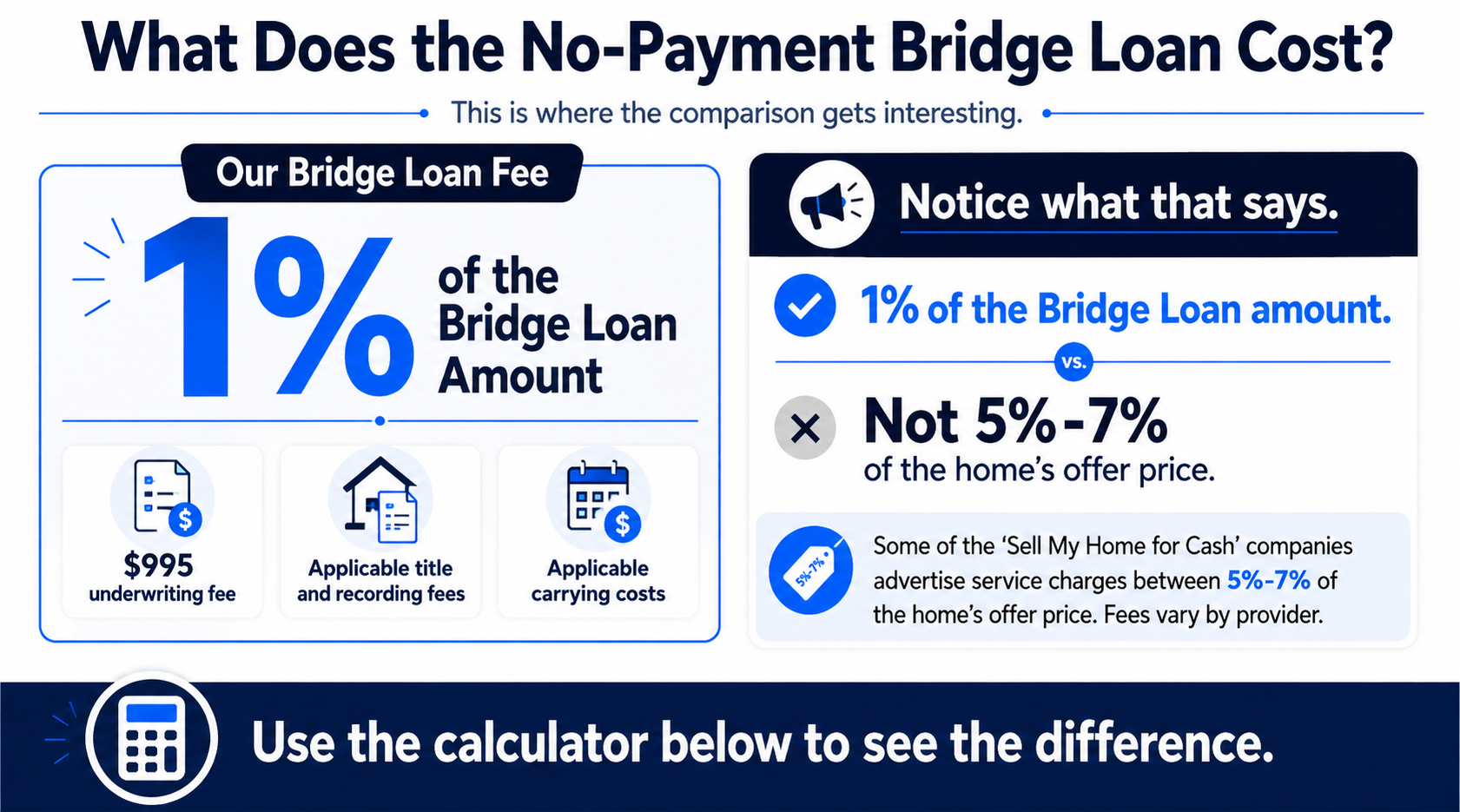
No-Payment Bridge Loan Fee Compared With Cash-Buyer Sale Costs
Moving First Can Make Selling Easier Too
Once you move out, think about what happens to the home you still need to sell.
Vacate Before Listing: Prepare the Current Home Without Living Through Showings

Vacate Before Listing: Prepare the Current Home Without Living Through Showings
Bridge Financing Benefits for Timing, Equity, and Open-Market Control
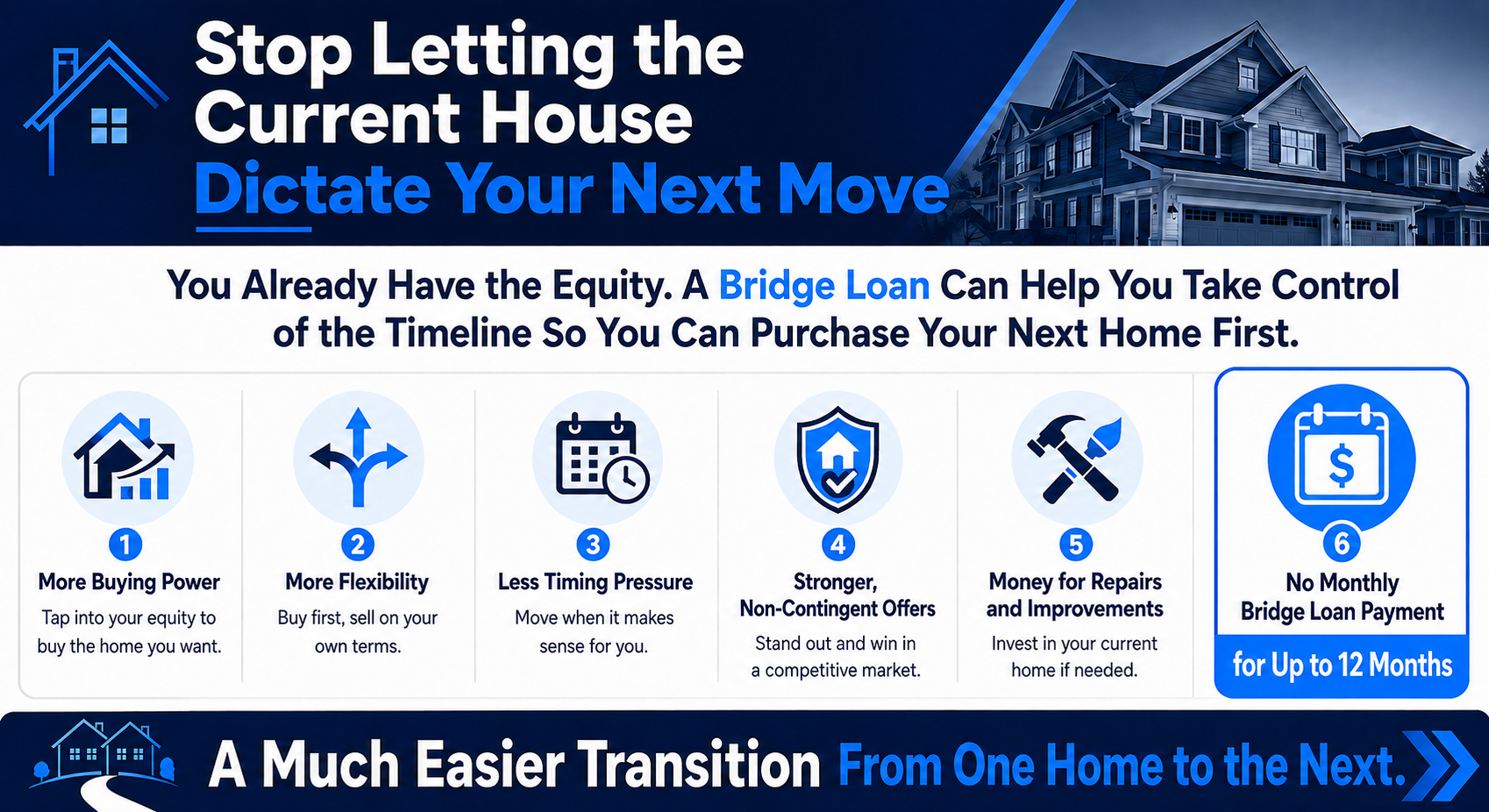
Bridge Financing Benefits for Timing, Equity, and Open-Market Control
What Would This Look Like With Your Numbers?
There’s no reason to guess.
Let’s plug in your current mortgage balance, estimated next-home purchase price, down payment, any debt you would like to pay off, and any repairs or improvements you may need to make on your current home.
Then we can see whether a Bridge Loan creates a better path forward before you make a decision.
Have Questions:
➡️ Call or Text Michael @ 615-585-5900
Prefer to put a time on the calendar?
➡️ Schedule a 10-Minute Bridge Loan Review
Already used the calculator?
➡️ Send me the numbers, and I’ll review the scenario with you.
No presentation. No obligation. Just the numbers and whether the strategy makes sense for your move.
Explore Other Ways To Move Before You Sell
Every situation is different. Explore these related strategies designed to create more flexibility, remove common roadblocks, and make the next move easier.
Explore the No-Payment Bridge Loan
- Access equity from the current home before it sells, create funds for the next purchase, and gain more flexibility over the timing of the move.
See How The Purchase EDGE Guarantee Works
- Resolve a qualification roadblock caused by the mortgage on the current home that is preventing the next purchase from proceeding.
Explore Purchase EDGE & The Guaranteed Backup Offer
- Keep the current home on the market while having a guaranteed backup buyer available if greater certainty is needed.
Best regards,
Michael Thayer, CMPS, CMA
Planet Home Lending
NMLS #173264 | Company NMLS #17022
Explore Buyer & Seller Resources & Next Steps
+ −Market Timing vs. Market Strategy: When Is the Right Time to Buy... And More Importantly, Why?
Calculators & Loan Programs Questions Answered: Mortgage Programs & Financing Calculator
Smart Financing Strategies to Lower Your Monthly Mortgage Payment: Smart Mortgage Strategies & Financing Hacks
Homebuying Roadmap: Your Mortgage GPS
Moving To Middle Tennessee: Moving To Middle Tennessee Resource Center
Search Open Houses: View All Middle Tennessee Open Houses
Main Resource Hub: Buyers, Sellers, Realtors, and Builders Resources and Strategies
Additional Information & Reference Guides
+ −Video Transcript
+ −00:00
Don't let the house you currently own prevent you from buying the house you want. Most people believe that they have to sell their current house first, because their equity, their down payment, and their buying power are all trapped inside their current house until it sells.
00:14
So now what? You just wait and hope?
00:16
That the house you want is still going to be available after you sell your current house? Or maybe you submit a weaker offer that has a sales contingency. Or you might consider selling to one of those buy-your-house-fast-for-cash companies and potentially give away thousands of dollars in equity.
00:31
You shouldn't have to choose between moving forward and protecting your money.
00:37
Use the calculator below to see how our no payment, no upfront cost bridge loan can unlock your equity BEFORE you sell your current house, giving you the ability to buy your next house first, make a stronger, non-contingent sales offer, and move on your timeline.
00:54
We can even pay off your current mortgage, so you have no mortgage payments on your current mortgage for up to 12 months.
01:01
So you can move first into the house you want.
01:04
Then do any necessary repairs on your current house, stage it properly, and sell it the right way.
01:09
Stop the stress and the anxiety that comes with trying to time up the sale of your current house with buying your next house. Ditch the last-minute showings. Don't give away your equity for the convenience of selling your house quickly.
01:24
Scroll down, run the numbers yourself. Don't sacrifice the house you want because you think you have to sell your current home first. Take control of your move. Send me the address. Let's create a path forward and a solution that works for you. We'll talk to you soon.
Five Ways a No-Payment Bridge Loan Can Fund the Next Move Image Overview
+ −What this image communicates
The image titled “Five Ways a No-Payment Bridge Loan Can Fund the Next Move” gives “No-Payment Bridge Loan vs Sell My House For Cash Companies” a focused primary visual message. Its communication job is to make one topic recognizable at a glance and give the reader a clear entry point into the deeper explanation on the page. In this page context, the underlying subject is buy-before-selling and seller-transition strategy: how equity, the current mortgage, next-home qualification, sale timing, liquidity, carrying costs, and backup plans interact. The visual presents “Five Ways a No-Payment Bridge Loan Can Fund the Next Move” as a sequence with dependencies. Its order matters: one confirmed input creates the next task, and an unresolved item can stop the file, listing, or purchase from advancing. By turning the process into visible stages, the graphic lets a reader identify the current position, the next handoff, and the deadline or evidence that controls progress.
Why it belongs on this page
The bridge-versus-cash-buyer page compares five uses of no-payment bridge financing with the cost and control tradeoffs of a fast cash sale. The primary visual message role of “Five Ways a No-Payment Bridge Loan Can Fund the Next Move” is the reason this image belongs at this point in “No-Payment Bridge Loan vs Sell My House For Cash Companies.”
How a reader can use it
Use “Five Ways a No-Payment Bridge Loan Can Fund the Next Move” for its stated primary visual message job on “No-Payment Bridge Loan vs Sell My House For Cash Companies.” Identify the claim, chart, comparison, process, property feature, or strategy shown and connect it to the exact decision the page addresses. The working notes for this panel should record the literal claim or comparison shown, the page fact it supports, the source behind that fact, and the decision the reader should make next. That record lets the reader identify whether the homeowner can move first while protecting the open-market listing and avoiding an unsupported promise about qualification or sale proceeds without asking this image to answer a different stage of the decision.
What still must be verified
Keep the visual in its proper role. The image does not approve financing, guarantee a sale, establish market value, remove contractual duties, or prove that one transition structure is best for every seller. If a later disclosure, source update, appraisal, inspection, title item, program rule, or contract term conflicts with “Five Ways a No-Payment Bridge Loan Can Fund the Next Move,” the current controlling evidence takes priority. On “No-Payment Bridge Loan vs Sell My House For Cash Companies,” that safeguard applies specifically to the primary visual message role assigned to “Five Ways a No-Payment Bridge Loan Can Fund the Next Move.”
Existing Mortgage Versus Second-Lien No-Payment Bridge Loan Options Image Overview
+ −What this image communicates
“Existing Mortgage Versus Second-Lien No-Payment Bridge Loan Options” establishes the visual entry point for this part of “No-Payment Bridge Loan vs Sell My House For Cash Companies.” Its primary visual message framing helps the reader understand how to make one topic recognizable at a glance and give the reader a clear entry point into the deeper explanation on the page. The decision underneath the graphic is how equity, the current mortgage, next-home qualification, sale timing, liquidity, carrying costs, and backup plans interact. The visual uses a side-by-side comparison to separate “Existing Mortgage Versus Second-Lien No-Payment Bridge Loan Options” into alternatives that should not be treated as interchangeable. Its layout asks the reader to compare structure, cost, timing, eligibility, and consequence—not select a winner from one headline number. The comparison is therefore a decision aid, with each column pointing to a different fact that must be confirmed.
Why it belongs on this page
Its images cover eligible uses, first- versus second-lien structure, fee comparison, moving out before marketing, and timing or equity benefits. The primary visual message role of “Existing Mortgage Versus Second-Lien No-Payment Bridge Loan Options” is the reason this image belongs at this point in “No-Payment Bridge Loan vs Sell My House For Cash Companies.”
The exact story carried by this graphic
This image isolates the structural difference between keeping the existing first mortgage and adding a second-lien, no-payment bridge facility. The first mortgage does not disappear; qualification, lien position, available equity, advance limits, fees, payoff rules, and the deadline for selling the current home all remain part of the analysis. The visual helps a homeowner see why a bridge option must be compared with the present mortgage, expected net sale proceeds, and the financing for the next purchase as one connected plan. It does not establish that the borrower qualifies or that deferring a bridge payment eliminates the cost or repayment obligation.
How a reader can use it
Use “Existing Mortgage Versus Second-Lien No-Payment Bridge Loan Options” for its stated primary visual message job on “No-Payment Bridge Loan vs Sell My House For Cash Companies.” Identify the claim, chart, comparison, process, property feature, or strategy shown and connect it to the exact decision the page addresses. The working notes for this panel should record the literal claim or comparison shown, the page fact it supports, the source behind that fact, and the decision the reader should make next. That record lets the reader identify whether the homeowner can move first while protecting the open-market listing and avoiding an unsupported promise about qualification or sale proceeds without asking this image to answer a different stage of the decision.
What still must be verified
The boundary is important. The image does not approve financing, guarantee a sale, establish market value, remove contractual duties, or prove that one transition structure is best for every seller. The “Existing Mortgage Versus Second-Lien No-Payment Bridge Loan Options” image can improve preparation and questions, but it cannot replace the records, disclosures, findings, approvals, or agreements issued for the actual borrower, property, and transaction. On “No-Payment Bridge Loan vs Sell My House For Cash Companies,” that safeguard applies specifically to the primary visual message role assigned to “Existing Mortgage Versus Second-Lien No-Payment Bridge Loan Options.”
No-Payment Bridge Loan Fee Compared With Cash-Buyer Sale Costs Image Overview
+ −What this image communicates
A reader encountering “No-Payment Bridge Loan Fee Compared With Cash-Buyer Sale Costs” should immediately recognize the buy-before-selling and seller-transition strategy question inside “No-Payment Bridge Loan vs Sell My House For Cash Companies.” The visual's role is primary visual message, so it must make one topic recognizable at a glance and give the reader a clear entry point into the deeper explanation on the page rather than merely repeat the headline. The visual uses a side-by-side comparison to separate “No-Payment Bridge Loan Fee Compared With Cash-Buyer Sale Costs” into alternatives that should not be treated as interchangeable. Its layout asks the reader to compare structure, cost, timing, eligibility, and consequence—not select a winner from one headline number. The comparison is therefore a decision aid, with each column pointing to a different fact that must be confirmed.
Why it belongs on this page
The reader should compare verified net proceeds, repayment, lien priority, carrying exposure, property requirements, repairs, fees, market sale assumptions, and fallback plans. The primary visual message role of “No-Payment Bridge Loan Fee Compared With Cash-Buyer Sale Costs” is the reason this image belongs at this point in “No-Payment Bridge Loan vs Sell My House For Cash Companies.”
How a reader can use it
Use “No-Payment Bridge Loan Fee Compared With Cash-Buyer Sale Costs” for its stated primary visual message job on “No-Payment Bridge Loan vs Sell My House For Cash Companies.” Identify the claim, chart, comparison, process, property feature, or strategy shown and connect it to the exact decision the page addresses. The working notes for this panel should record the literal claim or comparison shown, the page fact it supports, the source behind that fact, and the decision the reader should make next. That record lets the reader identify whether the homeowner can move first while protecting the open-market listing and avoiding an unsupported promise about qualification or sale proceeds without asking this image to answer a different stage of the decision.
What still must be verified
The explanation around “No-Payment Bridge Loan Fee Compared With Cash-Buyer Sale Costs” must remain inside the evidence available for this page. The image does not approve financing, guarantee a sale, establish market value, remove contractual duties, or prove that one transition structure is best for every seller. The “No-Payment Bridge Loan Fee Compared With Cash-Buyer Sale Costs” visual supports a better-informed conversation, while the actual decision remains tied to current evidence and the people authorized to interpret it. On “No-Payment Bridge Loan vs Sell My House For Cash Companies,” that safeguard applies specifically to the primary visual message role assigned to “No-Payment Bridge Loan Fee Compared With Cash-Buyer Sale Costs.”
Vacate Before Listing: Prepare the Current Home Without Living Through Showings Image Overview
+ −What this image communicates
A reader encountering “Vacate Before Listing: Prepare the Current Home Without Living Through Showings” should immediately recognize the buy-before-selling and seller-transition strategy question inside “No-Payment Bridge Loan vs Sell My House For Cash Companies.” The visual's role is primary visual message, so it must make one topic recognizable at a glance and give the reader a clear entry point into the deeper explanation on the page rather than merely repeat the headline. The visual centers “Vacate Before Listing: Prepare the Current Home Without Living Through Showings” on a specific housing or listing decision. It connects the visible promise to the property, the people involved, and the transaction sequence instead of leaving the message as abstract marketing. A useful reading separates what can be illustrated now from what still depends on the home's condition, the negotiated terms, verified financing, and current market response.
Why it belongs on this page
The bridge-versus-cash-buyer page compares five uses of no-payment bridge financing with the cost and control tradeoffs of a fast cash sale. The primary visual message role of “Vacate Before Listing: Prepare the Current Home Without Living Through Showings” is the reason this image belongs at this point in “No-Payment Bridge Loan vs Sell My House For Cash Companies.”
How a reader can use it
Use “Vacate Before Listing: Prepare the Current Home Without Living Through Showings” for its stated primary visual message job on “No-Payment Bridge Loan vs Sell My House For Cash Companies.” Identify the claim, chart, comparison, process, property feature, or strategy shown and connect it to the exact decision the page addresses. The working notes for this panel should record the literal claim or comparison shown, the page fact it supports, the source behind that fact, and the decision the reader should make next. That record lets the reader identify whether the homeowner can move first while protecting the open-market listing and avoiding an unsupported promise about qualification or sale proceeds without asking this image to answer a different stage of the decision.
What still must be verified
The graphic has a defined limit: The image does not approve financing, guarantee a sale, establish market value, remove contractual duties, or prove that one transition structure is best for every seller. Use “Vacate Before Listing: Prepare the Current Home Without Living Through Showings” to understand and organize the issue, then rely on current source material for any number, eligibility rule, property fact, deadline, or professional conclusion. On “No-Payment Bridge Loan vs Sell My House For Cash Companies,” that safeguard applies specifically to the primary visual message role assigned to “Vacate Before Listing: Prepare the Current Home Without Living Through Showings.”
Bridge Financing Benefits for Timing, Equity, and Open-Market Control Image Overview
+ −What this image communicates
The image titled “Bridge Financing Benefits for Timing, Equity, and Open-Market Control” gives “No-Payment Bridge Loan vs Sell My House For Cash Companies” a focused primary visual message. Its communication job is to make one topic recognizable at a glance and give the reader a clear entry point into the deeper explanation on the page. In this page context, the underlying subject is buy-before-selling and seller-transition strategy: how equity, the current mortgage, next-home qualification, sale timing, liquidity, carrying costs, and backup plans interact. The visual centers “Bridge Financing Benefits for Timing, Equity, and Open-Market Control” on a specific housing or listing decision. It connects the visible promise to the property, the people involved, and the transaction sequence instead of leaving the message as abstract marketing. A useful reading separates what can be illustrated now from what still depends on the home's condition, the negotiated terms, verified financing, and current market response.
Why it belongs on this page
Its images cover eligible uses, first- versus second-lien structure, fee comparison, moving out before marketing, and timing or equity benefits. The primary visual message role of “Bridge Financing Benefits for Timing, Equity, and Open-Market Control” is the reason this image belongs at this point in “No-Payment Bridge Loan vs Sell My House For Cash Companies.”
The exact story carried by this graphic
The benefit shown here is control over timing: accessing equity may let a homeowner prepare the existing property, make a noncontingent purchase offer, move once, or expose the home to the open market instead of accepting a speed-driven cash discount. Each benefit has a corresponding cost or risk, including financing charges, two-property exposure, a delayed sale, or a lower-than-expected net proceed. The image should guide a net-outcome comparison—cash retained, payment obligations, time gained, market exposure, and fallback options—rather than imply that bridge financing is automatically better than a direct cash sale.
How a reader can use it
Use “Bridge Financing Benefits for Timing, Equity, and Open-Market Control” for its stated primary visual message job on “No-Payment Bridge Loan vs Sell My House For Cash Companies.” Identify the claim, chart, comparison, process, property feature, or strategy shown and connect it to the exact decision the page addresses. The working notes for this panel should record the literal claim or comparison shown, the page fact it supports, the source behind that fact, and the decision the reader should make next. That record lets the reader identify whether the homeowner can move first while protecting the open-market listing and avoiding an unsupported promise about qualification or sale proceeds without asking this image to answer a different stage of the decision.
What still must be verified
“Bridge Financing Benefits for Timing, Equity, and Open-Market Control” organizes the primary visual message part of the decision; it does not settle the rest. The image does not approve financing, guarantee a sale, establish market value, remove contractual duties, or prove that one transition structure is best for every seller. The responsible next step after “Bridge Financing Benefits for Timing, Equity, and Open-Market Control” is to obtain the current document or finding that governs the issue and reconcile any difference before proceeding. On “No-Payment Bridge Loan vs Sell My House For Cash Companies,” that safeguard applies specifically to the primary visual message role assigned to “Bridge Financing Benefits for Timing, Equity, and Open-Market Control.”