Sell My House Fast For Cash…
Cash-Buyer Certainty Without the High Fees. Just 2%.
Cash-Buyer Certainty Without the High Fees. Just 2%.
Don't Give Up The Chance To Sell Your House For More
Our Purchase Edge program is a lower-cost 2% cash-buyer alternative to the higher-cost alternatives that charge between 5% and 7%
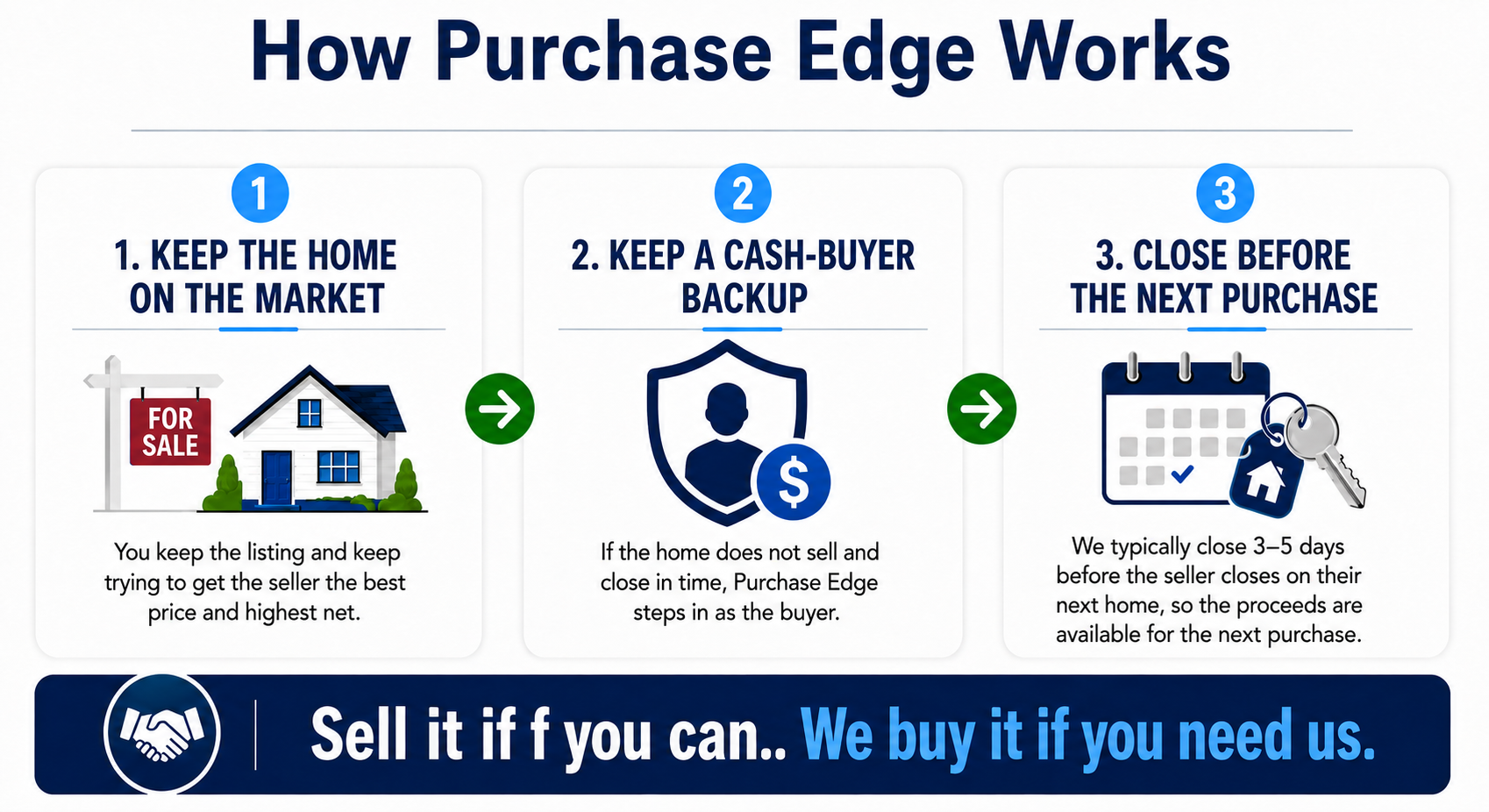
Plus, you keep the listing and keep trying to sell the home on the open market.
If it sells and closes in time, great!
If it doesn’t, we buy it.
Purchase Edge typically closes 3–5 days before your seller's closing on their next home, so they have the proceeds they need to move forward.
Try to sell it for more. Keep a backup buyer in place. Only pay 2% if you need it.
Purchase EDGE: Continue the Listing With a Guaranteed Cash Backup
Purchase EDGE: Continue the Listing With a Guaranteed Cash Backup
Cash-Buyer Certainty
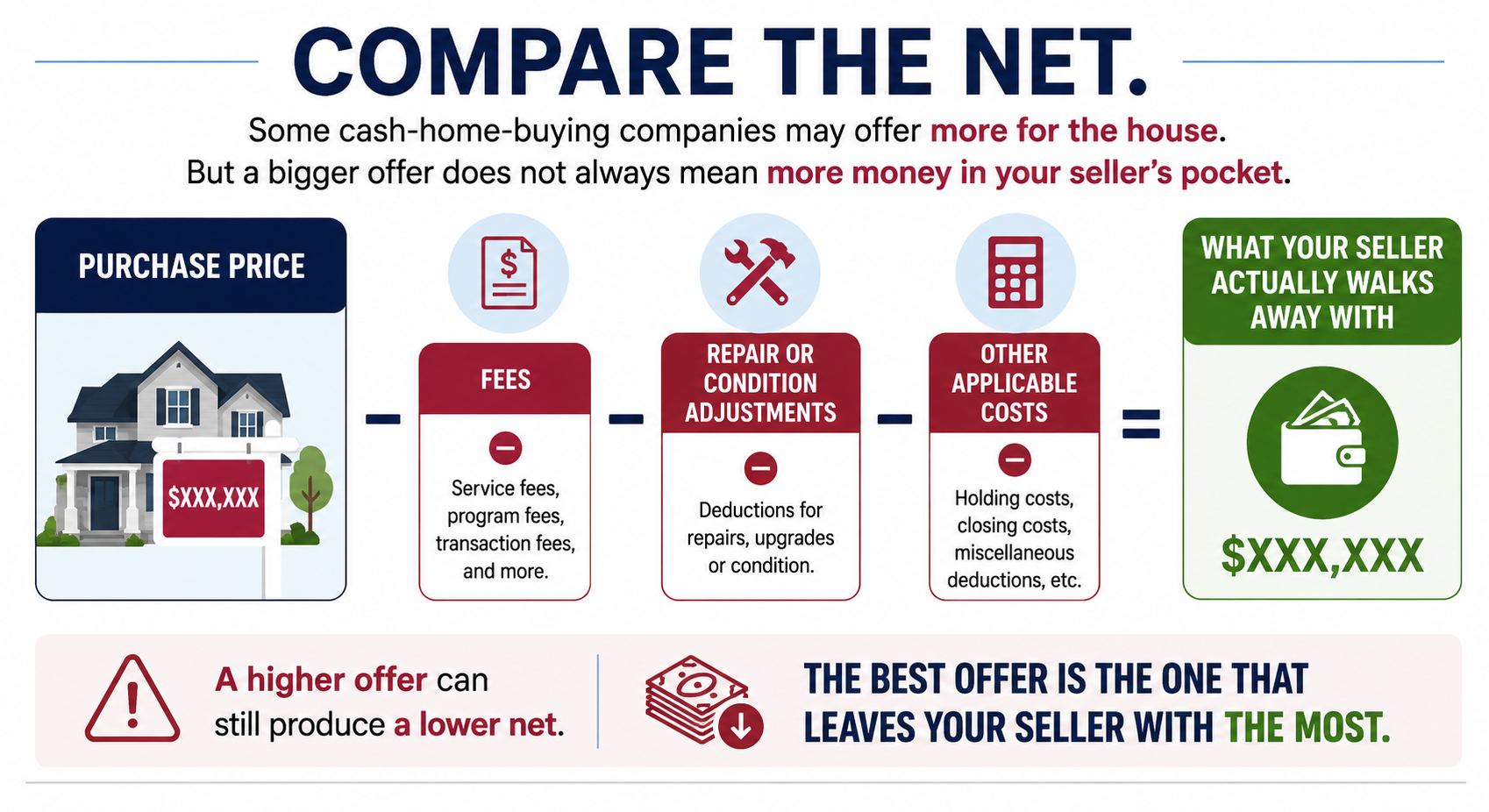
Don’t let a higher cash offer fool you. Some “Sell My House Fast” for cash companies offset that bigger offer with 5%–7% fees and other deductions.
A lower offer price, combined with fewer fees, can still put more money in your seller’s pocket.
**Compare the net, not the headline price.**
Compare Cash-Offer Net Proceeds After Fees, Repairs, and Other Costs
Compare Cash-Offer Net Proceeds After Fees, Repairs, and Other Costs
Which Cash Offer Actually Puts More In Your Seller's Pocket?
Enter the numbers and compare the estimated net proceeds, not just the headline offer price.
Calculate What the Seller Keeps Before Accepting a Fast Cash Offer

Calculate What the Seller Keeps Before Accepting a Fast Cash Offer
Before Your Seller Gives Up Thousands...
Those “Sell Your House Fast for Cash” companies make money by buying your seller’s home. The seller can give up too much equity for the convenience, and you can lose the listing.
That’s not how we make money.
We built these solutions to be low-cost and flexible because our goal isn’t to profit from your seller’s current home.
We make money when we help the seller finance their next purchase.
You Keep the Listing. We Finance the Next Home.
By Helping You Win, We Win.
Seller, Realtor, and Mortgage Team Alignment Under Purchase EDGE

Seller, Realtor, and Mortgage Team Alignment Under Purchase EDGE
Before Your Seller Commits to a Cash Buyer, Run the Net First.
Send me the property address, and I’ll show you what the 2% Purchase Edge option could look like.
We’ll compare the numbers, look at what your seller could actually net, and determine whether there’s a better way to get the certainty they want without giving away thousands unnecessarily.
➡️ Call or Text Michael @ 615-585-5900
Prefer to put a time on the calendar?
➡️ Schedule a 10-Minute Listing Strategy Review
No presentation. No obligation. Just the numbers and whether the strategy makes sense for your seller.
Explore Other Ways To Move Before You Sell
Every situation is different. Explore these related strategies designed to create more flexibility, remove common roadblocks, and make the next move easier.
Explore the No-Payment Bridge Loan
- Access equity from the current home before it sells, create funds for the next purchase, and gain more flexibility over the timing of the move.
See How The Purchase EDGE Guarantee Works
- Resolve a qualification roadblock caused by the mortgage on the current home that is preventing the next purchase from proceeding.
Explore Purchase EDGE & The Guaranteed Backup Offer
- Keep the current home on the market while having a guaranteed backup buyer available if greater certainty is needed.
Best regards,
Michael Thayer, CMPS, CMA
Planet Home Lending
NMLS #173264 | Company NMLS #17022
Explore Buyer & Seller Resources & Next Steps
+ −Market Timing vs. Market Strategy: When Is the Right Time to Buy... And More Importantly, Why?
Calculators & Loan Programs Questions Answered: Mortgage Programs & Financing Calculator
Smart Financing Strategies to Lower Your Monthly Mortgage Payment: Smart Mortgage Strategies & Financing Hacks
Homebuying Roadmap: Your Mortgage GPS
Moving To Middle Tennessee: Moving To Middle Tennessee Resource Center
Search Open Houses: View All Middle Tennessee Open Houses
Main Resource Hub: Buyers, Sellers, Realtors, and Builders Resources and Strategies
Additional Information & Reference Guides
+ −Video Transcript
+ −Purchase EDGE: Continue the Listing With a Guaranteed Cash Backup Image Overview
+ −What this image communicates
A reader encountering “Purchase EDGE: Continue the Listing With a Guaranteed Cash Backup” should immediately recognize the buy-before-selling and seller-transition strategy question inside “Sell My House Fast For Cash.” The visual's role is primary visual message, so it must make one topic recognizable at a glance and give the reader a clear entry point into the deeper explanation on the page rather than merely repeat the headline. The visual centers “Purchase EDGE: Continue the Listing With a Guaranteed Cash Backup” on a specific housing or listing decision. It connects the visible promise to the property, the people involved, and the transaction sequence instead of leaving the message as abstract marketing. A useful reading separates what can be illustrated now from what still depends on the home's condition, the negotiated terms, verified financing, and current market response.
Why it belongs on this page
This cash-sale comparison page presents Purchase EDGE as a two-track plan: continue the open-market listing while retaining a defined cash backup. The primary visual message role of “Purchase EDGE: Continue the Listing With a Guaranteed Cash Backup” is the reason this image belongs at this point in “Sell My House Fast For Cash….”
The exact story carried by this graphic
The Purchase EDGE image shows a two-track seller strategy: continue marketing the property to open-market buyers while preserving a defined cash-backup path if the listing does not produce the required result. The central value is optionality, not a guaranteed premium. A useful review must identify the backup offer's terms, eligibility conditions, deadlines, property requirements, fees, and how it interacts with the listing agreement and next-home purchase. The image helps the seller understand how the backup can reduce timing uncertainty while the listing remains active, but the signed program documents and actual property review control whether that option exists.
How a reader can use it
Use “Purchase EDGE: Continue the Listing With a Guaranteed Cash Backup” for its stated primary visual message job on “Sell My House Fast For Cash.” Identify the claim, chart, comparison, process, property feature, or strategy shown and connect it to the exact decision the page addresses. The working notes for this panel should record the literal claim or comparison shown, the page fact it supports, the source behind that fact, and the decision the reader should make next. That record lets the reader identify whether the homeowner can move first while protecting the open-market listing and avoiding an unsupported promise about qualification or sale proceeds without asking this image to answer a different stage of the decision.
What still must be verified
“Purchase EDGE: Continue the Listing With a Guaranteed Cash Backup” organizes the primary visual message part of the decision; it does not settle the rest. The image does not approve financing, guarantee a sale, establish market value, remove contractual duties, or prove that one transition structure is best for every seller. The responsible next step after “Purchase EDGE: Continue the Listing With a Guaranteed Cash Backup” is to obtain the current document or finding that governs the issue and reconcile any difference before proceeding. On “Sell My House Fast For Cash…,” that safeguard applies specifically to the primary visual message role assigned to “Purchase EDGE: Continue the Listing With a Guaranteed Cash Backup.”
Compare Cash-Offer Net Proceeds After Fees, Repairs, and Other Costs Image Overview
+ −What this image communicates
The “Compare Cash-Offer Net Proceeds After Fees, Repairs, and Other Costs” image turns the central issue on “Sell My House Fast For Cash” into a visible primary visual message. It is there to make one topic recognizable at a glance and give the reader a clear entry point into the deeper explanation on the page, while the page supplies the evidence and explanation needed to evaluate how goals, payment comfort, cash needs, property fit, timing, risk, and professional responsibilities come together. The image makes “Compare Cash-Offer Net Proceeds After Fees, Repairs, and Other Costs” the dominant visual message and gives the reader a defined entry point into the page's argument. The wording identifies what deserves attention first; the surrounding design establishes whether the reader is looking at a claim, a choice, a sequence, or a practical resource. That distinction determines what evidence should be gathered before the message is applied.
Why it belongs on this page
Its four images cover the backup structure, net-proceeds comparison, seller-keep calculation, and team responsibilities. The primary visual message role of “Compare Cash-Offer Net Proceeds After Fees, Repairs, and Other Costs” is the reason this image belongs at this point in “Sell My House Fast For Cash….”
How a reader can use it
Use “Compare Cash-Offer Net Proceeds After Fees, Repairs, and Other Costs” for its stated primary visual message job on “Sell My House Fast For Cash.” Identify the claim, chart, comparison, process, property feature, or strategy shown and connect it to the exact decision the page addresses. The working notes for this panel should record the literal claim or comparison shown, the page fact it supports, the source behind that fact, and the decision the reader should make next. That record lets the reader turn a broad housing question into a smaller set of facts, tradeoffs, and next actions without asking this image to answer a different stage of the decision.
What still must be verified
Keep the visual in its proper role. The image provides education, not a loan decision, property valuation, legal conclusion, tax result, inspection finding, insurance commitment, or guarantee of future market performance. If a later disclosure, source update, appraisal, inspection, title item, program rule, or contract term conflicts with “Compare Cash-Offer Net Proceeds After Fees, Repairs, and Other Costs,” the current controlling evidence takes priority. On “Sell My House Fast For Cash…,” that safeguard applies specifically to the primary visual message role assigned to “Compare Cash-Offer Net Proceeds After Fees, Repairs, and Other Costs.”
Calculate What the Seller Keeps Before Accepting a Fast Cash Offer Image Overview
+ −What this image communicates
On “Sell My House Fast For Cash,” the “Calculate What the Seller Keeps Before Accepting a Fast Cash Offer” visual isolates one decision from a larger housing conversation. As a primary visual message, it is meant to make one topic recognizable at a glance and give the reader a clear entry point into the deeper explanation on the page. The subject belongs to buy-before-selling and seller-transition strategy, where the useful question is how equity, the current mortgage, next-home qualification, sale timing, liquidity, carrying costs, and backup plans interact. The visual centers “Calculate What the Seller Keeps Before Accepting a Fast Cash Offer” on a specific housing or listing decision. It connects the visible promise to the property, the people involved, and the transaction sequence instead of leaving the message as abstract marketing. A useful reading separates what can be illustrated now from what still depends on the home's condition, the negotiated terms, verified financing, and current market response.
Why it belongs on this page
The reader should compare offer price, repairs, fees, concessions, commissions, timing, program conditions, next-home financing, and the value of optionality before choosing speed over market exposure. The primary visual message role of “Calculate What the Seller Keeps Before Accepting a Fast Cash Offer” is the reason this image belongs at this point in “Sell My House Fast For Cash….”
The exact story carried by this graphic
The seller-keeps calculation panel should begin with the offer and subtract every verified economic item: repairs or credits, service fees, commissions where applicable, closing costs, liens, taxes, concessions, carrying cost, and any program charge. It should then compare the timing and certainty of each path, not merely the headline net. The image benefits the seller by making hidden deductions and assumptions visible before acceptance. The signed offers, settlement estimate, listing agreement, property condition, and payoff statements control the actual result.
How a reader can use it
Use “Calculate What the Seller Keeps Before Accepting a Fast Cash Offer” for its stated primary visual message job on “Sell My House Fast For Cash.” Identify the claim, chart, comparison, process, property feature, or strategy shown and connect it to the exact decision the page addresses. The working notes for this panel should record the literal claim or comparison shown, the page fact it supports, the source behind that fact, and the decision the reader should make next. That record lets the reader identify whether the homeowner can move first while protecting the open-market listing and avoiding an unsupported promise about qualification or sale proceeds without asking this image to answer a different stage of the decision.
What still must be verified
The boundary is important. The image does not approve financing, guarantee a sale, establish market value, remove contractual duties, or prove that one transition structure is best for every seller. The “Calculate What the Seller Keeps Before Accepting a Fast Cash Offer” image can improve preparation and questions, but it cannot replace the records, disclosures, findings, approvals, or agreements issued for the actual borrower, property, and transaction. On “Sell My House Fast For Cash…,” that safeguard applies specifically to the primary visual message role assigned to “Calculate What the Seller Keeps Before Accepting a Fast Cash Offer.”
Seller, Realtor, and Mortgage Team Alignment Under Purchase EDGE Image Overview
+ −What the coordination image shows
“Seller, Realtor, and Mortgage Team Alignment Under Purchase EDGE” divides the plan into three responsibility lanes. The seller supplies complete property and financial information, evaluates documented tradeoffs, and authorizes decisions. The Realtor manages the listing, presentation, buyer feedback, contracts, and communication about market response. The mortgage team evaluates next-home financing, Purchase EDGE conditions, deadlines, and the effect of the current property on qualification. The graphic's message is that the strategy works only when those lanes exchange accurate information without blurring who controls each decision.
Why alignment changes the outcome
On “Sell My House Fast For Cash…,” the seller is comparing speed and certainty with open-market upside. A backup option can affect the listing timeline; a listing contract can affect the program; and a next-home contract can create a deadline for both. The image benefits the reader by exposing those dependencies before one participant assumes another person handled them. It also protects the Realtor relationship: financing support is shown as a coordinated lane around the listing, not a replacement for the agent's representation, marketing, negotiation, or fiduciary responsibilities.
How the team should use this visual
Convert the three lanes into a written ownership map. Identify who verifies the backup terms, property eligibility, liens, estimated net proceeds, current-home market response, next-home qualification, contract dates, and decision deadlines. Record which facts can change and who must notify the other participants. A useful checkpoint includes the evidence link or controlling document, not merely a verbal status. That operating discipline helps the seller compare the open-market path and the backup path with consistent assumptions while there is still time to correct a missed condition.
What coordination does not remove
Alignment does not guarantee Purchase EDGE eligibility, a cash-backup amount, a sale price, a closing date, buyer qualification, appraisal, title, property condition, or approval of the next-home loan. It does not transfer a Realtor's duties to the lender or turn the mortgage team into the seller's legal or tax adviser. Signed program documents, listing and purchase contracts, lender disclosures, underwriting, title findings, and current property evidence control the result. Any material change should reopen the shared plan before the seller relies on it.