Asset Depletion Mortgage Loans: Qualify Using Assets Instead of Traditional Income
A Different Mortgage Strategy Designed For Asset-Strong Borrowers.
Many financially strong buyers have substantial savings, retirement accounts, investments, or liquidity, yet still run into challenges with traditional mortgage qualification.
Traditional mortgage approval often focuses heavily on W2 income, tax returns, employment verification, and debt-to-income ratios. But many borrowers today build wealth very differently from traditional salaried employees.
Some buyers may have significant assets and a strong overall financial position, yet show lower taxable income on paper due to retirement planning, investment strategies, business structures, or long-term wealth management goals.
That’s where Asset Utilization loan programs may provide another strategic option.
What If Your Assets Could Help You Qualify
What If Your Assets Could Help You Qualify
Who Typically Uses Asset Utilization Financing

Who Typically Uses Asset Utilization Financing
Why Many Borrowers Explore Asset Utilization Strategies
Many financially stable borrowers intentionally structure their finances around:
➡️ Investments
➡️ Retirement Planning
➡️ Wealth Preservation
➡️ Business Ownership
➡️ Long-Term Asset Growth
Traditional underwriting models do not always align well with these financial strategies.
Asset Utilization programs may help create additional flexibility by focusing more broadly on overall assets, liquidity, reserves, and financial stability, rather than relying entirely on traditional income documentation.
You May Have More Options Than You Realize

You May Have More Options Than You Realize
Let’s Explore What May Be Possible
Every financial situation is different.
The right loan strategy depends on your complete financial picture, including assets, liquidity, reserves, investment strategy, retirement planning, and long-term goals.
A strategic review may help uncover financing solutions you may not have realized were available.
Not Sure Whether This Approach May Fit Your Situation
➡️ That’s exactly why we recommend scheduling a strategy call.
We’ll walk through your scenario together, review available financing options, and help you better understand which solutions may align with your income, financial profile, and long-term goals, with no pressure or obligation.
We’re Here To Help You Explore What’s Possible
If you have questions about Modern Income Qualification and Flexible Home Financing Strategies like:
➡️ 1099 & Profit & Loss (P&L) Programs
➡️ Asset Utilization Strategies
My team and I are here to help guide you through the process and help you better understand what may be possible for your situation.
We’re here to help you every step of the way, so don’t hesitate to Contact Us.
Ready To Get Started?
If you’re ready to take the next step, simply click the link below to submit your application.
Once we receive your information, my team and I will review it and reach out to schedule your personalized consultation to discuss your options and next steps.
➡️ Submit Your Application Here
➡️ Schedule Your Strategy Call Here
Best regards,
Michael Thayer, CMPS, CMA
NMLS #173264
Planet Home Lending, NMLS #17022
Explore Buyer & Seller Resources & Next Steps
+ −Market Timing vs. Market Strategy: When Is the Right Time to Buy... And More Importantly, Why?
Calculators & Loan Programs Questions Answered: Mortgage Programs & Financing Calculator
Smart Financing Strategies to Lower Your Monthly Mortgage Payment: Smart Mortgage Strategies & Financing Hacks
Homebuying Roadmap: Your Mortgage GPS
Moving To Middle Tennessee: Moving To Middle Tennessee Resource Center
Search Open Houses: View All Middle Tennessee Open Houses
Main Resource Hub: Buyers, Sellers, Realtors, and Builders Resources and Strategies
Additional Information & Reference Guides
+ −Welcome Video Transcript
+ −Video Transcript
00:00
One of the biggest misconceptions in mortgage lending today is that everyone has to qualify based solely on traditional income standards, and that's just not true. My name is Michael Thayer. I'm a mortgage advisor based in Nashville, Tennessee, serving clients nationwide.
00:13
Many financially strong buyers today have significant assets, large retirement accounts, investment portfolios, cash reserves, and/or non-traditional income structures that may not fit the standard underwriting model very well.
00:26
And sometimes, the issue isn't whether someone can afford the home; the issue is whether the traditional paperwork reflects the buyer's true financial strength. And that's where asset utilization strategies may help.
00:37
Depending on your situation, certain programs may allow eligible borrowers to use their assets, reserves, investments, retirement income, and other sources as their income qualifications.
00:47
Instead of relying on traditional employment income. For some buyers, this may create stronger purchasing power, more flexibility, ease of qualification, or access to financial options they didn't realize were available.
00:59
And because today's financial world looks very different from the way it did years ago, not everybody is a simple W-2 borrower anymore. Some buyers are self-employed, they're retired, commission-based, business owners, investors, or simply structuring, you know, structure their finances differently.
01:15
And that's exactly what this page is designed to help you. Explore this page, check out the options, and take a few minutes to review the information. If you'd like help in exploring whether an asset-based qualification strategy may make sense for you and your situation, schedule a strategy call. Let's walk through what may be possible for you and your goals. Talk to you soon.
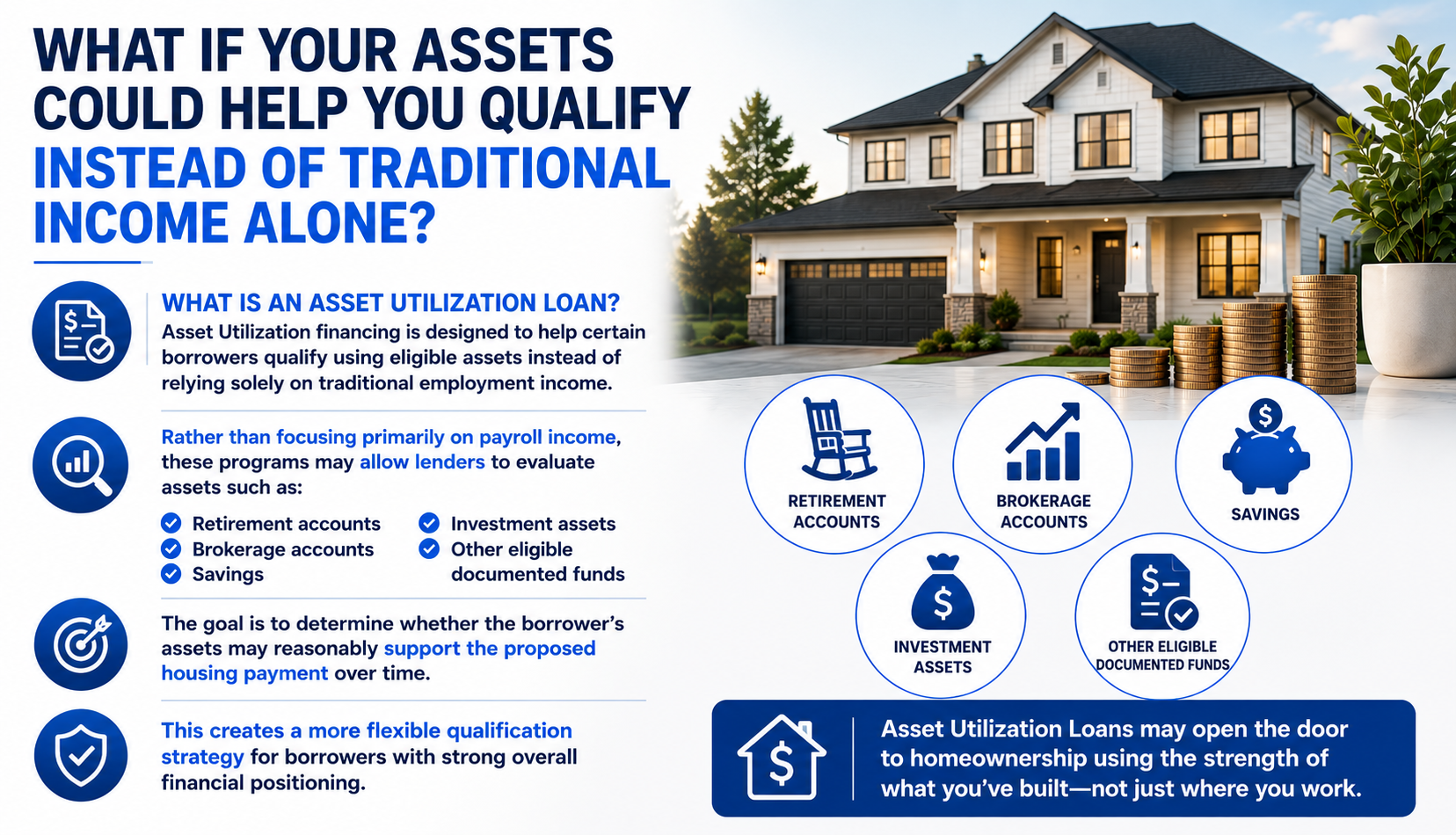
What If Your Assets Could Help You Qualify Image Overview
+ −The What If Your Assets Could Help You Qualify graphic introduces asset depletion or asset utilization mortgage concepts. Under an eligible program, certain verified assets may be converted through a program-defined formula into a monthly amount used in qualification.
The image shows how a borrower with significant savings, investments, or retirement assets may have financial capacity that is not reflected by a traditional paycheck. The lender does not simply count the account balance as income. It determines which assets are eligible, subtracts funds needed for down payment and closing when required, applies any required percentage or reduction, and divides the remaining amount over a specified period.
Retirees, business owners after a liquidity event, investors, high-net-worth households, recently transitioned professionals, and borrowers living partly from investments may find this approach relevant.
Underwriting may consider asset type, ownership, accessibility, age or retirement status when applicable, market-value adjustments, taxes or penalties, funds needed for closing, reserves, credit, debts, occupancy, and property eligibility.
Gather complete account statements, identify joint or restricted ownership, disclose loans or pledges against assets, and separate funds that will be spent at closing from funds expected to support qualification or reserves.
Ask which accounts qualify, how eligible value is calculated, whether retirement assets receive different treatment, what balance must remain after closing, and how market fluctuations or withdrawals are handled before funding.
Asset depletion is a mortgage calculation, not investment advice or a required withdrawal plan. Borrowers should discuss tax and investment consequences with their own qualified advisors.
The value of What If Your Assets Could Help You Qualify is the way it concentrates the date-stamped chart, the direction of the measures shown, the comparison period, and the housing or borrowing context surrounding the graphic into one recognizable message. “The What If Your Assets Could Help You Qualify graphic introduces asset depletion or asset utilization mortgage concepts.” is the key bridge between the artwork and the underlying topic on “Asset Depletion Mortgage Loans: Qualify Using Assets Instead of Traditional Income.” That bridge matters because it helps a reader move from curiosity to a more exact understanding of what could influence the decision and what still needs verification. For What If Your Assets Could Help You Qualify, the process is best understood as separating a current observation from a longer trend, checking the time period and source, and translating the signal into payment, inventory, negotiation, or timing implications. The image gives the reader the organizing idea; the supporting work supplies the proof. Keeping those two roles separate makes the page more useful because the graphic can guide attention while verified information controls the actual recommendation, timing, and next action. This image is most relevant to buyers, homeowners, sellers, Realtors, and households comparing whether to act now or keep preparing. It helps them identify whether the situation shown resembles their own and whether the next conversation should be exploratory, document-driven, or decision-ready. What If Your Assets Could Help You Qualify therefore functions as a screening and education tool, not as a substitute for the full facts addressed elsewhere on “Asset Depletion Mortgage Loans: Qualify Using Assets Instead of Traditional Income.”
This image section serves as the explanatory layer between the artwork and the real-world decision. What If Your Assets Could Help You Qualify captures attention; the surrounding text clarifies why the topic matters, how it is evaluated, who may benefit, and what should happen next.
Who Typically Uses Asset Utilization Financing Image Overview
+ −The Who Typically Uses Asset Utilization Financing graphic identifies borrowers whose verified financial strength is concentrated in assets rather than recurring W-2 income: retirees, investors, entrepreneurs, high-net-worth households, and people between established income phases.
These borrowers may hold brokerage accounts, savings, money-market funds, certificates, retirement accounts, or other program-eligible assets. A lender applies its rules to determine availability, eligible value, and a monthly qualifying amount while preserving funds required for closing and reserves.
The image may help a retiree who prefers not to rely only on pension or distribution income, an entrepreneur after selling a business, an investor with substantial liquidity, or a borrower whose current income history is too short for a traditional calculation.
The program may examine ownership, vesting, accessibility, account history, large deposits, asset-backed loans, withdrawal restrictions, age-related eligibility, joint ownership, liquidation discounts, credit, debts, occupancy, and property type.
List every potentially eligible account, note ownership and restrictions, gather all statement pages, and identify which funds are earmarked for down payment, closing, reserves, living expenses, or other planned uses.
Ask which assets are included or excluded, whether income-producing assets can also generate separately counted income, how joint accounts are treated, and how much liquidity should remain after the transaction.
A large balance alone does not guarantee qualification. Eligibility depends on the program's calculation and the complete borrower and property profile.
On “Asset Depletion Mortgage Loans: Qualify Using Assets Instead of Traditional Income,” the Who Typically Uses Asset Utilization Financing graphic performs a specific educational job: it focuses attention on the date-stamped chart, the direction of the measures shown, the comparison period, and the housing or borrowing context surrounding the graphic. The phrase “A large balance alone does not guarantee qualification.” supplies the image-specific clue. This is why the visual should be read as a planning aid rather than decoration; it frames the question that must be understood before a reader compares options or assumes the apparent answer is complete. For Who Typically Uses Asset Utilization Financing, the process is best understood as separating a current observation from a longer trend, checking the time period and source, and translating the signal into payment, inventory, negotiation, or timing implications. The image gives the reader the organizing idea; the supporting work supplies the proof. Keeping those two roles separate makes the page more useful because the graphic can guide attention while verified information controls the actual recommendation, timing, and next action. This image is most relevant to buyers, homeowners, sellers, Realtors, and households comparing whether to act now or keep preparing. It helps them identify whether the situation shown resembles their own and whether the next conversation should be exploratory, document-driven, or decision-ready. Who Typically Uses Asset Utilization Financing therefore functions as a screening and education tool, not as a substitute for the full facts addressed elsewhere on “Asset Depletion Mortgage Loans: Qualify Using Assets Instead of Traditional Income.”
The purpose of the Who Typically Uses Asset Utilization Financing box is to make the visual independently useful. It gives the image a searchable, crawlable explanation and gives the reader enough context to understand the role the graphic plays within “Asset Depletion Mortgage Loans: Qualify Using Assets Instead of Traditional Income.” More importantly, it serves the decision process by recording the assumptions, evidence, and next steps that should be discussed before anyone relies on the pictured concept.
You May Have More Options Than You Realize Image Overview
+ −The You May Have More Options Than You Realize graphic encourages asset-rich borrowers to compare mortgage structures before assuming that limited traditional income ends the home-financing conversation.
Asset depletion may be one path, but a complete strategy can also compare documented retirement distributions, self-employed bank statements, 1099 income, no-ratio concepts, or DSCR financing for an eligible investment property. Each method treats income, assets, debts, occupancy, and property differently.
This overview may help retirees, investors, business owners, estate beneficiaries, and borrowers navigating a career transition or planned reduction in earned income.
The mortgage team may compare eligible income and asset methods, required reserves, down payment, credit, property use, estimated payment, closing funds, and the effect of using or preserving particular assets.
Define which assets are available, which should remain untouched, the personal monthly payment comfort, and the expected property use. Coordinate tax, estate, and investment questions with the appropriate advisors before liquidating or transferring funds.
Ask which structure uses the financial profile most accurately, how it affects cash needed and future liquidity, what documents must be updated, and what events could change the qualifying calculation.
Having options supports a better-informed decision; it does not mean every option is suitable or available. Compare total requirements and long-term goals, not only the initial approval path.
The value of You May Have More Options Than You Realize is the way it concentrates the income, asset, credit, debt, property, occupancy, reserve, and documentation facts that the image is designed to organize into one recognizable message. “Having options supports a better-informed decision; it does not mean every option is suitable or available.” is the key bridge between the artwork and the underlying topic on “Asset Depletion Mortgage Loans: Qualify Using Assets Instead of Traditional Income.” That bridge matters because it helps a reader move from curiosity to a more exact understanding of what could influence the decision and what still needs verification. The “how” behind You May Have More Options Than You Realize begins with matching verified borrower and property facts to the selected program, documenting the calculation, comparing cash and payment requirements, and resolving conditions before a deadline. Rather than treating the image as a stand-alone conclusion, the reader can test its message against the current file, timeline, and objective described on “Asset Depletion Mortgage Loans: Qualify Using Assets Instead of Traditional Income.” This creates a usable chain from what the artwork says, to what must be verified, to the next decision and the person responsible for it. The intended audience is not everyone in the abstract; it is borrowers with the income pattern, property goal, or documentation question depicted, together with Realtors who need dependable financing context before an offer. For those readers, the You May Have More Options Than You Realize visual can reveal a question they did not know to ask or a condition they had underestimated. It also helps advisers and real estate partners explain the subject consistently, using the same image-specific reference rather than offering disconnected generalities. What this portion of the page serves is a better-quality decision. You May Have More Options Than You Realize organizes the subject so the reader can separate the headline, the supporting evidence, the unresolved questions, and the next action.