1099 Mortgage Loans for Self-Employed Borrowers & Gig Workers
The Problem Is Traditional Mortgage Guidelines Don’t Always Understand Modern Income
For many self-employed buyers, entrepreneurs, contractors, freelancers, consultants, commission-based professionals, and business owners, qualifying for a mortgage can feel frustrating, confusing, and outdated.
On paper, it may look like your income is lower than it actually is.
But in the real world, you may have strong cash flow, healthy business revenue, consistent deposits, growing income, documented assets, and long-term financial stability.
More people than ever are self-employed, independent contractors, commission-based professionals, freelancers, consultants, business owners, and entrepreneurs.
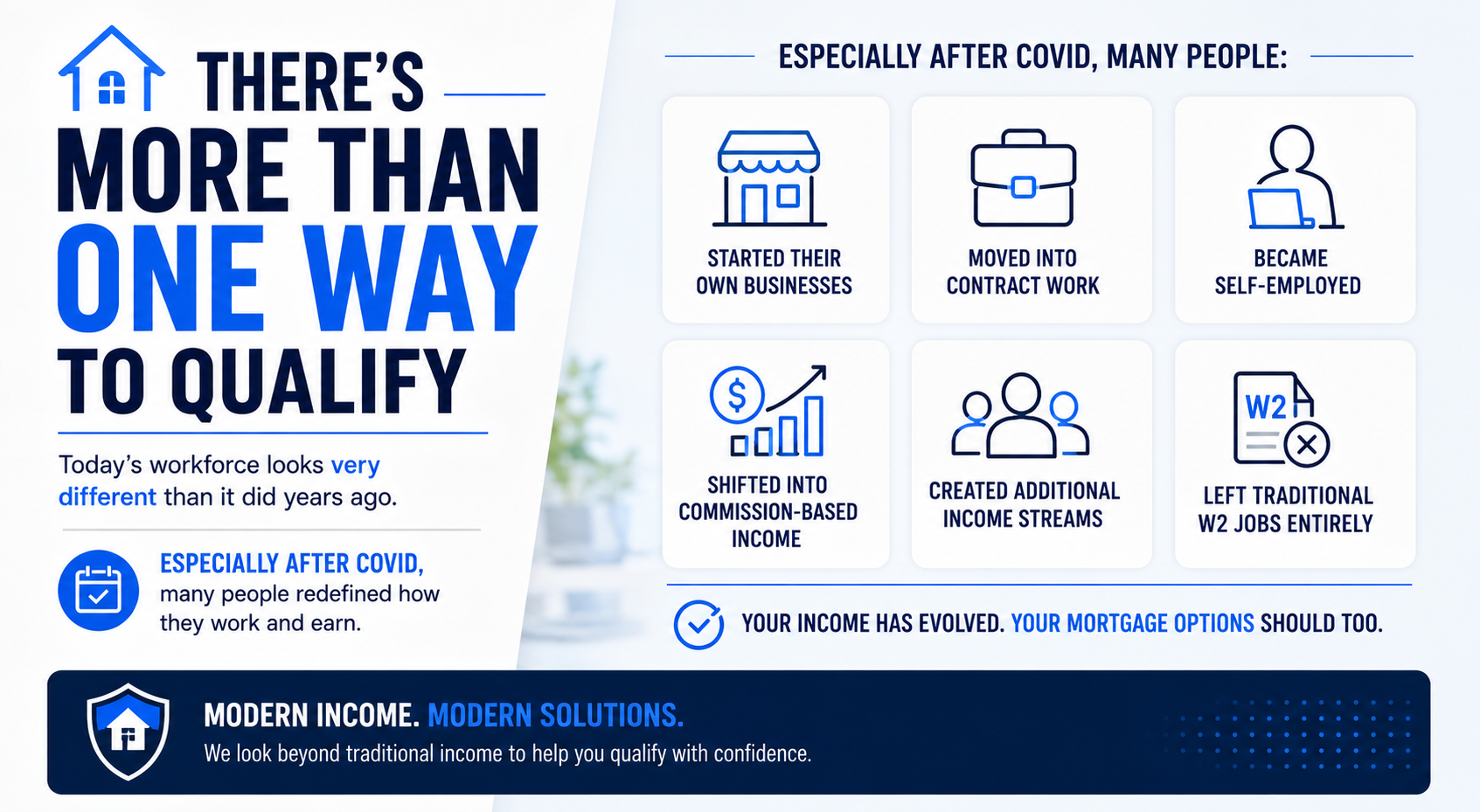
Especially after COVID, many people shifted away from traditional W2 employment and into more flexible, independent, and business-driven income models.
Yet many mortgage guidelines were originally built around traditional salaried W2 income structures.
That creates a disconnect for otherwise financially capable buyers whose real-world income and financial strength may look very different from a traditional paycheck.
There Is More Than One Way To Qualify
There Is More Than One Way To Qualify
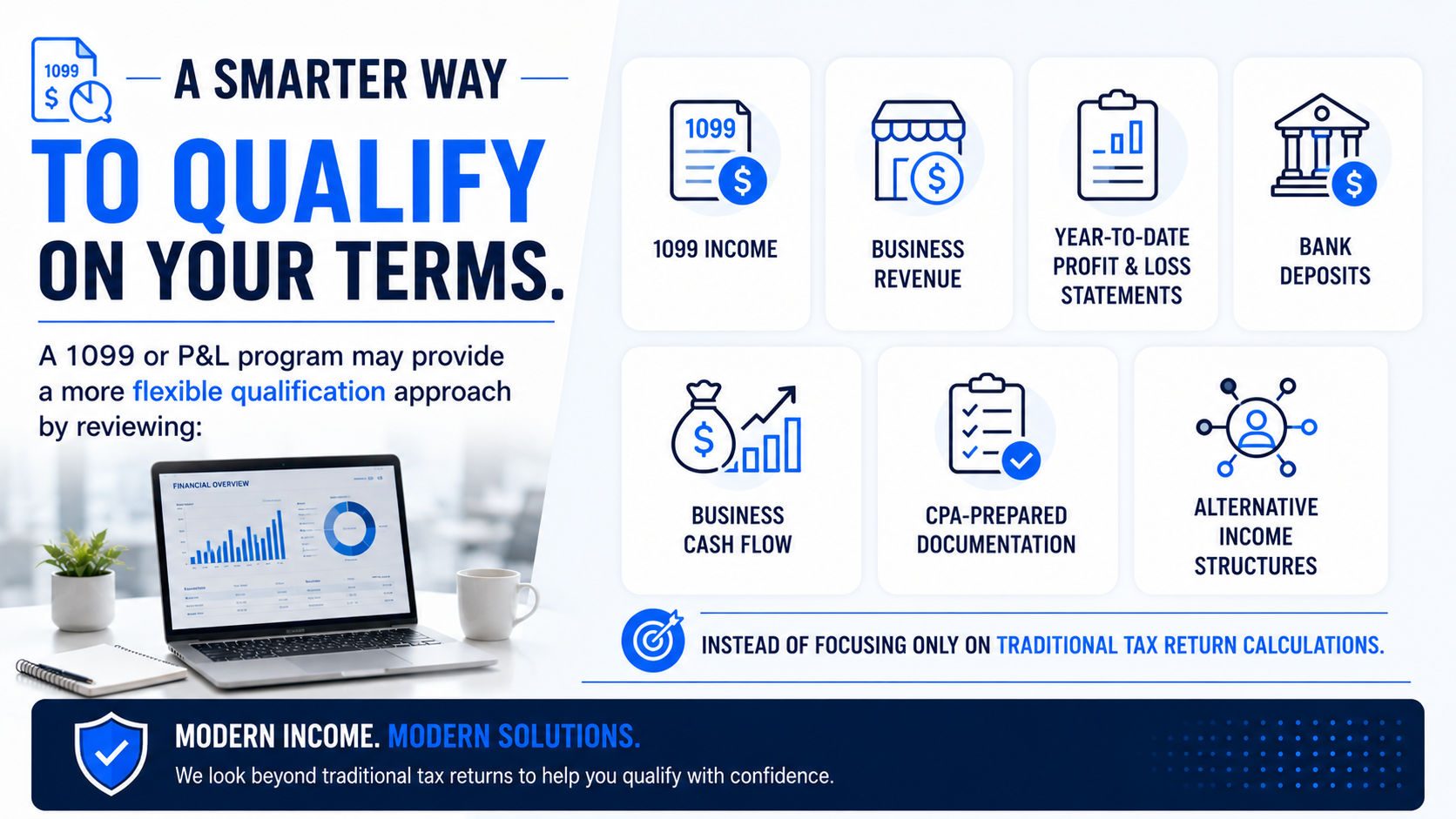
A Smarter Way To Qualify On Your Terms
A Smarter Way To Qualify On Your Terms
What Is A 1099 Loan Program
A 1099 loan program is designed for borrowers who receive income through 1099 forms instead of traditional W2 paychecks.
What’s The Difference Between W-2 and 1099 Income?
Traditional W-2 employees typically have taxes withheld directly from their paychecks by their employers.
Whereas 1099 workers and self-employed professionals are different.
They often receive gross income directly, manage their own business expenses, and handle their own taxes (quarterly or annually), deductions, healthcare, and financial planning.
Because of this, taxable income on paper may not always reflect the borrower’s true cash flow or overall financial strength.
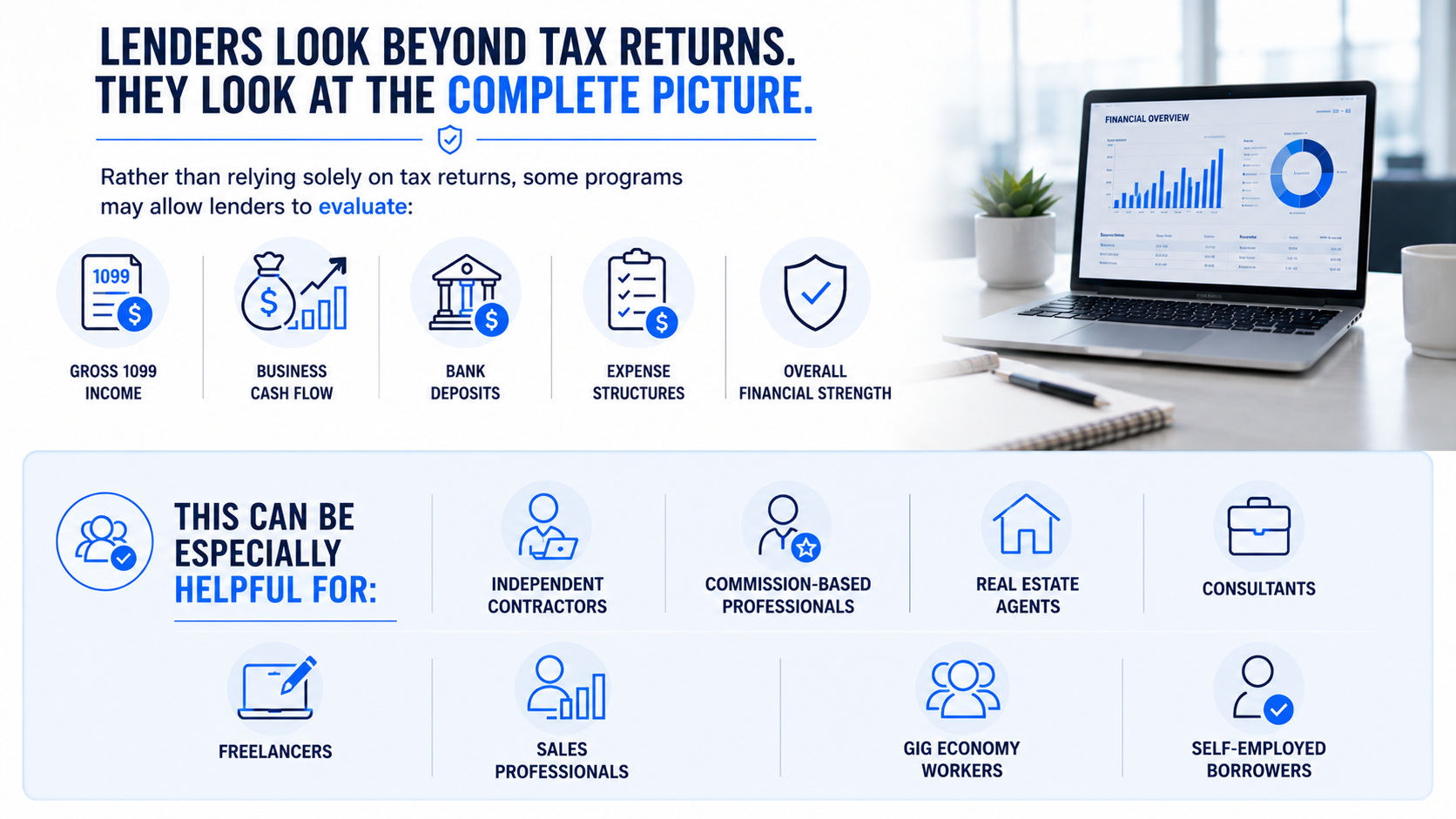
Lenders Review 1099 Income Beyond Traditional Tax Returns
Lenders Review 1099 Income Beyond Traditional Tax Returns
What Is A Profit & Loss (P&L) Loan Program
A Profit & Loss loan program allows some self-employed borrowers to qualify using a P&L statement prepared by a CPA or tax professional, sometimes combined with supporting bank statements.
Instead of relying entirely on tax returns that may contain significant write-offs or deductions, these programs may help demonstrate:
➡️ Business revenue
➡️ Net income
➡️ Cash flow consistency
➡️ Business stability
➡️ Overall earning capacity
For many business owners, this can create a more realistic picture of their financial situation.
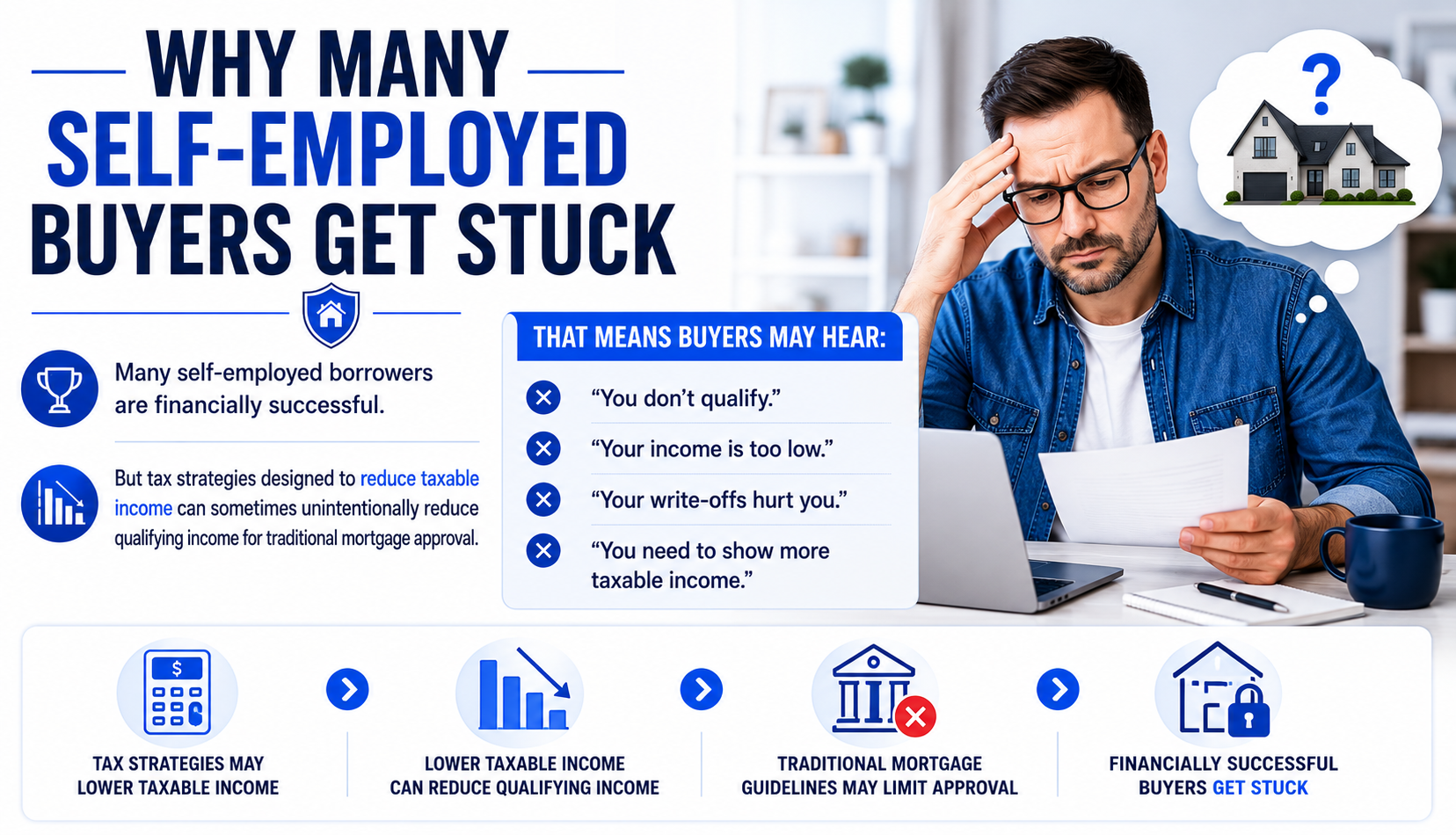
Why Many Self-Employed Buyers Get Stuck
Why Many Self-Employed Buyers Get Stuck
Even when they may have strong revenue, healthy reserves, consistent deposits, strong credit, substantial savings, and long-term business stability.
The issue is not always affordability.
Sometimes the issue is simply that traditional qualification models were not designed for modern income structures.
Why These Programs May Help Self-Employed Borrowers
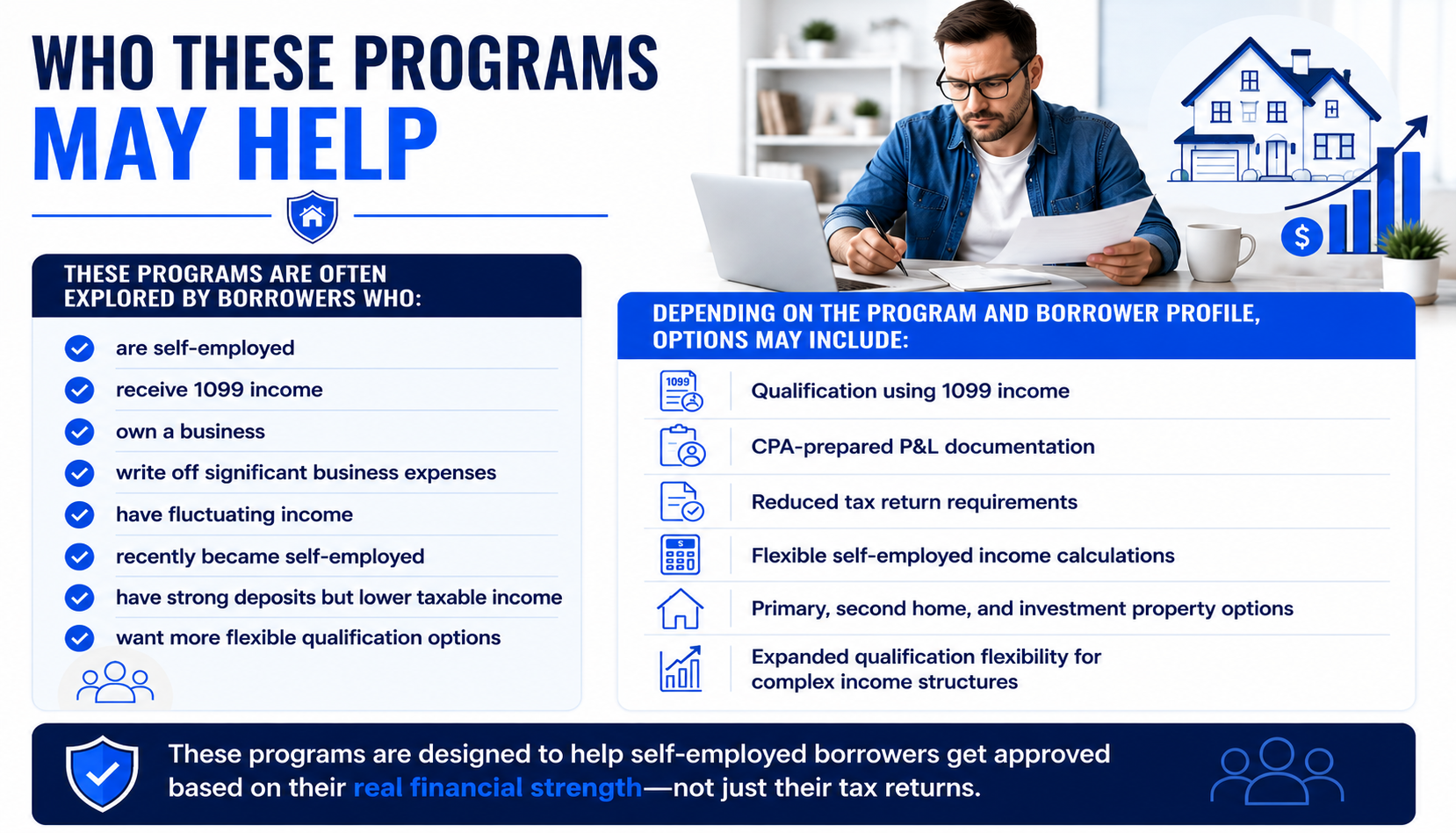
Why These Programs May Help Self-Employed Borrowers
The Goal Is Simplicity, Clarity, And Strategy
Buying a home should not feel impossible simply because your income structure differs from that of a traditional W-2 employee.
Modern buyers earn income in many different ways.
The right strategy may help create more clarity, flexibility, confidence, and options moving forward.
The key is understanding which loan strategy best aligns with your specific financial picture.
You May Have More Options Than You Realize

You May Have More Options Than You Realize
Let Us Explore What May Be Possible

Let Us Explore What May Be Possible
Not Sure Whether This Approach May Fit Your Situation
➡️ That’s exactly why we recommend scheduling a strategy call.
We’ll walk through your scenario together, review available financing options, and help you better understand which solutions may align with your income, financial profile, and long-term goals, with no pressure or obligation.
We’re Here To Help You Explore What’s Possible
If you have questions about Modern Income Qualification and Flexible Home Financing Strategies like:
➡️ 1099 & Profit & Loss (P&L) Programs
➡️ Asset Utilization Strategies
My team and I are here to help guide you through the process and help you better understand what may be possible for your situation.
We’re here to help you every step of the way, so don’t hesitate to Contact Us.
Ready To Get Started?
If you’re ready to take the next step, simply click the link below to submit your application.
Once we receive your information, my team and I will review it and reach out to schedule your personalized consultation to discuss your options and next steps.
➡️ Submit Your Application Here
➡️ Schedule Your Strategy Call Here
Best regards,
Michael Thayer, CMPS, CMA
NMLS #173264
Planet Home Lending, NMLS #17022
Explore Buyer & Seller Resources & Next Steps
+ −Market Timing vs. Market Strategy: When Is the Right Time to Buy... And More Importantly, Why?
Calculators & Loan Programs Questions Answered: Mortgage Programs & Financing Calculator
Smart Financing Strategies to Lower Your Monthly Mortgage Payment: Smart Mortgage Strategies & Financing Hacks
Homebuying Roadmap: Your Mortgage GPS
Moving To Middle Tennessee: Moving To Middle Tennessee Resource Center
Search Open Houses: View All Middle Tennessee Open Houses
Main Resource Hub: Buyers, Sellers, Realtors, and Builders Resources and Strategies
Additional Information & Reference Guides
+ −Welcome Video Transcript
+ −Video Transcript
00:00
Have you recently applied for a mortgage and been told you don't make enough money to qualify? Or maybe your income looked too low on paper.
00:08
If so, you're not alone. My name is Michael Thayer, I'm a mortgage advisor based in Nashville, Tennessee, advising clients nationwide. And honestly, the problem may not be your actual income. The reality is that many traditional mortgage guidelines were originally built around salary W-2 income structures and a standard paycheck model.
00:24
But today's workforce looks very different than it did years ago.
00:28
So, for many people who are self-employed now, business owners, independent contractors, consultants, commission-based professionals, and 1099 workers.
00:37
Especially after COVID, means that people shifted into more flexible, independent income models. So, while your tax returns may show one number, your real financial picture may tell a completely different story.
00:50
You may have strong cash flow, healthy business revenue, consistent deposits, growing income, documented access, and long-term financial stability. Yet, many financially capable buyers are still being told they don't qualify.
01:03
The good news is that there may be alternative mortgage solutions out there designed specifically for modern income situations, including 1099 and profit and loss programs. So, before you assume home ownership is out of reach, take a few minutes to explore information on this page.
01:19
And if you've already been told no, or feel like your income situation wasn't fully understood, reach out, and let's take a second look at your financial picture. Because sometimes the issue isn't that you didn't make enough money. It's possible that your income may have been evaluated through the wrong guidelines that really weren't designed for how modern income people earn their money today.
01:37
So, your income's evolved; your mortgage options and advice should evolve as well. Talk to you soon.
There Is More Than One Way To Qualify Image Overview
+ −The graphic titled "There Is More Than One Way To Qualify" highlights 1099 mortgage options tailored for independent contractors and gig workers whose income may be significant but is not reported as traditional W-2 wages.
A 1099-based review considers eligible 1099 earnings, supporting documentation, and a program-specific approach to handling expenses when calculating qualifying income. This method aligns with how the borrower is compensated while still assessing stability, credit, assets, debts, property, and reserves.
This information is particularly useful for independent sales professionals, consultants, drivers, content creators, medical contractors, tradespeople, real estate professionals, and others who receive income via Form 1099.
Lenders typically review the duration and consistency of 1099 income, year-to-date earnings, business expenses, contracts or payor relationships, credit history, assets, reserves, property type, and occupancy status.
To support the application, gather all 1099 forms, recent income statements, business records required by the program, and a detailed explanation of the work performed and how long it has been ongoing.
Ask the lender which 1099 forms are acceptable, how expenses are treated, whether income from multiple payors can be combined, and how factors like income fluctuations, gaps, or changes in contract work are assessed.
Receiving a 1099 does not automatically qualify as income. The program must confirm that the documented earnings are eligible, stable, and calculated in accordance with its guidelines.
At the application-planning stage, this image serves as a reminder to separate the way income is earned from the way a loan program is permitted to calculate it. Two people may receive identical totals on 1099 forms yet present very different files because one has several long-standing payors, another relies on one recent contract, and each carries different business expenses. A useful review therefore traces the earnings from source documents into deposits, identifies whether the work is ongoing, and tests the lender’s required expense factor instead of treating the face value of a form as automatically usable.
For someone preparing to buy, the practical value is earlier certainty. The borrower can organize the most recent two years of 1099s when available, current year-to-date evidence, bank statements that show receipt of the income, contracts or invoices when requested, and a short history of the occupation. That preparation helps the mortgage professional distinguish recurring compensation from reimbursements, one-time payments, transfers, or other deposits that may not count. It also makes it easier to identify whether a bank-statement, profit-and-loss, or traditional tax-return approach should be compared before a property is under contract.
The graphic is especially relevant for a borrower whose cash flow is healthy but whose tax documents do not resemble a fixed paycheck. It helps Realtors and buyers discuss financing before an offer is written, and it gives the loan team a disciplined framework for asking the right questions. Its purpose is educational: to show that a different documentation path may exist while preserving the full review of credit, debts, assets, reserves, property, occupancy, and ability to repay.
The limitation matters just as much as the opportunity. Program availability, minimum history, acceptable payors, expense calculations, down payment, reserves, credit standards, interest rate, and property eligibility can vary. A strong 1099 total cannot cure an unsupported income history or an otherwise ineligible file. The next step is a documented comparison using the borrower’s real records and a written explanation of the calculation, not a promise based on the image alone.
A Smarter Way To Qualify On Your Terms Image Overview
+ −The A Smarter Way To Qualify On Your Terms graphic focuses on aligning mortgage documentation with the borrower's real 1099 earning pattern instead of assuming that every applicant receives a fixed salary.
Independent work can involve several clients, seasonal peaks, project payments, commissions, platform income, and deductible business costs. A thoughtful strategy identifies which records accurately establish recurring earnings and how the selected program treats expenses.
This may help established contractors, freelancers, consultants, and commission earners who want to understand the difference between gross 1099 receipts, net business income, deposits, and usable qualifying income.
The mortgage team may compare earnings across periods, verify the business or occupation, identify nonrecurring income, account for expenses, and review the borrower's complete debts, credit, assets, and property plan.
Organize income by payor and year, reconcile 1099 forms with deposits, identify business expenses, and explain recent changes in clients, contracts, or occupation before the file enters underwriting.
Ask whether the program uses a percentage of 1099 income, what history is required, which current records supplement prior forms, and how the calculation compares with bank statement or traditional qualification.
On your terms means the strategy reflects verified facts and personal goals; it does not mean the borrower selects an income number or bypasses program requirements.
This image also supports a more precise strategy conversation about what “on your terms” should mean. It does not mean choosing whichever income figure creates the desired approval. It means selecting a documentation method that accurately reflects a verified earning pattern and then judging that method against the borrower’s payment comfort, cash available for closing, reserve goals, property plans, and expected time in the loan. That broader view helps prevent a technically possible approval from becoming an uncomfortable long-term decision.
A detailed review can begin by building a payor-by-payor timeline. The borrower can note when each relationship began, how often compensation arrives, whether payments are seasonal or project-based, and whether current work is expected to continue. The mortgage professional can then compare those facts with 1099s, deposits, invoices, contracts, and any program-required business records. If the records disagree, the discrepancy should be resolved before underwriting rather than explained after an offer deadline. This process serves contractors with changing projects, agents with commission cycles, consultants with retainers, creators with platform income, and other professionals whose revenue does not arrive in equal monthly installments.
The image’s promise is smarter alignment, not lighter scrutiny. A strong strategy may reveal that a 1099 calculation is efficient, that bank statements present the cash flow more clearly, or that traditional documentation remains the best-priced option. Comparing the estimated rate, payment, down payment, reserves, mortgage insurance or other program costs, prepayment features when applicable, and future refinance considerations is part of that decision. Documentation burden and closing timeline should be compared as well.
For the buyer, this approach creates a concrete next step: assemble consistent records, state the desired purchase and payment range, disclose all debts and properties, and ask for the exact income calculation behind each viable option. For the Realtor, it provides a stronger basis for offer timing and financing terms. For the loan team, it produces a cleaner file and a clearer list of conditions. The limitation is that personalized strategy cannot override investor guidelines or substitute for final underwriting, appraisal, title, insurance, or property approval.
Lenders Review 1099 Income Beyond Traditional Tax Returns Image Overview
+ −The Lenders Look Beyond Tax Returns graphic explains that an eligible 1099 mortgage program may consider documented contractor earnings through a method that differs from a traditional tax-return analysis.
The image highlights why a tax return with business deductions may not mirror gross contract revenue. A program may review eligible 1099 forms, current earnings evidence, deposit history, or other required documentation, then apply its own expense and stability rules.
The topic is relevant to borrowers with consistent contract work, multiple 1099 payors, commission income, or a long-term freelance business whose taxable income differs from total receipts.
Underwriting may verify the occupation, time in the line of work, continuity of earnings, payor concentration, expense assumptions, assets, debts, credit, reserves, occupancy, and property.
Keep 1099 forms, contracts when requested, year-to-date income records, business statements, and explanations consistent. Do not assume that every amount reported on a form can be counted without adjustment.
Ask what income history is needed, how current income is confirmed, what happens when one client represents most earnings, and whether the program requires a profit-and-loss statement or bank statements.
Looking beyond tax returns remains a documented underwriting process. The exact source records and calculation must meet the selected program's requirements.
The wording in this image is important because “looking beyond tax returns” can easily be misunderstood. The intended message is not that tax information is ignored or that income can be stated without proof. It is that certain programs use an alternative, defined set of documents and calculations when those rules are appropriate for the borrower. The lender still has to establish identity, employment or business activity, recurring income, assets, debts, credit, occupancy, property acceptability, and the source of funds.
A useful analysis follows the money through the file. The mortgage professional may compare 1099 totals with deposits, identify payments that are reimbursements or nonrecurring, evaluate whether current activity is consistent with prior periods, and apply the program’s treatment of business expenses. A borrower with one dominant payor may need different support from someone with many unrelated clients. A recent change in occupation, a sharp decline in receipts, unexplained gaps, or heavy reliance on a short-term contract may require additional explanation or may limit what can be used.
This image helps self-employed applicants understand why preparation is more than collecting a single form. The borrower may be asked for complete 1099s, current earnings records, business or personal bank statements, a profit-and-loss statement, contracts, invoices, or verification of the length of time in the same line of work. The exact list depends on the chosen program, so documents should be gathered only after the loan team defines the proposed path. Keeping business and personal transactions understandable and avoiding unexplained account movement during the process can reduce preventable questions.
What the graphic serves is a clearer distinction between taxable income, gross receipts, cash flow, and qualifying income. Those numbers can differ, and none should be substituted for another without the applicable calculation. The limitation is that an alternative-documentation program may carry different pricing, down-payment, reserve, credit, loan-size, occupancy, and property requirements. A borrower should review the full cost and eligibility picture, receive the calculation in plain language, and understand that final approval still depends on a complete and verified file.
Why Many Self-Employed Buyers Get Stuck Image Overview
+ −The Why Many Self-Employed Buyers Get Stuck graphic identifies the gap between strong real-world earnings and a mortgage calculation that may be reduced by write-offs, variable pay, short history, incomplete records, or an unsuitable program choice.
A borrower can become stuck when gross receipts are confused with qualifying income, business and personal funds are mixed, documentation is incomplete, income is declining, or the selected loan requires a history the borrower does not yet have. The solution is a fact-based review, not simply submitting the same incomplete file elsewhere.
Independent contractors, new or growing business owners, gig workers, and borrowers previously told that their income is too difficult to document may benefit from this overview.
The mortgage team may identify the specific reason the file does not fit, test eligible documentation paths, review recent stability, and compare the additional cash, reserves, credit, or property requirements of another option.
Ask for the calculation and the unresolved conditions in plain language. Gather missing statements and forms, reconcile discrepancies, and avoid large unexplained deposits, new debts, or account changes during the review.
Ask whether the challenge is income amount, history, documentation, expenses, credit, assets, debt, occupancy, or property eligibility—and what measurable change would be required.
A different program may help, but it may also introduce different costs or conditions. Understanding the reason for the problem is more useful than relying on a broad approval claim.
This image can be used as a diagnostic map for a borrower who has already encountered a decline or an unexpectedly low pre-approval amount. The first question is not simply, “Which lender will say yes?” It is, “Which verified requirement caused the current result?” Income may be insufficient after allowable expenses, the history may be too short, current earnings may be declining, required statements may be incomplete, the proposed property may not fit the program, or debts, credit, reserves, occupancy, or cash to close may be the real constraint.
Once the limiting condition is identified, the next step becomes measurable. A borrower may need to document a longer period of contract work, reconcile deposits with 1099s, provide a current profit-and-loss statement, separate business and personal activity, reduce a recurring obligation, preserve additional reserves, correct a factual credit-report issue, or choose a property and price range that better fits the verified profile. Sometimes a different income method solves the documentation mismatch; sometimes it does not. That distinction protects the borrower from repeated applications that create work without addressing the underlying problem.
The graphic helps independent professionals, newly self-employed buyers, Realtors, and loan teams communicate about the file in specific terms. It serves the buyer by replacing a vague rejection with an explanation and a next-step plan. It serves the Realtor by clarifying whether an offer should wait, be restructured, or proceed with different financing terms. It serves underwriting by producing consistent records and a focused response to outstanding conditions.
There are also practical cautions. Moving money between accounts, opening new credit, changing business structure, taking on a new payment, or making large undocumented deposits can create additional review during the mortgage process. The borrower should ask before making a material financial change. Alternative programs may require more down payment, reserves, documentation, or cost than traditional financing. The educational point is not that every stuck file has an immediate solution; it is that a precise diagnosis is the only responsible basis for deciding whether another program, more preparation time, or a different purchase plan is appropriate.
Why These Programs May Help Self-Employed Borrowers Image Overview
+ −The Why These Programs May Help Self-Employed Borrowers graphic summarizes the value of a documentation method designed around contract and 1099 earnings: it may recognize an eligible income stream that a standard W-2 workflow was not built to evaluate.
A 1099 program can create a structured way to review recurring contractor revenue, current earning activity, and reasonable expenses. It may reduce reliance on a tax-return figure when the program permits, while preserving credit, asset, debt, property, and underwriting safeguards.
This may be useful for established gig workers, consultants, commission professionals, and contractors with verifiable 1099 history and the credit, liquidity, and property profile required by the program.
The lender may analyze form history, current income, line-of-work continuity, business expenses, concentration among payors, credit, down payment, reserves, occupancy, and appraisal.
Compare the 1099 option with bank statement and traditional alternatives. Review estimated payment and cash requirements, not only the income calculation, and prepare complete support for every income source used.
Ask which feature of the program helps this specific file, which tradeoffs change, how income will be updated before closing, and whether another option would provide a better long-term fit.
May help is intentionally conditional. A program is useful only when the borrower and property satisfy its full requirements and the structure supports the borrower's own financial plan.
The practical benefit illustrated here is a better match between a legitimate earning pattern and a loan program designed to evaluate that pattern. For an established contractor, freelancer, consultant, or commission professional, the relevant question is whether the documentation demonstrates stable, recurring, and eligible income after the program’s required adjustments. When that answer is yes, the borrower may be able to present financial strength that was not captured well by a simple W-2 checklist.
A complete review still reaches far beyond the 1099 forms. The loan team considers the borrower’s credit history, recurring obligations, funds for down payment and closing, required reserves, occupancy, property type, appraisal, insurance, and any other program conditions. It also tests whether current earnings are consistent with the historical record and whether the work is reasonably expected to continue. Multiple payors, seasonal swings, or deductible expenses are not automatically disqualifying, but they must be understood and calculated correctly.
This image helps a buyer decide whether the potential advantage is meaningful for the actual transaction. A higher usable-income calculation may expand the price range, but the borrower should still compare the estimated payment with a personal comfort limit. The rate, fees, down payment, reserve requirement, mortgage insurance or related program costs, and possible future refinance path should be reviewed alongside the income benefit. A strategy is useful only when both qualification and long-term affordability make sense.
The graphic also serves Realtors and referral partners by providing a responsible way to discuss options without promising approval. They can encourage early document collection and direct the borrower to a full pre-approval review before relying on alternative financing in an offer. The limitation is that program names can sound broader than the actual guidelines. Some 1099 income may be ineligible, a minimum work history may apply, and the property or occupancy may fall outside the program. The final decision belongs to the underwriter after all required borrower and property information is verified.
You May Have More Options Than You Realize Image Overview
+ −The You May Have More Options Than You Realize graphic encourages 1099 borrowers to compare documented financing paths before treating one traditional calculation as the final answer.
Possible paths may include a 1099-based calculation, personal or business bank statements, asset utilization, or a property-based DSCR approach for an eligible investment. Each solves a different documentation problem and carries its own requirements. A contractor paid by several clients may need a different analysis from a borrower with one long-term payor, consistent business deposits, substantial liquid assets, or a rental property already producing documented income.
The image may help a borrower who has several income sources, significant deposits or assets, rental-property goals, or a prior decline tied to taxable income.
A complete comparison considers usable income, credit, debts, down payment, reserves, property type, occupancy, estimated payment, closing funds, and documentation burden.
Bring the whole financial picture to one strategy conversation and avoid choosing a program based only on its name. Use consistent records and explain prior application results when relevant.
Ask which options are actually available, why each one fits or does not fit, how costs differ, and which future documentation or refinance considerations should be understood.
More options do not mean unlimited options. Availability and qualification depend on verified facts, market offerings, and applicable underwriting rules.
The range of choices suggested by this image becomes useful only when each option is tied to the problem it is intended to solve. A 1099 calculation may fit documented contractor compensation; bank statements may be relevant when recurring deposits provide the clearest permitted record of business cash flow; asset utilization may help a borrower with substantial eligible assets; and DSCR financing addresses qualifying cash flow for an eligible investment property rather than personal earnings. These approaches are not interchangeable shortcuts, and a borrower may fit one while clearly not fitting another.
A disciplined comparison starts with the transaction: primary residence, second home, or investment; expected price and property type; planned down payment; funds remaining after closing; and desired payment range. It then adds the borrower’s verified income sources, business structure, credit, debts, existing properties, liquidity, and timeline. That sequence helps the mortgage professional rule out unsuitable paths quickly and spend time documenting the strongest realistic option.
This image helps borrowers who have heard conflicting advice understand why a program-by-program comparison is more useful than collecting broad promises. Ask for the income method, required history, documents, estimated rate and fees, down payment, reserves, appraisal or rent requirements, prepayment terms when relevant, and expected underwriting timeline for each alternative. The best choice may be the option with the clearest documentation and lowest total risk, not the one that produces the largest headline approval.
The graphic serves as an invitation to uncover options while maintaining guardrails. It can help a Realtor understand whether financing is ready to support an offer and can help a borrower decide what preparation remains. Its limitation is that not every product is available in every market, loan size, occupancy, or property type, and guideline or pricing changes can affect the comparison. More options should create a better-informed decision, not pressure to borrow more. Final eligibility requires current program terms and full underwriting of the borrower and property.
Let Us Explore What May Be Possible Image Overview
+ −The Let Us Explore What May Be Possible graphic closes the 1099 mortgage series with a practical invitation: organize the facts, identify the documentation challenge, compare eligible programs, and define the next step without promising a result.
Exploration begins with goals, property use, timing, income sources, available cash, reserves, debts, credit, and prior mortgage feedback. The mortgage team can then determine which questions can be answered immediately and which require documents or underwriting review. For a buyer preparing to make an offer, this early review can also identify whether changing the price range, property use, down payment, or documentation path would materially change the available options.
This is relevant to 1099 borrowers at the beginning of planning, borrowers who have been declined, and Realtors helping an independent contractor prepare before writing an offer.
The review may test traditional, 1099, bank statement, asset, or investment-property cash-flow concepts where appropriate, then identify program-specific documentation and conditions.
Complete the pre-approval document checklist, write down income sources and business structures, collect current statements and 1099 forms, and state a personal payment and cash-comfort range.
Ask what can be evaluated now, which documents are missing, what assumptions are being used, and what milestones must occur before a pre-approval, offer, or closing decision.
Possible means worthy of verified review—not guaranteed. The final decision rests on the complete borrower and property file under the selected program.
A productive exploration begins with a structured intake rather than a yes-or-no question. The borrower can describe the intended property use, target timing, preferred monthly-payment range, available funds, desired reserves after closing, current debts, credit concerns, every source of income, and any prior approval or decline. Those facts allow the mortgage professional to identify which documentation paths deserve analysis and which can be ruled out before more time is spent.
For a 1099 earner, the document discussion may include complete forms from relevant periods, current evidence of earnings, bank statements showing receipt of income, contracts or invoices when requested, business records, and an explanation of the occupation and payor relationships. The owned Mortgage Pre-Approval Document Checklist can help organize identification, income, asset, and supporting records, while the selected program determines what additional items are necessary. Consistency matters: names, dates, amounts, business entities, and account activity should tell the same story.
This image helps buyers at several stages. An early planner can learn what to organize before shopping. A borrower with a prior decline can isolate the unresolved requirement. A buyer ready to offer can confirm whether the proposed financing, property, and timeline have been reviewed closely enough to support the contract. Realtors benefit because financing assumptions become clearer, and the loan team benefits because missing information is discovered before a deadline.
The purpose of the graphic is to turn possibility into a documented decision path. The review should end with a plain-language summary of the viable method, the income calculation, estimated cash and payment, remaining conditions, and the events that could change the result. Its limitation is deliberate: exploring is not approving. Rates, product availability, credit, assets, debts, income stability, appraisal, title, insurance, property condition, occupancy, and final underwriting can all affect the outcome. A responsible next step is to verify the complete file, keep documents current, and avoid material financial changes without first discussing their possible impact.