Bank Statement Loans for Self-Employed Borrowers: Qualify for a Mortgage Without Tax Returns
Bank Statement Programs Were Designed For How Many Business Owners Actually Earn Income
Many self-employed borrowers earn high incomes… But traditional mortgage approvals often rely heavily on what you report as your taxable income shown on tax returns.
The challenge is that many business owners are also encouraged to maximize deductions and reduce taxable income for tax purposes.
As a result, borrowers who are financially capable of affording a home may appear to earn far less “on paper” than they actually do.
That’s where bank statement programs can help.
Instead of relying solely on tax returns, these programs calculate your income by evaluating your actual bank deposits and cash flow patterns, helping to create a more realistic picture of your financial strength.
For many:
- Entrepreneurs
- Self-employed professionals
- Contractors
- Consultants
- Commission-based earners
- Many others... Click here for a list of examples
This can become a much more practical path toward homeownership.
How Bank Statement Programs Work for Self-Employed Borrowers
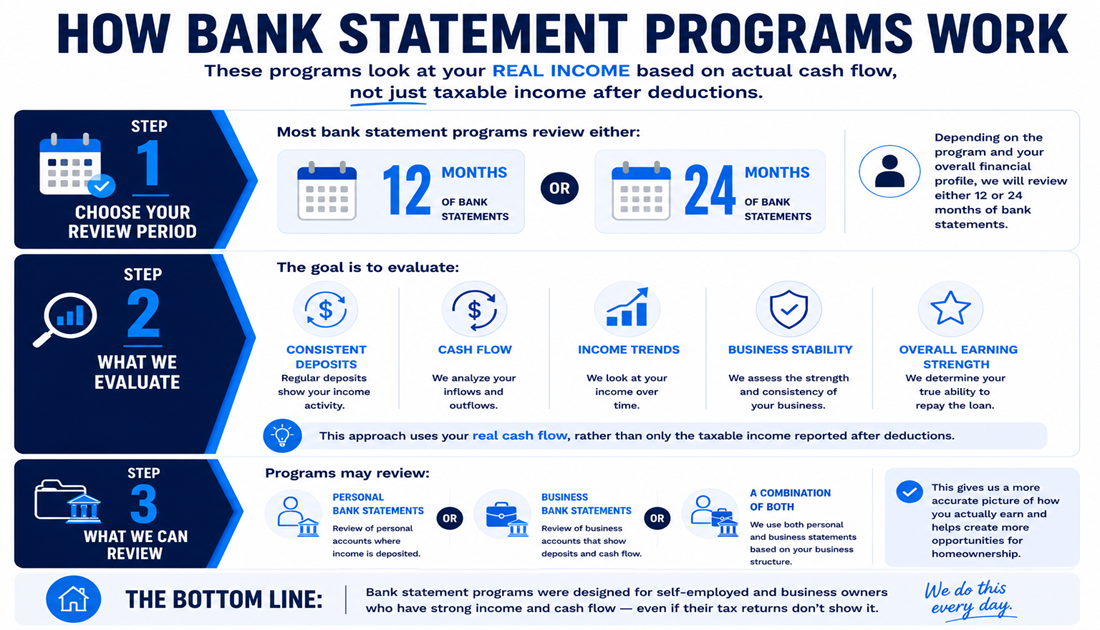
How Bank Statement Programs Work for Self-Employed Borrowers
Understanding Expense Ratios
One of the biggest questions borrowers ask is:
“If I deposit $20,000 per month… does all $20,000 count as income?”
Not necessarily.
Many bank statement programs apply an estimated business expense factor, often called an expense ratio, to help account for normal operating expenses.
For example:
- Some businesses operate with lower overhead
- Others have higher operating costs
- Certain industries may qualify for reduced expense factors depending on the business type
In some cases:
- CPA letters
- Profit & Loss statements
- Or business documentation may help support lower expense assumptions.
The good news is:
These programs were specifically designed to evaluate income differently from traditional mortgage guidelines.
That flexibility is often what helps make qualification possible for many self-employed borrowers.
Common Questions We Hear From Borrowers
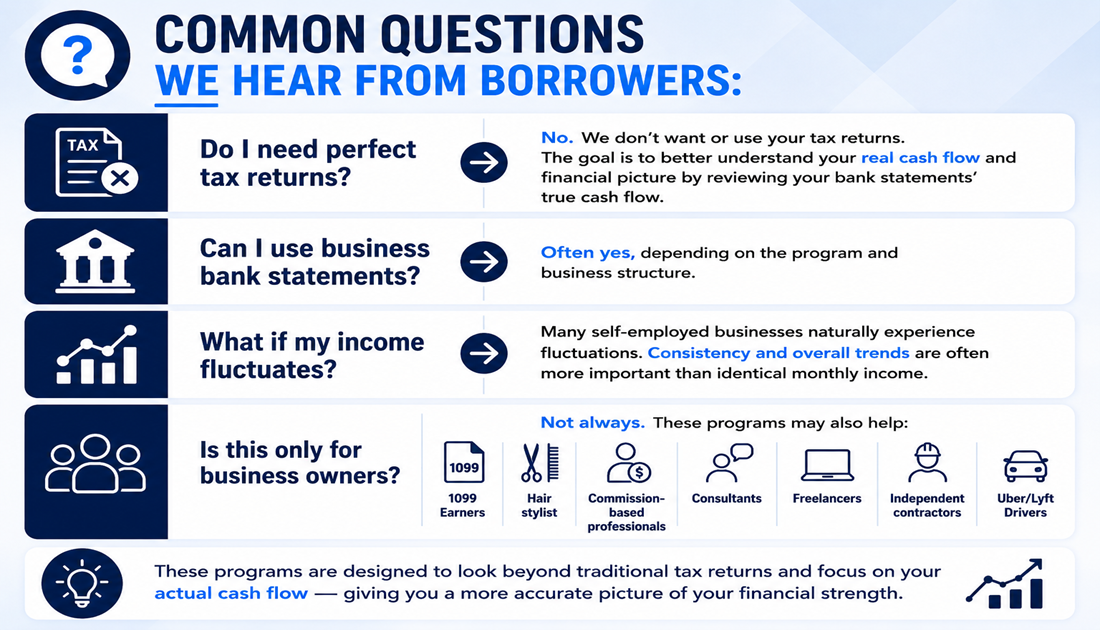
Common Questions We Hear From Borrowers
Not Sure Whether This Approach May Fit Your Situation
➡️ That’s exactly why we recommend scheduling a strategy call.
We’ll walk through your scenario together, review available financing options, and help you better understand which solutions may align with your income, financial profile, and long-term goals, with no pressure or obligation.
We’re Here To Help You Explore What’s Possible
If you have questions about Modern Income Qualification and Flexible Home Financing Strategies like:
➡️ 1099 & Profit & Loss (P&L) Programs
➡️ Asset Utilization Strategies
My team and I are here to help guide you through the process and help you better understand what may be possible for your situation.
We’re here to help you every step of the way, so don’t hesitate to Contact Us.
Ready To Get Started?
If you’re ready to take the next step, simply click the link below to submit your application.
Once we receive your information, my team and I will review it and reach out to schedule your personalized consultation to discuss your options and next steps.
➡️ Submit Your Application Here
➡️ Schedule Your Strategy Call Here
Best regards,
Michael Thayer, CMPS, CMA
NMLS #173264
Planet Home Lending, NMLS #17022
Explore Buyer & Seller Resources & Next Steps
+ −Market Timing vs. Market Strategy: When Is the Right Time to Buy... And More Importantly, Why?
Calculators & Loan Programs Questions Answered: Mortgage Programs & Financing Calculator
Smart Financing Strategies to Lower Your Monthly Mortgage Payment: Smart Mortgage Strategies & Financing Hacks
Homebuying Roadmap: Your Mortgage GPS
Moving To Middle Tennessee: Moving To Middle Tennessee Resource Center
Search Open Houses: View All Middle Tennessee Open Houses
Main Resource Hub: Buyers, Sellers, Realtors, and Builders Resources and Strategies
Additional Information & Reference Guides
+ −Welcome Video Transcript
+ −Video Transcript
00:00
If you're self-employed, a business owner, commissioner, or a 1099 professional, there's a good chance your tax returns may not fully reflect what you actually earn. And that creates one of the biggest frustrations many borrowers face today when trying to buy a home. Because the tax code often encourages business owners to maximize deductions and reduce their tax liability.
00:18
Traditional mortgage approvals often rely heavily on the income shown on those tax returns. So, even when your business is strong, your cash flow is healthy, and you can comfortably afford a home.
00:28
You may still feel like traditional financing doesn't accurately reflect your financial picture. If that sounds familiar, you're not alone. My name is Michael Thayer. I'm a mortgage advisor based in Nashville, Tennessee, serving clients nationwide, and we help self-employed borrowers navigate these complex income situations every single day. That's exactly why the Bank Statement Program was created.
00:47
Instead of relying primarily on your tax returns, these programs allow us to evaluate your actual bank deposits and cash flow patterns. Depending on the program and the lender, 12 to 24 months of bank statements will be reviewed to better understand how your business performs in the real world.
01:02
For many borrowers, this can create a more realistic path towards mortgage qualification. Now, every situation's different, different programs, different guidelines, but the bottom line is this.
01:11
Many financially capable borrowers have more mortgage options available to them than they originally thought.
01:17
So, go through this page, and I'll walk you through how bank statement programs work, who they are best fit for, and common questions asked by borrowers. And if you'd like to help navigate and review in your personal situation, just schedule a strategy call, and we'll walk through your options together.
01:31
Because sometimes, the issue isn't whether you can earn, if you earn enough income, it's whether or not the income is being evaluated the right way. Talk to you soon.
How Bank Statement Programs Work for Self-Employed Borrowers Image Overview
+ −The How Bank Statement Programs Work graphic explains how an eligible bank statement mortgage may use documented deposits and a program-defined expense calculation to evaluate self-employed cash flow when tax returns do not fully reflect current earning activity.
A bank statement program generally reviews a specified period of personal or business account statements. The analysis identifies potentially qualifying deposits and separates transfers, borrowed funds, one-time receipts, and other amounts that may not represent recurring income. When business statements are used, an expense factor or documented expense analysis may be applied before a monthly qualifying figure is calculated. The exact method varies and should be confirmed before documents are submitted.
Business owners, sole proprietors, consultants, commission earners, independent contractors, and other self-employed borrowers may find this useful when substantial legitimate deductions reduce taxable income. It can also help a Realtor understand why a bank statement pre-approval may require different records and timing than a W-2 file.
The lender may review deposit consistency, business type, ownership percentage, commingled funds, declining or seasonal activity, overdrafts, unusual deposits, existing debts, credit, assets, reserves, down payment, occupancy, and property eligibility. Gross account activity is not automatically qualifying income.
Gather every page of the requested statements, keep business and personal funds clearly organized, identify recurring transfers, and prepare support for large or unusual deposits. Know the legal business name, ownership structure, years in operation, and normal expense pattern.
Ask whether personal or business statements are appropriate, how many months are required, which deposits are excluded, what expense method applies, and whether a profit-and-loss statement or business verification is needed.
Bank statement financing is an alternative documentation approach, not a no-document loan. The program must still establish qualifying income, assets, credit, property eligibility, and repayment ability under its guidelines.
In the context of “Bank Statement Loans for Self-Employed Borrowers: Qualify for a Mortgage Without Tax Returns,” How Bank Statement Programs Work highlights the income, asset, credit, debt, property, occupancy, reserve, and documentation facts that the image is designed to organize so the reader can see why this portion of the page matters. The existing copy states, “The exact method varies and should be confirmed before documents are submitted.” That sentence is image-specific evidence, not filler: it explains the pressure, opportunity, or misunderstanding the visual is meant to surface and gives the rest of the discussion a concrete foundation. The “how” behind How Bank Statement Programs Work begins with matching verified borrower and property facts to the selected program, documenting the calculation, comparing cash and payment requirements, and resolving conditions before a deadline. Rather than treating the image as a stand-alone conclusion, the reader can test its message against the current file, timeline, and objective described on “Bank Statement Loans for Self-Employed Borrowers: Qualify for a Mortgage Without Tax Returns.” This creates a usable chain from what the artwork says, to what must be verified, to the next decision and the person responsible for it. The intended audience is not everyone in the abstract; it is borrowers with the income pattern, property goal, or documentation question depicted, together with Realtors who need dependable financing context before an offer. For those readers, the How Bank Statement Programs Work visual can reveal a question they did not know to ask or a condition they had underestimated.
Common Questions We Hear From Borrowers Image Overview
+ −The Common Questions We Hear From Borrowers graphic organizes the practical issues self-employed buyers often raise about bank statement loans: whether tax returns are required, which accounts may be used, how deposits become qualifying income, and what happens when business expenses or monthly revenue vary.
The image is a reminder that the answer depends on the specific program. Some approaches use personal statements, others use business statements, and the treatment of transfers, payment-platform deposits, seasonal revenue, cash deposits, expense factors, and multiple businesses may differ. A careful review should trace recurring income to complete statements and avoid counting the same funds twice.
This information is useful for borrowers who own more than one business, deposit revenue through several accounts, receive income through payment processors, move money between business and personal accounts, or have a seasonal sales cycle. It may also help buyers who are comparing a bank statement option with a traditional loan.
The mortgage team may need to verify self-employment, account ownership, business ownership percentage, the source and recurrence of deposits, business expenses, credit, funds for closing, reserves, occupancy, and the selected property. Consistency between the application, statements, business records, and explanations matters.
Create a simple account map showing what each account is used for, where customers pay, which transfers are internal, and which expenses are paid from each account. Provide requested statements without missing pages and avoid unexplained financial changes while the file is being reviewed.
Ask how irregular months are averaged, how negative balances or overdrafts are treated, whether multiple accounts can be combined, how ownership percentage affects the calculation, and what documentation must be updated before closing.
A bank statement calculation can differ materially from gross sales, taxable income, or the amount visible in one recent month. Only the approved program calculation determines usable income for that file.
“Common Questions We Hear From Borrowers” is more than a caption inside “Bank Statement Loans for Self-Employed Borrowers: Qualify for a Mortgage Without Tax Returns.” It gives the reader a visual starting point for interpreting the income, asset, credit, debt, property, occupancy, reserve, and documentation facts that the image is designed to organize. One particularly useful line in the existing explanation is: “The image is a reminder that the answer depends on the specific program.” Read in context, that detail shows why the issue can affect preparation, expectations, and the quality of the next conversation instead of remaining a vague piece of advice. The visual becomes operational when its message is translated through matching verified borrower and property facts to the selected program, documenting the calculation, comparing cash and payment requirements, and resolving conditions before a deadline. On “Bank Statement Loans for Self-Employed Borrowers: Qualify for a Mortgage Without Tax Returns,” that means identifying the exact issue pictured, gathering the supporting information, and comparing the result with the reader’s stated goal. This method helps prevent a broad educational message from being mistaken for individualized advice or a finished approval. This image is most relevant to borrowers with the income pattern, property goal, or documentation question depicted, together with Realtors who need dependable financing context before an offer. It helps them identify whether the situation shown resembles their own and whether the next conversation should be exploratory, document-driven, or decision-ready.