Weekly Mortgage Market and Rate Update – August 10, 2026
Current Mortgage Rates Get Some Relief as Job Growth Slows
Updated August 10, 2026
What Is the Market Doing?
Mortgage rates got some relief late last week after several reports showed that the job market is slowing.
Friday’s jobs report showed that the economy lost 23,000 jobs in July. Earlier job totals for May and June were also lowered by a combined 103,000 jobs. Wage growth cooled too.
Why does this matter? A weaker job market can reduce inflationary pressure and make another Federal Reserve rate increase less likely. That helped mortgage bonds improve and gave rates some breathing room.
Why did some of that improvement fade?
Oil prices moved higher again on Monday as talks involving Iran and the Strait of Hormuz failed to make progress.
Higher oil prices can raise the cost of fuel, shipping, and everyday goods. That can keep inflation higher. Mortgage bonds moved lower on Monday, giving back some of Friday’s improvement.
Mortgage bonds and mortgage rates usually move in opposite directions. When bonds improve, rates may move lower. When bonds fall, rates may come under pressure.
What does the bond chart tell us?
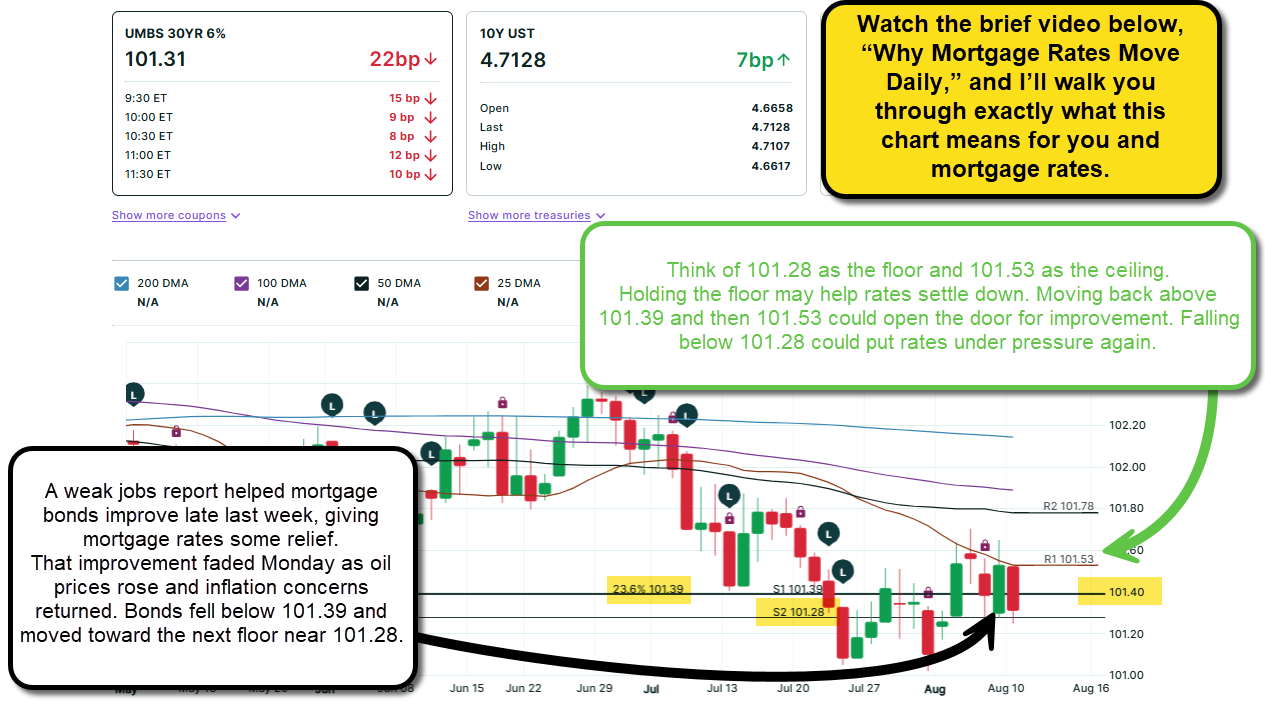
Mortgage bonds slipped below 101.39 and are now testing the next floor near 101.28.
Think of 101.28 as the floor under the market. If bonds hold that floor, rate conditions may settle down.
Bonds need to move back above 101.39 first. The next important ceiling is near 101.53. Moving above that ceiling would be a better sign for lower rates.
- Holding 101.28 may help rates stabilize.
- Moving back above 101.39, then 101.53, could give rates room to improve.
- Falling below 101.28 could push rates higher.
These are levels to watch, not promises about where rates will go.
What are we watching this week?
Inflation is now the biggest story.
Wednesday brings the Consumer Price Index, or CPI. This report measures how prices are changing for consumers.
Thursday brings the Producer Price Index, or PPI. This report measures the costs businesses face. Friday brings retail sales and consumer sentiment.
Cooler inflation could help bonds and mortgage rates improve. Hotter inflation could push rates higher. Oil prices and events in the Middle East remain important too.
Bottom line
Weak job growth gave mortgage rates some relief, but rising oil prices took back part of that improvement.
Mortgage bonds are now testing the 101.28 floor. This week’s inflation reports may decide whether bonds recover toward the 101.53 ceiling or move lower again.
If you are wondering what these market changes mean for your plans, call or message me. I will explain what matters without all the confusing market talk.
Mortgage Bond Market: Updated on 8-10-26
Mortgage Bond Market: Updated on 8-10-26
Watch the Trend, Not the Headline Rate
Below you’ll find the National Average Mortgage Rates as published for industry reference. These rates are for illustration only and reflect recently closed loans, not current market rates. Use this only for a general trend indicator. Your actual rate will depend on your financial profile and local market conditions, which is why getting pre-approved before you start shopping is key.
National Rate Averages
Historical Trend
Source: Optimal Blue Mortgage Market Indices (OBMMI). Indices reflect aggregate rate lock data. Learn more.
See What’s Happening: Locally & Nationally
The market moves fast. These two updates give you the clarity to stay ahead, so you can make confident, well-timed decisions, whether you’re buying, selling, or waiting.
MISSED A PREVIOUS WEEK'S UPDATE? CATCH UP HERE:
+ −Weekly Mortgage Market and Rate Update on 8-3-26
Weekly Mortgage Market and Rate Update on 7-28-26
Weekly Mortgage Market and Rate Update on 7-22-26
Weekly Mortgage Market and Rate Update on 7-15-26
Weekly Mortgage Market and Rate Update on 7-7-26
Weekly Mortgage Market and Rate Update on 6-30-26
Weekly Mortgage Market and Rate Update on 6-23-26
Weekly Mortgage Market and Rate Update on 6-16-26
Weekly Mortgage Market and Rate Update on 6-9-26
Weekly Mortgage Market and Rate Update on 6-2-26
Weekly Mortgage Market and Rate Update on 5-26-26
Weekly Mortgage Market and Rate Update on 5-19-26
Weekly Mortgage Market and Rate Update on 5-12-26
Weekly Mortgage Market and Rate Update on 5-6-26
Weekly Mortgage Market and Rate Update on 4-27-26
Weekly Mortgage Market and Rate Update on 4-22-26
WE'RE HERE TO HELP
If you have any questions or need more information about our affordable home financing solutions, please don’t hesitate to CONTACT ME. My team and I are here to help you every step of the way!
Ready to start your home journey? Click here to submit your loan application today!
Best regards,
Michael Thayer, CMPS, CMA
NMLS #173264
Planet Home Lending, NMLS #17022
Explore Buyer & Seller Resources & Next Steps
Market Timing vs. Market Strategy: When Is the Right Time to Buy... And More Importantly, Why?
Calculators & Loan Programs Questions Answered: Mortgage Programs & Financing Calculator
Smart Financing Strategies to Lower Your Monthly Mortgage Payment: Smart Mortgage Strategies & Financing Hacks
Homebuying Roadmap: Your Mortgage GPS
Moving To Middle Tennessee: Moving To Middle Tennessee Resource Center
Search Open Houses: View All Middle Tennessee Open Houses
Main Resource Hub: Buyers, Sellers, Realtors, and Builders Resources and Strategies
Video Transcripts
+ −Mortgage rates change every day, but most people don’t understand why… Or what it actually means for them. This page (updated weekly) is designed to simplify everything. In this video, you’ll learn:
- How to track mortgage rate trends
- What’s happening in the bond market
- The simple “teeter-totter” relationship between mortgage bonds and rates
- What’s driving rate movement (inflation, economic data, market reactions)
Whether you're:
- A homebuyer (first-time or moving up)
- A Realtor or builder advising clients
- A real estate investor
This resource helps you stay ahead of the market and make more confident decisions. You’ll also find:
- Local Nashville market data
- National housing trends
- Weekly outlooks on where rates may be heading next
Bookmark this page and check back weekly to stay informed.
- Go to: www.michaelthayer.com
- Scroll down to "Weekly Mortgage Market and Rate Update"
- Save the link to check back for the weekly updates.
Have questions or want a breakdown for your local market? Reach out; I am happy to help.
Why Rates Move Daily:
Alright, before we get into this, let me be very clear: if anyone is telling you mortgage rates move for some random reason or pointing to anything other than what I’m about to explain, they’re wrong; you’re talking to the wrong person. Mortgage rates are driven by two core factors: inflation and the economic data that impacts it, and more specifically, how those factors influence the way mortgage bonds trade on Wall Street. That’s what ultimately drives the rates you and I see every day, and it really is that simple. Some people point to the 10-year Treasury as an indicator, and while it can be helpful, it doesn’t always tell the full story and can be misleading at times. Most people can’t explain this clearly, and that’s why this exists: to break it down simply so you finally have clarity. It can feel confusing because it’s counterintuitive, but once you understand that it works in the opposite way you might expect, it becomes much easier. Think of it like a teeter-totter: when one side goes up, the other side comes down, and that’s exactly how mortgage bonds and mortgage rates behave. What you’re looking at in a bond chart is daily movements shown as candlesticks; each bar represents one full day of trading. Green is good, meaning bonds improved and rates typically move lower; red is bad, meaning bonds declined and rates move higher. Now tie that back to the teeter-totter. When bond yields improve, rates get better; when bond yields decline, rates get worse. The biggest factor influencing all of this is inflation, because inflation erodes the value of bonds over time. When inflation rises or is expected to rise, bonds struggle, and when bonds struggle, mortgage rates increase. When inflation cools, bonds improve, and rates can move lower. So if you’re watching one thing, watch inflation; it’s the key driver. If inflation comes in higher than expected, expect rates to rise; if it cools, rates can improve. The good news is you don’t have to figure this out on your own. I break this down and update it every week, so you can understand the trend, see what’s happening, and make better decisions. Most people fear what they don’t understand, and that costs them money, but when you have clarity, you make stronger, more confident decisions. Use this as your resource, come back to it, and if you have questions, reach out. I’m here to help make sense of it all.