VA Home Loans Explained
Who They're Best For, How They Work, and When They May Make Sense

Who They're Best For, How They Work, and When They May Make Sense
Built to Reward Those Who Served
A VA home loan is one of the most valuable mortgage benefits available to eligible veterans, active-duty service members, and many surviving spouses. Backed by the U.S. Department of Veterans Affairs, VA loans make homeownership more affordable by allowing qualified buyers to purchase with no down payment, no monthly mortgage insurance, and flexible credit guidelines.
Whether you are buying your first home, relocating to Middle Tennessee, or purchasing after military service, a VA loan may provide significant long-term savings compared to many other financing options.
Is This Loan Right For You?
A VA loan may be an excellent option if you:
➡️ Are an eligible veteran, active-duty service member, National Guard member, Reservist, or qualifying surviving spouse
➡️ Want to purchase with little or no down payment
➡️ Want to avoid monthly mortgage insurance
➡️ Prefer lower monthly housing costs
➡️ Want competitive interest rates
➡️ Plan to occupy the property as your primary residence
Who Is A VA Home Loan Best For

Who Is A VA Home Loan Best For
Why Buyers Choose a VA Home Loan

Why Buyers Choose a VA Home Loan
Real World Example
A buyer purchasing a $450,000 home may qualify for a VA loan with no down payment and no monthly mortgage insurance (MI). Compared with many other loan programs, this can significantly reduce the upfront cash needed to buy a home while preserving more savings for other financial priorities. The example below illustrates how these benefits may impact a buyer's overall financing strategy.
Compare Conventional, FHA, USDA & VA Payments Side by Side
Compare Conventional, FHA, USDA & VA Payments Side by Side
Mortgage Payment Comparison — Documentation Calculations and Planning Details
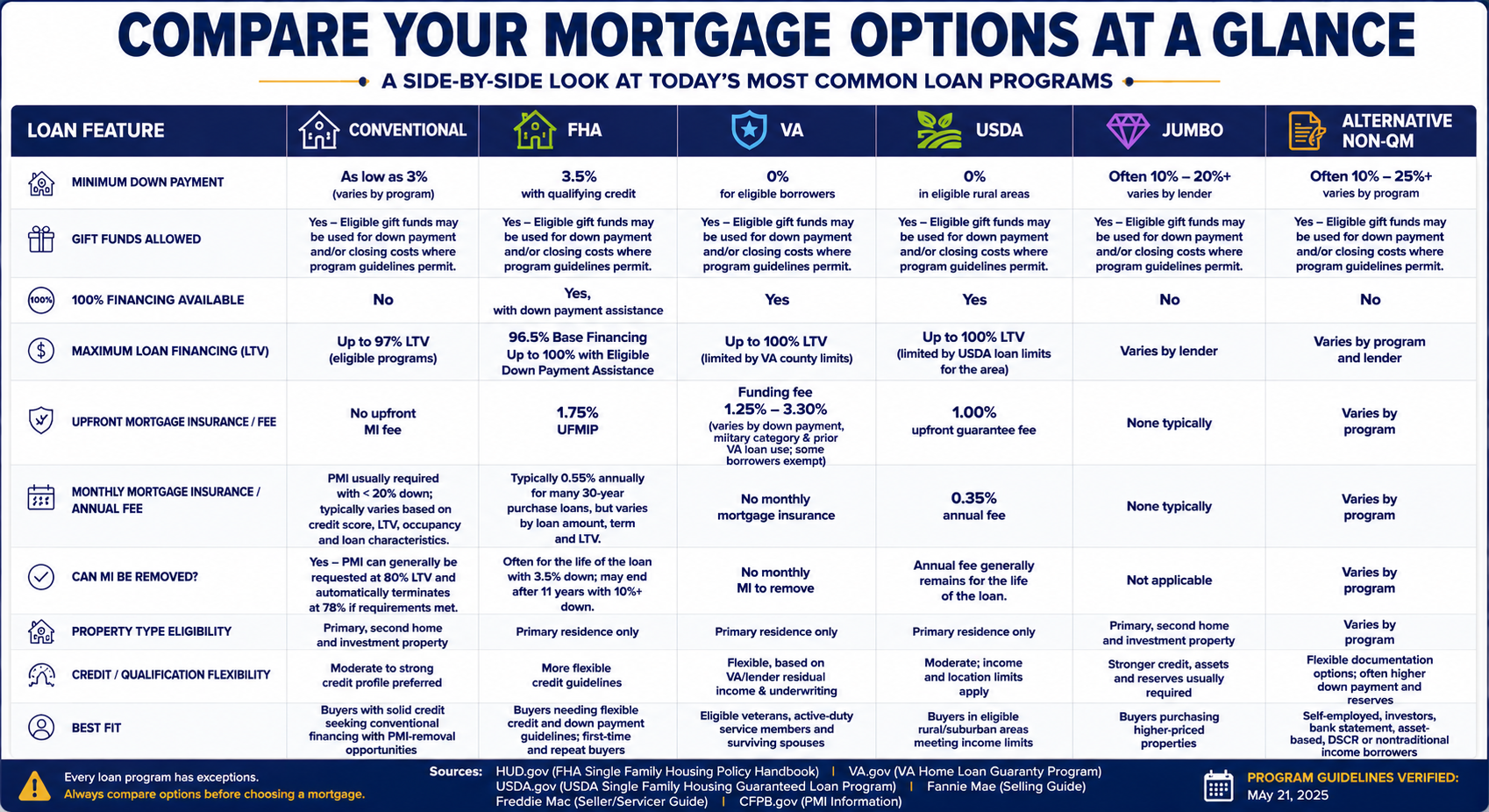
Mortgage Payment Comparison — Documentation Calculations and Planning Details
Common VA Misconceptions
Many veterans and military families are surprised to learn that several widely repeated statements about VA home loans simply are not true.
Examples include:
❌ VA loans take longer to close than Conventional loans.
❌ Sellers will not accept VA-financed offers.
❌ You can only use your VA home loan benefit once.
❌ VA loans require a down payment.
❌ VA loans are only for first-time homebuyers.
➡️ Explore Common Myths & Misconceptions About VA Home Loans
Put the VA Loan Guidelines to Work
Use the calculator below to estimate your potential purchase price range and monthly payment based on the income, debts, down payment, and loan terms we just reviewed.
Tip: Click the Full Screen button in the bottom-right corner for the best viewing experience.
Still Have Questions About VA Home Loans?
VA home loans are among the most valuable benefits available to eligible veterans, active-duty service members, and many surviving spouses, yet they are also among the most misunderstood. Many buyers are unsure who qualifies, how the VA funding fee works, whether the benefit can be used more than once, or if a VA loan is the right choice compared to other financing options.
Our comprehensive VA Home Loan FAQ Guide answers the questions buyers ask most often, including eligibility requirements, Certificates of Eligibility (COEs), no-down-payment financing, the VA funding fee, funding fee exemptions, occupancy requirements, seller concessions, gift funds, refinancing options, appraisal requirements, and much more.
Whether you're purchasing your first home, relocating to Middle Tennessee, or comparing a VA loan with Conventional, FHA, or USDA financing, this guide provides clear, straightforward answers to help you make a confident home-buying decision.
The more you understand your VA benefits, the more value you can get from them.
Ready To Get Started
Whether you are purchasing your first home after military service or using your VA benefit again, choosing the right financing starts with understanding your options.
Together, we will review your eligibility, estimate your payment, compare financing scenarios, and build a mortgage strategy that supports your long-term financial goals.
Schedule your personalized mortgage consultation today to see how a VA home loan could help you buy with confidence.
Sometimes, a 10-minute conversation before you write an offer can save weeks of frustration later.
➡️ Schedule Your Personalized Mortgage Strategy Consultation
No pressure. No obligation. Just personalized guidance designed around your goals.
Best regards,
Michael Thayer, CMPS, CMA
NMLS #173264
Planet Home Lending, NMLS #17022
Continue Building Your Home-Buying Knowledge
Choosing the right mortgage is only one piece of a successful home-buying journey. Understanding financing, affordability, monthly payments, today's housing market, and the overall home-buying process can help you make more informed financial decisions with greater confidence at every step.
This guide is part of the Middle Tennessee Mortgage Knowledge Series, a growing educational library designed to help home-buyers compare mortgage programs, understand financing options, explore payment strategies, and navigate the home-buying process with clarity and confidence.
The recommended resources displayed alongside this guide have been selected to help you take the next step based on where you are in your home-buying journey. Whether you are comparing mortgage programs, exploring affordability strategies, researching today's housing market, preparing to make an offer, or planning for closing day, our goal is to provide clear, straightforward education at every step.
Explore Buyer & Seller Resources & Next Steps
+ −Market Timing vs. Market Strategy: When Is the Right Time to Buy... And More Importantly, Why?
Calculators & Loan Programs Questions Answered: Mortgage Programs & Financing Calculator
Smart Financing Strategies to Lower Your Monthly Mortgage Payment: Smart Mortgage Strategies & Financing Hacks
Homebuying Roadmap: Your Mortgage GPS
Moving To Middle Tennessee: Moving To Middle Tennessee Resource Center
Search Open Houses: View All Middle Tennessee Open Houses
Main Resource Hub: Buyers, Sellers, Realtors, and Builders Resources and Strategies
Additional Information & Reference Guides
+ −Who They're Best For, How They Work, and When They May Make Sense Image Overview
+ −What this image communicates
“Who They're Best For, How They Work, and When They May Make Sense” establishes the visual entry point for this part of “VA Home Loans Explained.” Its primary visual message framing helps the reader understand how to make one topic recognizable at a glance and give the reader a clear entry point into the deeper explanation on the page. The decision underneath the graphic is whether the loan structure fits the borrower's documented finances, property, occupancy, cash plan, and longer-term goals. The image frames “Who They're Best For, How They Work, and When They May Make Sense” as a question that cannot be answered responsibly from a slogan. Its visual emphasis is an invitation to test the premise against the reader's actual property, finances, timing, and goals. That question-led design is useful because it creates a pause between interest and action and makes the missing evidence easier to name.
Why it belongs on this page
The VA page is for eligible service members, veterans, and qualifying surviving spouses evaluating the VA guaranty. The primary visual message role of “Who They're Best For, How They Work, and When They May Make Sense” is the reason this image belongs at this point in “VA Home Loans Explained.”
The exact story carried by this graphic
The opening VA panel is for a borrower who may have earned a VA home-loan benefit through qualifying service or survivor status. It should connect that benefit with entitlement, Certificate of Eligibility, occupancy, residual-income analysis, funding fee treatment, property standards, appraisal, and lender pricing. The visual's purpose is not to say every veteran should choose VA; it is to ensure the VA scenario is compared fairly, including zero-down potential, seller concessions, cash reserves, and long-term cost.
How a reader can use it
Use “Who They're Best For, How They Work, and When They May Make Sense” for its stated primary visual message job on “VA Home Loans Explained.” Identify the claim, chart, comparison, process, property feature, or strategy shown and connect it to the exact decision the page addresses. The working notes for this panel should record the literal claim or comparison shown, the page fact it supports, the source behind that fact, and the decision the reader should make next. That record lets the reader compare the complete financing structure instead of choosing by rate or down payment alone without asking this image to answer a different stage of the decision.
What still must be verified
The explanation around “Who They're Best For, How They Work, and When They May Make Sense” must remain inside the evidence available for this page. The image is educational and cannot establish eligibility, approval, pricing, appraisal acceptability, or the final terms shown on loan disclosures. The “Who They're Best For, How They Work, and When They May Make Sense” visual supports a better-informed conversation, while the actual decision remains tied to current evidence and the people authorized to interpret it. On “VA Home Loans Explained,” that safeguard applies specifically to the primary visual message role assigned to “Who They're Best For, How They Work, and When They May Make Sense.”
Who Is A VA Home Loan Best For Image Overview
+ −What this image communicates
“Who Is A VA Home Loan Best For” establishes the visual entry point for this part of “VA Home Loans Explained.” Its primary visual message framing helps the reader understand how to make one topic recognizable at a glance and give the reader a clear entry point into the deeper explanation on the page. The decision underneath the graphic is whether the loan structure fits the borrower's documented finances, property, occupancy, cash plan, and longer-term goals. The image frames “Who Is A VA Home Loan Best For” as a question that cannot be answered responsibly from a slogan. Its visual emphasis is an invitation to test the premise against the reader's actual property, finances, timing, and goals. That question-led design is useful because it creates a pause between interest and action and makes the missing evidence easier to name.
Why it belongs on this page
Its images cover borrower fit, reasons buyers choose VA financing, and a payment comparison. The primary visual message role of “Who Is A VA Home Loan Best For” is the reason this image belongs at this point in “VA Home Loans Explained.”
How a reader can use it
Use “Who Is A VA Home Loan Best For” for its stated primary visual message job on “VA Home Loans Explained.” Identify the claim, chart, comparison, process, property feature, or strategy shown and connect it to the exact decision the page addresses. The working notes for this panel should record the literal claim or comparison shown, the page fact it supports, the source behind that fact, and the decision the reader should make next. That record lets the reader compare the complete financing structure instead of choosing by rate or down payment alone without asking this image to answer a different stage of the decision.
What still must be verified
The final safeguard is verification. The image is educational and cannot establish eligibility, approval, pricing, appraisal acceptability, or the final terms shown on loan disclosures. A reader should leave “Who Is A VA Home Loan Best For” knowing what to ask and what to gather—not believing that a graphic has already supplied an approval, valuation, legal conclusion, or guaranteed outcome. On “VA Home Loans Explained,” that safeguard applies specifically to the primary visual message role assigned to “Who Is A VA Home Loan Best For.”
Why Buyers Choose a VA Home Loan Image Overview
+ −What this image communicates
The visible message in “Why Buyers Choose a VA Home Loan” directs attention to mortgage-program comparison on “VA Home Loans Explained.” The image functions as a primary visual message: it should make one topic recognizable at a glance and give the reader a clear entry point into the deeper explanation on the page. That gives the reader a specific reason to slow down before acting. The image frames “Why Buyers Choose a VA Home Loan” as a question that cannot be answered responsibly from a slogan. Its visual emphasis is an invitation to test the premise against the reader's actual property, finances, timing, and goals. That question-led design is useful because it creates a pause between interest and action and makes the missing evidence easier to name.
Why it belongs on this page
The reader needs to connect entitlement, occupancy, funding fee treatment, residual-income analysis, property standards, appraisal, credit and debt review, seller concessions, and lender pricing before deciding how the benefit fits the purchase. The primary visual message role of “Why Buyers Choose a VA Home Loan” is the reason this image belongs at this point in “VA Home Loans Explained.”
How a reader can use it
Use “Why Buyers Choose a VA Home Loan” for its stated primary visual message job on “VA Home Loans Explained.” Identify the claim, chart, comparison, process, property feature, or strategy shown and connect it to the exact decision the page addresses. The working notes for this panel should record the literal claim or comparison shown, the page fact it supports, the source behind that fact, and the decision the reader should make next. That record lets the reader compare the complete financing structure instead of choosing by rate or down payment alone without asking this image to answer a different stage of the decision.
What still must be verified
Keep the visual in its proper role. The image is educational and cannot establish eligibility, approval, pricing, appraisal acceptability, or the final terms shown on loan disclosures. If a later disclosure, source update, appraisal, inspection, title item, program rule, or contract term conflicts with “Why Buyers Choose a VA Home Loan,” the current controlling evidence takes priority. On “VA Home Loans Explained,” that safeguard applies specifically to the primary visual message role assigned to “Why Buyers Choose a VA Home Loan.”
Mortgage Payment Comparison — Documentation Calculations and Planning Details Image Overview
+ −What this image communicates
The “Mortgage Payment Comparison — Documentation Calculations and Planning Details” image turns the central issue on “VA Home Loans Explained” into a visible evidence and calculation layer. It is there to separate measurable inputs from assumptions and reveal which figures or documents control the comparison, while the page supplies the evidence and explanation needed to evaluate whether the loan structure fits the borrower's documented finances, property, occupancy, cash plan, and longer-term goals. The visual uses a side-by-side comparison to separate “Mortgage Payment Comparison” into alternatives that should not be treated as interchangeable. Its layout asks the reader to compare structure, cost, timing, eligibility, and consequence—not select a winner from one headline number. The comparison is therefore a decision aid, with each column pointing to a different fact that must be confirmed.
Why it belongs on this page
The VA page is for eligible service members, veterans, and qualifying surviving spouses evaluating the VA guaranty. The evidence and calculation layer role of “Mortgage Payment Comparison” is the reason this image belongs at this point in “VA Home Loans Explained.”
How a reader can use it
Use “Mortgage Payment Comparison” for its stated evidence and calculation layer job on “VA Home Loans Explained.” Write down every input, source, date, unit, estimate, and unresolved condition before relying on a calculation or side-by-side result. The working notes for this panel should record each number, unit, source, date, estimate, document, calculation method, and unresolved input that could change the comparison. That record lets the reader compare the complete financing structure instead of choosing by rate or down payment alone without asking this image to answer a different stage of the decision.
What still must be verified
The explanation around “Mortgage Payment Comparison” must remain inside the evidence available for this page. The image is educational and cannot establish eligibility, approval, pricing, appraisal acceptability, or the final terms shown on loan disclosures. The “Mortgage Payment Comparison — Documentation Calculations and Planning Details” visual supports a better-informed conversation, while the actual decision remains tied to current evidence and the people authorized to interpret it. On “VA Home Loans Explained,” that safeguard applies specifically to the evidence and calculation layer role assigned to “Mortgage Payment Comparison.”
Recommended Resources
+ −Mortgage Programs & Financing Calculator Center
Mortgage Programs & Financing Calculator Center
Smart Mortgage Strategies & Financing Hacks
Smart Mortgage Strategies & Financing Hacks
Your Step-by-Step Roadmap to a Smoother Home Purchase
Your Step-by-Step Roadmap to a Smoother Home Purchase
Income Documentation Guide for Mortgage Pre-Approval
Income Documentation Guide for Mortgage Pre-Approval
Townhouse vs. Condo: Ownership, Costs and Financing Differences
Townhouse vs. Condo: Ownership, Costs and Financing Differences
Should You Buy a Home Now or Wait? A Market Strategy Guide
Should You Buy a Home Now or Wait? A Market Strategy Guide
Low Down Payment Homebuying Options: What Buyers Should Know
Low Down Payment Homebuying Options: What Buyers Should Know
Middle Tennessee Relocation & Home Buying Guide
Middle Tennessee Relocation & Home Buying Guide
Renovation Loan Options for Homes That Need Improvements
Renovation Loan Options for Homes That Need Improvements
Your Current House Shouldn't Cost You The Next One
Your Current House Shouldn't Cost You The Next One
Recommended Resources Guides
+ −Homebuyer Mortgage & Financing Resource Center Overview
+ −Choosing a mortgage is about far more than simply finding the lowest interest rate. Every homebuyer has a unique financial situation, long-term goals, available down payment, credit profile, income structure, and future plans. The Mortgage Loan & Financing Resource Center was created to help buyers understand the differences between today's most popular home loan programs so they can confidently choose the financing option that best supports their goals.
This educational image represents a centralized learning hub where buyers can explore mortgage loan programs, compare financing options, understand qualification requirements, estimate monthly payments, and receive clear answers to common mortgage questions. Rather than focusing on sales, this Resource Center is designed to provide practical education that empowers buyers to make informed financial decisions before submitting an offer on a home.
Within this Resource Center, visitors can explore detailed educational guides covering Conventional loans, FHA loans, VA loans, USDA loans, Jumbo financing, renovation loans, first-time homebuyer programs, low down payment options, down payment assistance programs, self-employed financing, Non-QM loans, DSCR investment financing, bank statement loans, asset qualification programs, and many other specialized mortgage solutions.
The goal is to simplify what is often one of the most confusing parts of the home-buying process by breaking complex lending guidelines into easy-to-understand explanations that help buyers not only identify which loan programs exist but also understand why one option may be a better fit than another.
What This Graphic Teaches
This Resource Center helps buyers understand the complete mortgage financing process by explaining topics such as:
➡️ The differences between FHA, Conventional, VA, USDA, Jumbo, and specialty mortgage programs.
➡️ Minimum down payment requirements for various loan options.
➡️ Credit score guidelines and qualification requirements.
➡️ Debt-to-income ratio considerations.
➡️ Loan limits and financing eligibility.
➡️ Closing costs and cash-to-close expectations.
➡️ Monthly payment comparisons between different financing strategies.
➡️ Permanent rate buydowns and payment reduction opportunities.
➡️ Mortgage insurance requirements and how they differ by loan type.
➡️ Financing options for self-employed borrowers, 1099 income, business owners, investors, and non-traditional income sources.
➡️ Renovation financing that combines the purchase price and renovation costs into one mortgage.
➡️ Frequently asked mortgage questions that buyers commonly ask throughout the home-buying process.
Rather than presenting generic information, each guide is designed to answer real-world questions buyers ask every day while providing practical examples and side-by-side comparisons whenever possible.
Why This Matters To Buyers
The mortgage you choose can impact your monthly payment, upfront cash required, borrowing power, future refinancing opportunities, and long-term financial flexibility for many years.
Many buyers mistakenly believe they only qualify for one type of mortgage or assume that the loan with the lowest advertised interest rate is automatically the best choice. In reality, different loan programs are designed for different financial situations, and selecting the right financing strategy often involves balancing monthly payment, cash needed at closing, mortgage insurance, eligibility requirements, and long-term goals.
Understanding these options before shopping for a home can help buyers:
➡️ Improve affordability without necessarily lowering the purchase price.
➡️ Reduce the cash needed at closing.
➡️ Expand the number of homes they can comfortably afford.
➡️ Compare financing strategies with confidence.
➡️ Avoid common mortgage misconceptions.
➡️ Make stronger, more informed purchase decisions.
This Resource Center supports an education-first approach, helping buyers understand the "why" behind each financing option so they can move forward with greater clarity and confidence.
Related Topics To Explore
Continue your home-buying education by exploring other resources within the Middle Tennessee Housing Buyer Resource Center:
➡️ Homebuyer & Mortgage Resource Center
➡️ Your Mortgage GPS™ – A Smarter, Less Stressful Way to Buy a Home
➡️ Affordability Strategies & Payment Comparison Tools
➡️ Down Payment Assistance Programs
➡️ Buy Now, Sell Later Solutions
➡️ Renovation Loan Resource Center
➡️ Self-Employed & Non-QM Mortgage Solutions
➡️ Mortgage FAQ Resource Center
➡️ Cost of Waiting Analysis
➡️ Weekly Housing Market & Mortgage Rate Updates
➡️ Middle Tennessee Relocation & Community Guides
Mortgage Financing & Payment Strategies Overview
+ −The Home Buying & Mortgage Resource Center serves as one of the cornerstone educational resources within the Middle Tennessee Home Buying Resource Center, providing homebuyers with a comprehensive roadmap designed to simplify the mortgage process from the earliest planning stages through closing day. Rather than focusing on a single loan program or mortgage product, this resource was created to help buyers understand the complete home-buying journey, eliminate uncertainty, reduce stress, and make informed financial decisions with confidence.
Many buyers believe the home-buying process begins with finding a home online or scheduling showings. In reality, successful home purchases often begin much earlier with education, financial planning, mortgage strategy, affordability analysis, and understanding the financing options available before beginning a home search. The Home Buying & Mortgage Resource Center was developed to guide buyers through each step of that journey using a clear, organized approach that removes confusion while helping buyers avoid many of the common mistakes that delay closings or create unnecessary stress.
Throughout this resource center, buyers learn how each stage of the mortgage process connects to the next. Topics include understanding credit and financial readiness, comparing mortgage loan options, calculating affordability, evaluating down payment strategies, obtaining mortgage pre-approval, searching for homes with confidence, navigating the purchase contract process, coordinating inspections and appraisals, satisfying underwriting requirements, preparing for closing, and ultimately receiving the keys to a new home.
Unlike many mortgage websites that focus primarily on promoting loan products, this educational resource emphasizes understanding the entire process before making important financial decisions. Buyers are encouraged to build a personalized mortgage strategy based on their financial goals, monthly budget, available cash, future plans, and long-term homeownership objectives rather than simply choosing the first loan program they encounter.
The Home Buying & Mortgage Resource Center also serves as the central hub for many of the educational resources found throughout the Middle Tennessee Home Buying Resource Center. Visitors can explore detailed guides covering affordability strategies, mortgage calculators, down payment assistance programs, first-time homebuyer education, renovation financing, Buy Before You Sell planning, weekly mortgage rate updates, market education, relocation resources, and answers to many of today's most common home-buying questions.
Topics Covered Throughout This Resource
➡️ Understanding the complete home-buying process from planning through closing
➡️ Building a personalized mortgage strategy before beginning a home search
➡️ Comparing conventional, FHA, VA, USDA, jumbo, renovation, and specialty mortgage programs
➡️ Mortgage pre-approval and financial preparation
➡️ Down payment planning and affordability strategies
➡️ Monthly payment calculations and budgeting
➡️ Credit considerations and mortgage qualification
➡️ First-time homebuyer education
➡️ Down payment assistance programs and grants
➡️ Renovation loan options for homes that need updating
➡️ Buy Before You Sell financing strategies
➡️ Understanding interest rates and weekly mortgage market updates
➡️ Home search planning and offer preparation
➡️ Contract timelines and important financing milestones
➡️ Appraisals, inspections, underwriting, and closing preparation
➡️ Mortgage GPS step-by-step home-buying guidance
➡️ Reducing stress through proactive planning and education
➡️ Making informed home-buying decisions with confidence
One of the primary goals of this resource center is to help buyers replace uncertainty with confidence. Purchasing a home is often one of the largest financial decisions people make, yet many buyers begin the process without fully understanding how financing, affordability, contract timelines, inspections, underwriting, and closing all work together. By organizing these topics into easy-to-follow educational guides, buyers can prepare earlier, ask better questions, strengthen their purchase offers, and avoid many of the surprises that can arise during a real estate transaction.
Whether someone is purchasing their very first home, relocating to Middle Tennessee, moving into a larger home, downsizing, buying new construction, investing in real estate, or exploring financing options, this resource center provides practical, consumer-focused education to support confident decision-making at every stage of the journey. Rather than promoting one-size-fits-all solutions, the content encourages buyers to evaluate their individual financial circumstances, compare available options, and develop a strategy tailored to their unique goals.
Designed for homebuyers throughout Nashville, Davidson County, Williamson County, Rutherford County, Wilson County, Sumner County, Robertson County, Cheatham County, Dickson County, Montgomery County, Maury County, and communities across Middle Tennessee, the Home Buying & Mortgage Resource Center serves as a centralized educational hub that combines mortgage guidance, financial planning, affordability strategies, market education, and practical home-buying resources into one organized platform. Its purpose is simple: to provide buyers with a smarter, less stressful way to buy a home by replacing uncertainty with education, thoughtful planning, and a personalized strategy before one of life's most important financial decisions.
Your Step-by-Step Roadmap to a Smoother Home Purchase Overview
+ −The Mortgage GPS is one of the cornerstone educational resources within the Middle Tennessee Home Buying Resource Center, created to help homebuyers understand the complete home-buying journey before they begin searching for a home. Rather than treating mortgage pre-approval as the first step, Mortgage GPS introduces a smarter, strategy-first approach that helps buyers build a personalized plan based on their financial goals, affordability, financing options, and long-term homeownership objectives.
Many buyers begin the process by browsing homes online, attending open houses, or requesting a mortgage pre-approval without fully understanding how financing decisions affect affordability, negotiating power, monthly payments, closing costs, or future financial flexibility. The Mortgage GPS was developed to eliminate that uncertainty by providing a clear roadmap that explains every major milestone from the initial planning conversation through closing day.
Instead of focusing on a single loan program or promoting one mortgage solution, Mortgage GPS teaches buyers how each stage of the home-buying process connects to the next. Visitors learn how mortgage planning, budgeting, loan selection, home searching, contract negotiations, underwriting, inspections, appraisals, title work, and closing all work together to create a successful home purchase. By understanding the entire process before making important financial decisions, buyers can move forward with greater confidence while avoiding many of the common mistakes that create unnecessary delays, stress, or unexpected surprises.
One of the primary goals of Mortgage GPS is replacing confusion with clarity. Purchasing a home is often the largest financial decision many families will ever make, yet the mortgage process can seem overwhelming without a clear understanding of what happens next. Mortgage GPS breaks the journey into simple, easy-to-understand steps, allowing buyers to focus on one milestone at a time while always understanding where they are in the process and what comes next.
Unlike many mortgage websites that emphasize interest rates or loan products first, Mortgage GPS focuses on helping buyers develop a personalized financing strategy before shopping for homes. This proactive approach often results in stronger purchase offers, better financial decisions, improved affordability planning, smoother transactions, and a more enjoyable overall buying experience.
Topics Covered Throughout This Resource
➡️ Understanding the complete home-buying process from planning through closing
➡️ Building a personalized home-buying strategy before beginning a home search
➡️ Establishing a comfortable monthly payment and budget
➡️ Comparing mortgage loan options and financing programs
➡️ Understanding conventional, FHA, VA, USDA, jumbo, renovation, and specialty financing
➡️ Mortgage pre-approval and financial preparation
➡️ Credit considerations and mortgage qualification
➡️ Affordability planning and down payment strategies
➡️ Beginning your home search with confidence
➡️ Writing competitive purchase offers
➡️ Understanding purchase contracts and financing timelines
➡️ Home inspections, appraisals, and title work
➡️ Mortgage processing and underwriting milestones
➡️ Clearing loan conditions and preparing for closing
➡️ Understanding Closing Disclosures and final loan approval
➡️ Closing day expectations and receiving the keys to your new home
➡️ Avoiding common home-buying mistakes
➡️ Reducing stress through proactive planning and communication
➡️ Making informed financial decisions with confidence
Mortgage GPS also serves as the foundation for many of the additional educational resources available throughout the Middle Tennessee Home Buying Resource Center. Buyers can seamlessly continue learning about affordability strategies, down payment assistance, renovation financing, Buy Before You Sell planning, weekly mortgage rate updates, market education, relocation resources, mortgage calculators, and answers to many of today's most frequently asked home-buying questions. Rather than viewing each topic independently, Mortgage GPS connects every educational resource into one organized system that supports buyers throughout every stage of their journey.
Whether someone is purchasing their first home, relocating to Middle Tennessee, moving into a larger home, downsizing, buying new construction, investing in residential real estate, or simply exploring mortgage options, Mortgage GPS provides practical, step-by-step guidance designed to simplify the process and reduce uncertainty. Buyers are encouraged to understand their options before making commitments, ask better questions, compare financing strategies, and develop a personalized roadmap that reflects their unique financial goals rather than following a one-size-fits-all approach.
Designed for homebuyers throughout Nashville, Davidson County, Williamson County, Rutherford County, Wilson County, Sumner County, Robertson County, Cheatham County, Dickson County, Montgomery County, Maury County, and communities across Middle Tennessee, the Mortgage GPS transforms a complex mortgage process into a clear, organized, and consumer-friendly roadmap. By combining education, financial planning, personalized strategy, and transparent communication, this resource provides buyers with a smarter, less stressful way to buy a home while helping them move from their first questions to closing day with greater confidence, clarity, and peace of mind.
Income Documentation Guide for Mortgage Pre-Approval Overview
+ −Getting pre-approved for a mortgage involves much more than simply filling out a loan application. Every document requested during the mortgage process helps verify your financial profile, confirm your ability to repay the loan, and ensure your financing meets lending guidelines. While the documentation requirements may seem overwhelming at first, each item serves an important purpose in helping move your loan smoothly from application to closing.
This educational image introduces the "Understanding the Income Documents Behind Your Pre-Approval" Resource Center, a step-by-step guide that explains exactly why lenders request specific documents and how they are used during the mortgage approval process. Instead of simply providing a checklist, this Resource Center helps buyers understand the purpose behind each requirement so they can prepare with confidence before beginning the home-buying journey.
Throughout this Resource Center, buyers will learn about identification and residency documentation, income verification, employment verification, asset and down payment documentation, tax returns, bank statements, self-employed income documentation, VA-specific requirements, and additional supporting documents that may be needed depending on their financial situation. By understanding these requirements in advance, buyers can reduce delays, avoid unnecessary stress, and move through underwriting more efficiently.
What This Graphic Teaches
This Resource Center explains the documentation commonly requested during the mortgage pre-approval and underwriting process, including:
➡️ Identification and residency verification.
➡️ Income documentation, including W-2s, pay stubs, and tax returns.
➡️ Bank statements and asset verification.
➡️ Down payment and gift fund documentation.
➡️ Employment and self-employment verification.
➡️ VA loan documentation requirements.
➡️ Additional supporting documents that may be requested during underwriting.
➡️ Why lenders ask for certain documents and how they are reviewed.
➡️ How to organize your paperwork before applying for a mortgage.
➡️ Tips to help reduce underwriting delays and create a smoother approval process.
Rather than simply telling buyers what documents to provide, this guide explains how each document supports the mortgage approval process and why preparing early can improve the overall experience.
Why This Matters to Buyers
One of the biggest sources of frustration during the mortgage process is not understanding why documentation is being requested. Buyers often assume lenders are asking for unnecessary paperwork, when in reality every document helps verify income, assets, employment, residency, or other information required to approve the loan.
Preparing your documentation before applying for a mortgage can significantly reduce delays, minimize last-minute requests, and help your loan move through underwriting more efficiently. It also gives buyers greater confidence because they understand what to expect throughout each stage of the approval process.
Whether you are purchasing your first home, moving to a new community, refinancing, purchasing a second home, or qualifying as a self-employed borrower, understanding the documentation requirements in advance can make the mortgage process smoother, less stressful, and more predictable.
Related Topics to Explore
➡️ Homebuyer and Mortgage Resource Center
➡️ Mortgage Loan and Financing Resource Center
➡️ Your Mortgage GPS: A Smarter, Less Stressful Way to Buy a Home
➡️ Mortgage FAQ Resource Center
➡️ Self-Employed and Non-QM Mortgage Solutions
➡️ Down Payment Assistance Programs
➡️ Affordability Strategies and Payment Comparison Tools
➡️ VA Home Loan Resource Center
➡️ Renovation Loan Resource Center
➡️ Cost of Waiting Analysis
➡️ Weekly Housing Market and Mortgage Rate Updates
➡️ Middle Tennessee Relocation and Community Guides
How This Resource Helps Homebuyers
This Resource Center helps buyers understand one of the most important parts of the mortgage process before they ever submit an application. Whether you are researching mortgage documentation requirements, preparing for pre-approval, organizing income and asset documents, learning what underwriters review, understanding self-employed documentation, gathering VA loan paperwork, or simply wondering why lenders request certain information, this guide provides practical, education-first explanations designed to make the mortgage process easier to understand.
By combining clear explanations, visual learning tools, and real-world examples, this Resource Center helps buyers prepare more effectively, reduce unnecessary underwriting delays, and move from pre-approval to closing with greater confidence. It also serves as a valuable educational resource for first-time homebuyers, move-up buyers, relocating families, veterans, self-employed borrowers, and anyone seeking a better understanding of today's mortgage approval process.
Townhouse vs. Condo: Ownership, Costs and Financing Differences Overview
+ −At first glance, townhouses and condominiums can appear remarkably similar. Both may offer modern designs, shared community amenities, homeowner associations (HOAs), and affordable alternatives to traditional single-family homes. However, beneath the surface, they often differ significantly in ownership structure, financing requirements, maintenance responsibilities, insurance needs, and long-term costs.
This educational image introduces the Townhouse vs. Condo Resource Center, designed to help homebuyers understand the important differences between these housing types before making an offer. The split visual intentionally contrasts a townhouse community with a condominium development to reinforce one of the most common misconceptions buyers face that similar-looking properties are financed and owned the same way.
Inside this Resource Center, buyers will learn how lenders evaluate each property type, when condo project approvals may be required, how HOA responsibilities affect financing, and why identifying the property's legal classification before writing an offer can prevent costly delays or financing surprises.
Whether you are purchasing your first home, relocating to Middle Tennessee, downsizing, or comparing communities, this guide provides the education you need to confidently determine which property type best aligns with your financial goals, lifestyle, and long-term homeownership plans.
What This Graphic Teaches
This Resource Center helps buyers understand the key differences between townhouses and condominiums by explaining topics such as:
➡️ The legal ownership differences between townhouses and condominiums.
➡️ Why townhouses and condos often have different financing requirements.
➡️ When condo project approval or warrantability reviews may be required.
➡️ How HOA responsibilities affect ownership and maintenance.
➡️ Exterior maintenance responsibilities versus shared community maintenance.
➡️ Insurance differences between townhouse and condominium ownership.
➡️ HOA fees, reserve funds, assessments, and community financial health.
➡️ Financing challenges associated with non-warrantable condominium projects.
➡️ Questions buyers should ask before submitting an offer.
➡️ How understanding these differences early can help prevent closing delays, unexpected costs, and financing complications.
Rather than relying on assumptions based on appearance alone, this guide helps buyers understand the financial, legal, and practical differences that can significantly impact the home-buying process.
Why This Matters To Buyers
One of the most common mistakes homebuyers make is assuming that if two properties look similar, they will be financed the same way. In reality, the property's legal ownership structure often determines the lending guidelines, documentation requirements, underwriting process, and even loan program eligibility.
For example, purchasing a condominium may require additional project reviews, HOA financial documentation, insurance verification, reserve fund analysis, and warrantability approval before financing can move forward. A townhouse, depending on its ownership structure, may not require these additional reviews.
Understanding these distinctions before writing an offer can help buyers:
➡️ Avoid financing delays.
➡️ Reduce the risk of unexpected underwriting issues.
➡️ Better understand HOA obligations and ownership responsibilities.
➡️ Compare total ownership costs beyond the monthly mortgage payment.
➡️ Select the property type that best supports their lifestyle and financial goals.
➡️ Make stronger, more informed purchase decisions with confidence.
Education before making an offer often leads to fewer surprises during underwriting, a smoother closing process, and greater peace of mind throughout the transaction.
Related Topics To Explore
Continue your home-buying education by exploring other resources within the Middle Tennessee Housing Buyer Resource Center:
➡️ Homebuyer & Mortgage Resource Center
➡️ Mortgage Loan & Financing Resource Center
➡️ Your Mortgage GPS™ – A Smarter, Less Stressful Way to Buy a Home
➡️ Affordability Strategies & Payment Comparison Tools
➡️ Down Payment Assistance Programs
➡️ Mortgage FAQ Resource Center
➡️ Renovation Loan Resource Center
➡️ Self-Employed & Non-QM Mortgage Solutions
➡️ Cost of Waiting Analysis
➡️ Weekly Housing Market & Mortgage Rate Updates
➡️ Middle Tennessee Relocation & Community Guides
Low Down Payment Homebuying Options: What Buyers Should Know Overview
+ −The Don't Have Enough Saved for a Down Payment? guide is one of the flagship educational resources within the Middle Tennessee Home Buying Resource Center, created to help homebuyers understand the many financial assistance programs, grants, and mortgage strategies that may reduce the amount of cash needed to purchase a home. Designed for buyers who believe they need a large down payment or years of savings before becoming homeowners, this educational guide demonstrates that, in many cases, affordable financing solutions may already be available.
Rather than focusing on a single loan program, this comprehensive resource explains the wide variety of affordability strategies available to qualified buyers. Visitors learn how down payment assistance programs work, who may qualify, how homebuyer grants differ from repayable assistance, and how these resources can reduce both the required down payment and the total cash needed at closing. The goal is to help buyers understand every available option before assuming homeownership is out of reach.
The guide also explores additional financing strategies that many buyers overlook, including low down payment conventional mortgage programs, FHA financing, VA home loans for eligible veterans and currently serving military members, USDA Rural Development financing, first-time homebuyer loan programs, gift funds from family members, seller-paid closing costs, lender credits, permanent mortgage rate buydowns, and other affordability solutions that can significantly reduce the upfront cost of purchasing a home.
Throughout this resource, buyers gain a better understanding of the qualification process, common misconceptions about down payment assistance, income limits, property eligibility requirements, occupancy guidelines, and how different mortgage options compare based on their financial goals, monthly budget, and long-term homeownership plans.
Topics Covered Throughout This Resource
➡️ Down payment assistance programs
➡️ First-time homebuyer assistance programs
➡️ Homebuyer grants and forgivable assistance
➡️ Low down payment mortgage options
➡️ FHA, VA, USDA, and Conventional financing
➡️ First-time homebuyer loan programs
➡️ Gift funds and family contribution guidelines
➡️ Seller-paid closing costs and affordability strategies
➡️ Permanent mortgage rate buydowns
➡️ Lower cash-to-close solutions
➡️ Home affordability planning
➡️ Mortgage pre-approval preparation
➡️ Qualification requirements for assistance programs
➡️ Common myths about buying a home with limited savings
➡️ Building a personalized home-buying strategy
Many buyers are surprised to learn that assistance programs are not limited exclusively to first-time homebuyers. Depending on the program, qualified repeat buyers may also have access to valuable resources that can help reduce the financial barriers to purchasing a home. This guide explains how these programs work, who may qualify, and how they can become part of a personalized financing strategy.
Whether someone is purchasing their first home, relocating to Middle Tennessee, moving into a larger home, buying new construction, or simply exploring affordable ways to become a homeowner, this educational resource demonstrates that there are often far more financing options available than most buyers realize.
Rather than encouraging buyers to postpone homeownership while saving for years, this guide explains how responsible mortgage planning, financial education, and available assistance programs can help qualified buyers achieve homeownership sooner while making informed long-term financial decisions that fit their personal goals and financial situation.
Designed for homebuyers throughout Nashville, Davidson County, Williamson County, Rutherford County, Wilson County, Sumner County, Robertson County, Cheatham County, Dickson County, Montgomery County, and communities across Middle Tennessee, this flagship educational resource simplifies complex mortgage programs into clear, consumer-friendly guidance that helps buyers move forward with greater clarity, confidence, and a personalized home-buying strategy.
Should You Buy a Home Now or Wait? A Market Strategy Guide Overview
+ −The Million Dollar Question Series, Should I Buy a House Now or Wait? series is one of the flagship educational resources within the Middle Tennessee Home Buying Resource Center, created to help buyers confidently navigate one of the most important financial decisions they will ever make. Rather than relying on headlines, social media opinions, or market speculation, this educational series explains the housing market using data, historical trends, and practical mortgage strategies to help buyers make informed decisions aligned with their individual goals and financial situation.
One of the biggest questions facing homebuyers today is whether they should purchase a home now or wait for mortgage rates to decline, home prices to fall, or additional inventory to become available. While there is no universal answer, making a confident decision begins with understanding the economic forces that influence affordability, home values, buyer competition, financing opportunities, and long-term wealth creation. This series provides the context buyers need to evaluate today's market using facts instead of emotion.
The Million Dollar Question Series breaks these complex housing and mortgage topics into clear, easy-to-understand educational guides designed for first-time homebuyers, move-up buyers, relocating families, military buyers, veterans, self-employed borrowers, investors, and anyone considering purchasing a home throughout Middle Tennessee, including Nashville, Franklin, Brentwood, Murfreesboro, Hendersonville, Gallatin, Mt. Juliet, Clarksville, Dickson, and surrounding communities.
Throughout This Educational Series, Buyers Will Learn
➡️ Why the national housing shortage and limited inventory continue to influence home prices.
➡️ Why home prices often continue rising even when mortgage interest rates increase.
➡️ What previous housing cycles teach us about buying during changing markets.
➡️ What typically happens when mortgage rates begin falling and why lower rates often increase buyer demand and competition.
➡️ Why waiting for the "perfect" market can sometimes reduce affordability by increasing competition, driving prices higher, or creating multiple-offer situations.
➡️ Why today's buyers still have opportunities to negotiate seller concessions, permanent interest rate buydowns, closing cost assistance, builder incentives, and financing strategies that were not widely available during highly competitive markets.
➡️ Why today's housing market is fundamentally different from the housing crash of 2008, including the differences in lending guidelines, homeowner equity, inventory levels, underwriting standards, and foreclosure rates.
In Addition to Understanding Market Trends, This Series Explores Questions Buyers Commonly Ask Before Purchasing a Home
➡️ Is now a good time to buy a house?
➡️ Should I wait for mortgage rates to drop?
➡️ Will home prices fall?
➡️ Are houses overpriced?
➡️ Is buying better than renting?
➡️ How much home can I afford?
➡️ What monthly mortgage payment fits my budget?
➡️ How much money do I need for a down payment?
➡️ Can I buy with less than 20% down?
➡️ What first-time homebuyer programs are available?
➡️ What down payment assistance programs exist?
➡️ How do permanent interest rate buydowns work?
➡️ What loan options are available for self-employed buyers?
➡️ What financing programs are available for veterans and military families?
➡️ How do I buy a new home before selling my current home?
➡️ What happens after I get pre-approved?
Rather than encouraging buyers to rush into a purchase or delay based solely on market predictions, this series focuses on education, financial strategy, and helping buyers understand how current housing market conditions relate to their own goals, budget, timeline, and long-term financial future.
Every article in the Million Dollar Question Series is designed to simplify complicated housing, mortgage, and affordability topics into practical, consumer-friendly guidance that helps buyers reduce uncertainty, avoid common misconceptions, and make confident decisions throughout the home-buying journey. By combining historical housing data, market analysis, mortgage education, and real-world buying strategies, each article equips buyers with the knowledge to make decisions based on facts rather than fear.
Whether you are relocating to Middle Tennessee, purchasing your first home, upgrading to a larger home, investing in real estate, or simply trying to determine whether now is the right time to buy, the Should I Buy a House Now or Wait? series provides trusted educational resources designed to help you understand today's housing market, evaluate your options with confidence, and make informed financial decisions before taking your next step.
Mortgage Rate Update Overview
+ −The Weekly Mortgage Rate Update is one of the flagship educational resources within the Middle Tennessee Home Buying Resource Center, providing homebuyers with timely, easy-to-understand explanations of today's mortgage market, housing market trends, and the economic events influencing mortgage interest rates. Updated every week, this resource helps buyers understand not only where mortgage rates are today, but why they are changing, how financial markets respond to new economic data, and what those changes may mean for buyers planning to purchase a home or refinance.
Rather than simply reporting whether mortgage rates moved higher or lower, each weekly update explains the market forces driving those changes, including inflation reports, employment data, Federal Reserve announcements, Treasury yields, mortgage-backed securities (MBS), consumer confidence, and broader economic conditions. Buyers gain practical insight into how these factors influence mortgage pricing, affordability, monthly payments, purchasing power, and overall home-buying strategy.
The weekly update also helps buyers understand how changing mortgage rates affect affordability, purchasing power, monthly mortgage payments, and long-term homeownership costs. Whether someone is purchasing their first home, moving to a larger home, relocating to Middle Tennessee, buying new construction, or purchasing an investment property, these market updates provide practical guidance to help buyers make informed financing decisions with greater confidence.
Topics Regularly Covered
➡️ Weekly mortgage rate trends and market movement
➡️ Why mortgage interest rates increased or decreased
➡️ Federal Reserve announcements and economic news
➡️ Inflation, employment, and consumer confidence reports
➡️ Treasury yields and mortgage-backed securities (MBS)
➡️ Housing market conditions affecting buyers
➡️ Lock versus float guidance based on current market conditions
➡️ How mortgage rates impact affordability and monthly payments
➡️ What buyers should watch during the coming week
➡️ Home-buying strategies during changing market conditions
These educational updates are designed to simplify complex financial news into practical guidance that helps buyers understand the market before making one of the largest financial decisions of their lives. By focusing on education, transparency, and data-driven analysis rather than headlines or speculation, the Weekly Mortgage Rate Update serves as a trusted resource for homebuyers throughout Nashville, Davidson County, Williamson County, Rutherford County, Wilson County, Sumner County, Robertson County, Cheatham County, Dickson County, Montgomery County, and communities across Middle Tennessee.
Whether you are wondering if now is a good time to buy a home, trying to determine whether to lock your mortgage rate, comparing financing options, or simply looking for reliable weekly housing market updates, this resource provides timely insights to help you move forward with greater clarity, confidence, and a better understanding of today's mortgage and housing markets.
Middle Tennessee Relocation & Home Buying Guide Overview
+ −The Moving to Middle Tennessee Guide is one of the flagship educational resources within the Middle Tennessee Home Buying Resource Center, created to help individuals, families, retirees, military personnel, remote workers, and professionals confidently plan every stage of their relocation to one of the nation's fastest-growing regions. Whether you are moving from another Tennessee community or relocating from across the country, this comprehensive guide brings together trusted local information, community insights, housing resources, and home-buying education to simplify the relocation process from planning through closing.
Rather than focusing only on homes for sale, this guide helps future residents understand what it is actually like to live throughout Middle Tennessee. Visitors can compare counties, cities, neighborhoods, schools, commuting patterns, housing options, local amenities, healthcare providers, parks, recreation, shopping, dining, entertainment, employment opportunities, and overall cost-of-living considerations before deciding where to call home. The goal is to help buyers choose not just the right house, but the right community for their lifestyle, financial goals, and long-term plans.
The resource is designed to answer the same questions nearly every relocating family asks before making a move, including:
➡️ Where should I live in Middle Tennessee?
➡️ Which communities fit my lifestyle and budget?
➡️ What are home prices throughout the region?
➡️ How much income do I need to comfortably buy a home?
➡️ What are property taxes like?
➡️ How do Tennessee's taxes compare to where I currently live?
➡️ Which school districts serve each community?
➡️ What is the daily commute like?
➡️ Which areas are growing the fastest?
➡️ What should I know before purchasing a home?
In addition to community information, this relocation guide provides practical education about buying a home in Tennessee, including mortgage pre-approval, financing options, down payment assistance programs, new construction opportunities, move-up buying strategies, first-time homebuyer resources, self-employed mortgage options, VA financing, USDA financing, FHA loans, conventional mortgage programs, and understanding today's mortgage market.
Visitors will also discover detailed county guides, city profiles, neighborhood overviews, weekly open house updates, local housing market trends, mortgage rate updates, affordability resources, home-buying timelines, and educational tools designed to help buyers make informed financial decisions before relocating.
Topics Covered Throughout This Resource
➡️ Moving to Middle Tennessee
➡️ Relocating to Nashville and surrounding communities
➡️ Davidson County relocation guide
➡️ Williamson County relocation guide
➡️ Rutherford County relocation guide
➡️ Wilson County relocation guide
➡️ Sumner County relocation guide
➡️ Robertson County relocation guide
➡️ Cheatham County relocation guide
➡️ Dickson County relocation guide
➡️ Montgomery County relocation guide
➡️ Best places to live in Middle Tennessee
➡️ Nashville suburbs and surrounding communities
➡️ Cost of living comparisons
➡️ Schools and education resources
➡️ Community amenities and lifestyle
➡️ Local parks, recreation, and entertainment
➡️ Healthcare systems and major employers
➡️ Transportation and commuting
➡️ Home buying in Tennessee
➡️ Mortgage financing options
➡️ Weekly housing market updates
➡️ Mortgage rate education
➡️ Open house guides
➡️ First-time homebuyer resources
➡️ Down payment assistance programs
➡️ Personalized home-buying strategies
Rather than simply helping someone purchase a home, this guide is designed to help individuals and families make informed relocation decisions by comparing communities, understanding local housing markets, evaluating lifestyle considerations, and planning with confidence before making one of life's biggest financial decisions.
Whether you are relocating for a new job, transferring with your employer, retiring, serving in the military, working remotely, purchasing new construction, or simply seeking a better quality of life, this resource provides trusted local guidance to help make your transition to Middle Tennessee as smooth as possible.
Serving Nashville, Davidson County, Williamson County, Rutherford County, Wilson County, Sumner County, Robertson County, Cheatham County, Dickson County, Montgomery County, and surrounding communities, the Moving to Middle Tennessee Guide combines local expertise, housing education, mortgage guidance, community insights, and consumer-focused planning tools to help future residents make informed decisions before, during, and after their move.
Renovation Loan Options for Homes That Need Improvements Overview
+ −The Renovation & Home Improvement Financing Guide is one of the flagship educational resources within the Middle Tennessee Home Buying Resource Center, created to help homebuyers discover opportunities they might otherwise overlook when searching for a home. Many buyers eliminate properties from their search because they need cosmetic updates, outdated kitchens or bathrooms, flooring replacement, roof repairs, or other improvements without realizing there may be financing solutions available that allow qualified buyers to purchase and renovate a home using one coordinated mortgage strategy.
Rather than limiting buyers to homes that are already move-in ready, this educational resource demonstrates how looking beyond cosmetic imperfections may significantly expand available housing opportunities while creating additional flexibility in competitive real estate markets. Buyers learn how renovation financing can potentially increase their buying power, reduce competition by considering homes other buyers overlook, and transform a property into a home that better fits their lifestyle, needs, and long-term goals.
The Renovation & Home Improvement Financing Guide explains how eligible improvements may be financed as part of the home purchase, allowing qualified buyers to complete many repairs, renovations, and modernization projects after closing instead of paying for them entirely out of pocket. Rather than purchasing a home exactly as it exists today, buyers learn how to evaluate a home's potential while understanding the financing strategies that may help make those improvements possible.
Throughout this guide, buyers are introduced to renovation mortgage options, the renovation process, contractor considerations, project planning, budgeting, appraisal requirements, and financing guidelines that help simplify what initially appears to be a complicated process. Complex mortgage concepts are presented in clear, consumer-friendly language designed to help buyers understand their options before making important financial decisions.
Unlike many renovation articles that focus exclusively on remodeling ideas or home improvement projects, this resource focuses on the financial planning and mortgage strategies that allow buyers to evaluate whether purchasing and improving a home may be a smarter long-term decision than continuing to search for an already renovated property.
Topics Covered Throughout This Resource
➡️ Understanding renovation mortgage financing
➡️ Buying homes that need cosmetic updates
➡️ Financing renovations as part of your mortgage
➡️ Expanding your home search by considering fixer-uppers
➡️ Comparing move-in-ready homes versus renovation opportunities
➡️ Kitchen and bathroom remodeling considerations
➡️ Flooring, roofing, HVAC, and major home improvements
➡️ Eligible renovation projects and financing guidelines
➡️ Contractor selection and project planning
➡️ Renovation appraisals and property value considerations
➡️ Budgeting for improvements and unexpected costs
➡️ Increasing long-term home value through strategic renovations
➡️ Understanding renovation loan timelines and closing requirements
➡️ Mortgage qualification for renovation financing
➡️ Evaluating affordability while maximizing buying power
➡️ Turning overlooked homes into personalized living spaces
➡️ Avoiding common renovation financing misconceptions
➡️ Building a personalized renovation strategy before making an offer
One of the greatest advantages of renovation financing is that it allows buyers to evaluate homes based on their potential rather than their current appearance. Many homes with outdated finishes, worn flooring, older kitchens, aging bathrooms, or deferred maintenance receive less attention from competing buyers despite being located in highly desirable neighborhoods. By understanding renovation financing options before beginning a home search, buyers may discover opportunities that better align with both their budget and their long-term vision.
This guide also explains the differences between cosmetic improvements and structural repairs, how renovation costs may affect financing, how completed improvements may influence future home value, and why planning renovations before purchasing a property often creates a smoother overall buying experience. Buyers learn how mortgage planning, contractor coordination, inspections, appraisals, and project timelines work together throughout the renovation process.
Whether you are purchasing your first home, relocating to Middle Tennessee, searching for an older home with character, buying in an established neighborhood, considering a fixer-upper, or simply looking for more affordable housing opportunities, this educational resource provides practical guidance to help you understand whether renovation financing may fit your goals.
Designed for homebuyers throughout Nashville, Davidson County, Williamson County, Rutherford County, Wilson County, Sumner County, Robertson County, Cheatham County, Dickson County, Montgomery County, Maury County, and communities across Middle Tennessee, the Renovation & Home Improvement Financing Guide simplifies the renovation mortgage process into clear, step-by-step educational guidance that empowers buyers to look beyond cosmetic imperfections, recognize hidden potential, and make confident home-buying decisions. By combining mortgage education, renovation planning, affordability strategies, and practical financing insights, this resource helps buyers answer one important question:
What if the perfect home wasn't perfect... yet?
Your Current House Shouldn't Cost You The Next One Overview
+ −The Buy Before You Sell Guide is one of the flagship educational resources within the Middle Tennessee Home Buying Resource Center, created to help homeowners understand how they may be able to purchase their next home before selling their current one. Many homeowners believe they must sell first, move into temporary housing, or submit offers contingent upon selling their existing property. This educational guide explores the financing strategies and mortgage planning options that may allow qualified buyers to transition directly into their next home while maintaining greater flexibility, stronger negotiating power, and more control throughout the moving process.
Rather than focusing on a single loan program, this comprehensive resource explains the full range of financing solutions available to homeowners planning their next move. Buyers learn how existing home equity can become a powerful financial tool, how purchasing without a sale contingency may strengthen an offer, and how thoughtful mortgage planning can simplify the transition from one home to the next while reducing stress and uncertainty.
The guide explains how move-up buyers can evaluate the equity in their current home, understand available financing options, compare the advantages and trade-offs of buying before selling versus selling before buying, and develop a personalized strategy based on their financial goals, available equity, monthly payment comfort level, and current housing market conditions.
Throughout the guide, buyers learn how different financing strategies can reduce stress, eliminate unnecessary moves, strengthen purchase offers, and provide greater flexibility when searching for the right home. The resource also explains common misconceptions surrounding sale contingencies, temporary financing, bridge-style solutions, home equity utilization, mortgage qualification, debt-to-income considerations, and coordinating the timing of two real estate transactions.
Topics Covered Throughout This Resource
➡️ Buying a new home before selling your current home
➡️ Buy now, sell later financing strategies
➡️ Home equity planning and utilization
➡️ Purchasing without a sale contingency
➡️ Strengthening purchase offers in competitive markets
➡️ Timing the sale of your current home
➡️ Coordinating two real estate transactions
➡️ Move-up buyer financing options
➡️ Bridge financing concepts and alternative strategies
➡️ Mortgage qualification for current homeowners
➡️ Monthly payment planning and affordability
➡️ Reducing moving stress and avoiding temporary housing
➡️ Personalized mortgage strategy development
➡️ Understanding financing timelines from pre-approval through closing
Rather than forcing homeowners into rushed decisions, temporary living arrangements, or unnecessary compromises, this guide demonstrates how proactive mortgage planning may create additional flexibility, reduce uncertainty, and provide more options during one of life's most significant financial transitions. Every buyer's situation is unique, and understanding the available strategies before listing a home can lead to better financial and lifestyle outcomes.
Whether you are moving because your family is growing, relocating for work, downsizing, purchasing new construction, or simply looking for a home that better fits your lifestyle, this educational resource provides practical guidance to help you evaluate your options before making important financial decisions.
Designed for homeowners throughout Nashville, Davidson County, Williamson County, Rutherford County, Wilson County, Sumner County, Robertson County, Cheatham County, Dickson County, Montgomery County, and communities across Middle Tennessee, the Buy Before You Sell Guide simplifies complex financing concepts into clear, consumer-friendly explanations that help buyers move forward with greater confidence, flexibility, and a personalized mortgage strategy.