Self-Employed Mortgage Loans: Bank Statement, 1099, DSCR & Alternative Income Options
Traditional Mortgage Guidelines Weren’t Built For How Many Modern Professionals Actually Earn Income Today
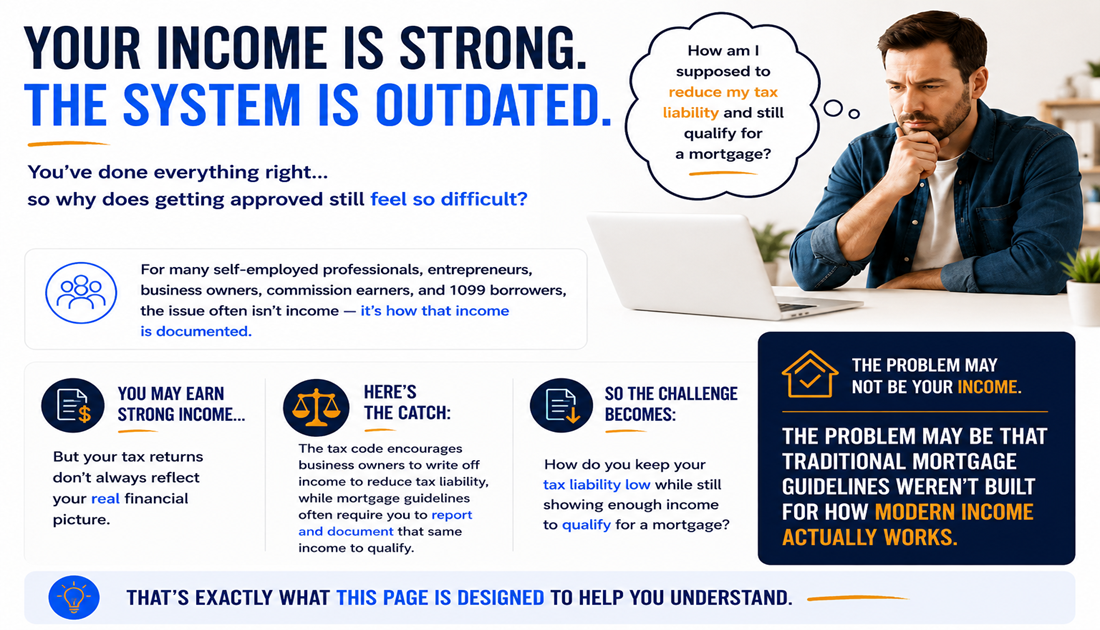
You’ve done everything right... You have good credit... You’ve built income... You pay your bills on time... So why does getting approved still feel so difficult?
For many self-employed professionals, entrepreneurs, business owners, commission earners, and 1099 borrowers, the issue often isn’t income; it’s how that income is documented.
You may earn strong money… But your tax returns don’t always reflect your real financial picture.
The tax code encourages business owners to write off income to reduce tax liability, while mortgage guidelines often require you to report and document that same income to qualify.
In other words, many self-employed borrowers legally reduce taxable income through deductions, but traditional mortgage guidelines often interpret that as lower earning power.
So the challenge becomes:
How do you keep your tax liability low while still showing enough income to qualify for a mortgage?
That’s exactly what this page is designed to help you understand.
Your Income Is Strong: The System Is Outdated — Core Strategy and Decision Context
Your Income Is Strong: The System Is Outdated — Core Strategy and Decision Context
Modern Income Strategies Look Beyond Tax Returns — How the Process Works in Practice
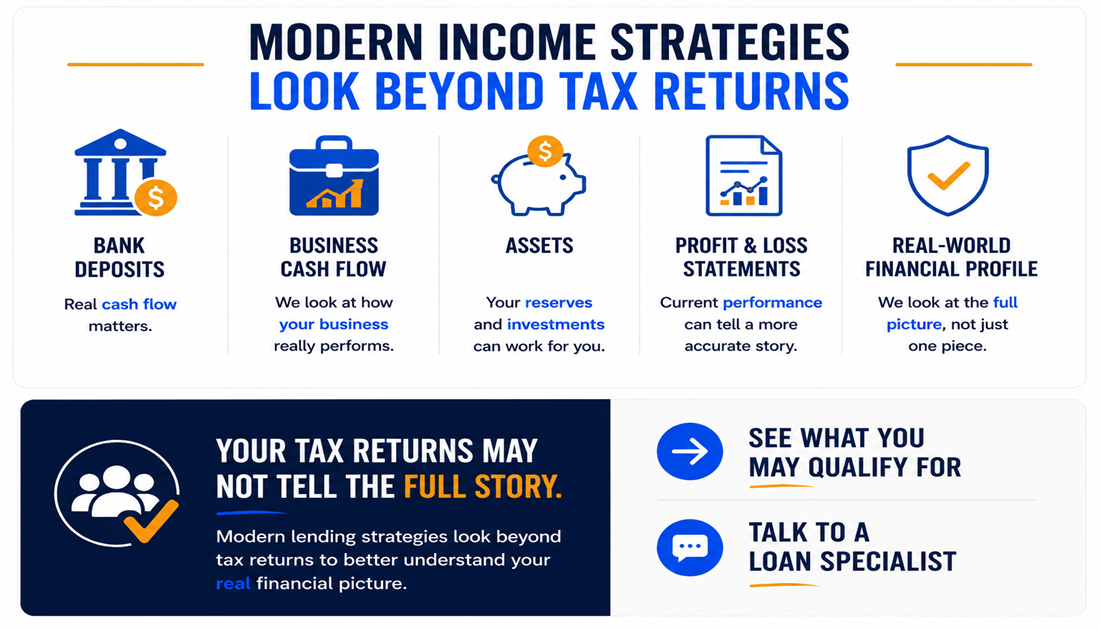
Modern Income Strategies Look Beyond Tax Returns — How the Process Works in Practice
Why Getting Approved Feels So Frustrating
Traditional Mortgage Approvals Were Designed Around Predictable W-2 Income.
But today’s workforce looks very different.
➡️ Business owners & Entrepreneurs
➡️ 1099 Earners & Freelancers
➡️ Commission-Based Professionals
➡️ Real Estate Investors
Many financially capable buyers simply don’t fit traditional approval formulas.
And ironically…The same deductions that help reduce tax liability can also reduce the income lenders use for qualification.
So even when your business is strong, and your cash flow is healthy… Traditional financing may not accurately reflect your real financial picture.
That doesn’t necessarily mean you can’t afford a home.
It may simply mean the income strategy needs to match how you actually earn.
More Than One Way To Qualify For A Mortgage — Who This Resource Helps and Why
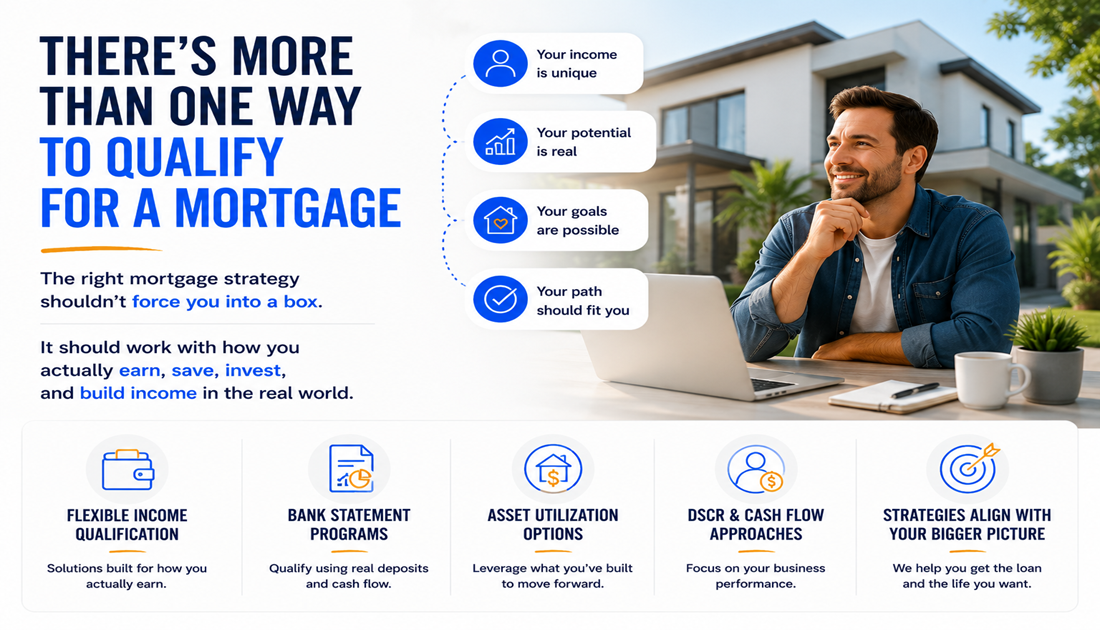
More Than One Way To Qualify For A Mortgage — Who This Resource Helps and Why
Explore Modern Income Qualification Strategies
Every borrower’s financial picture is different.
That’s why modern mortgage solutions can offer multiple ways to qualify depending on how you earn income, structure your business, manage cash flow, and build wealth.
Click on the links below to explore the strategies further to better understand which options may align with your situation:
➡️ 1099 & Profit & Loss (P&L) Programs
➡️ Asset Utilization Strategies
Many financially capable buyers have more options available than they originally realize.
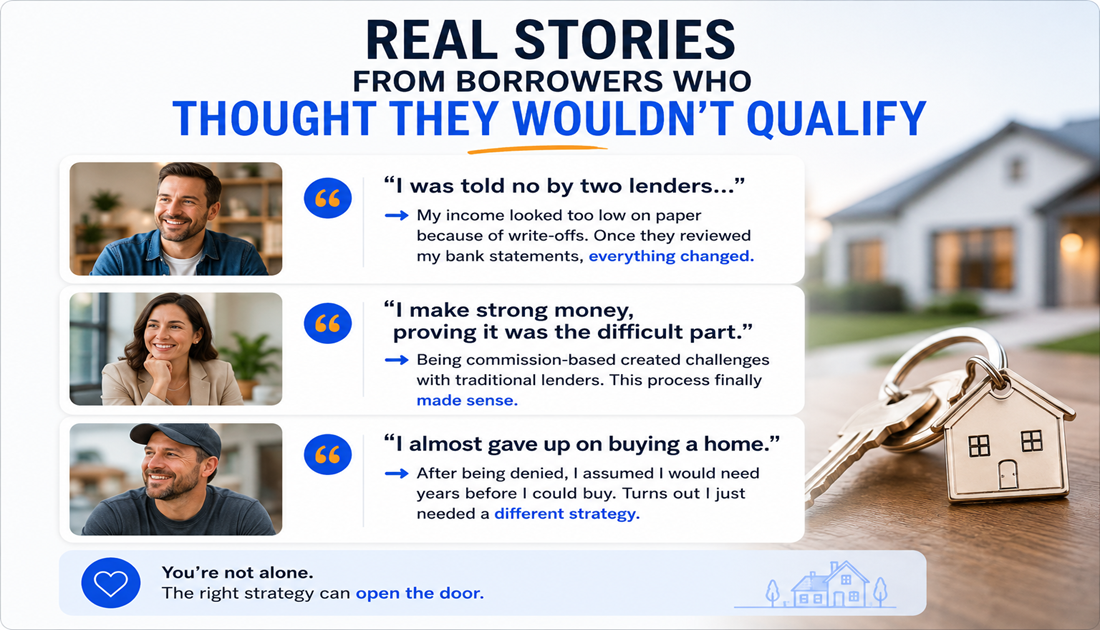
Real Stories From Borrowers Who Thought They Wouldn’t Qualify
“I was told no by two lenders…”
➡️ My income looked too low on paper because of write-offs. Once they reviewed my bank statements, everything changed.
“I make strong money, proving it was the difficult part.”
➡️ Being commission-based created challenges with traditional lenders. This process finally made sense.
“I almost gave up on buying a home.”
➡️ After being denied, I assumed I would need years before I could buy. Turns out I just needed a different strategy.
Real Borrower Stories And Alternative Mortgage Strategies — Documentation Calculations and Planning Details
Real Borrower Stories And Alternative Mortgage Strategies — Documentation Calculations and Planning Details
Frequently Asked Questions
Is this harder than a traditional mortgage?
➡️ Not necessarily; it’s simply structured differently to better reflect how you earn income.
Do I need perfect credit?
➡️ No. We look at your full financial picture.
How do I know which program fits me?
➡️ That’s exactly what we help you determine.
Will I need a large down payment?
➡️ Options vary, but many flexible solutions are available depending on your situation.
Not Sure Whether This Approach May Fit Your Situation
➡️ That’s exactly why we recommend scheduling a strategy call.
We’ll walk through your scenario together, review available financing options, and help you better understand which solutions may align with your income, financial profile, and long-term goals, with no pressure or obligation.
We’re Here To Help You Explore What’s Possible
If you have questions about Modern Income Qualification and Flexible Home Financing Strategies like:
➡️ 1099 & Profit & Loss (P&L) Programs
➡️ Asset Utilization Strategies
My team and I are here to help guide you through the process and help you better understand what may be possible for your situation.
Sometimes the issue is not the buyer. Sometimes the issue is simply finding the right strategy and financing structure for how you earn income today.
We’re here to help you every step of the way, so don’t hesitate to Contact Us.
Ready To Get Started?
If you’re ready to take the next step, simply click the link below to submit your application.
Once we receive your information, my team and I will review it and reach out to schedule your personalized consultation to discuss your options and next steps.
➡️ Submit Your Application Here
➡️ Schedule Your Strategy Call Here
Best regards,
Michael Thayer, CMPS, CMA
NMLS #173264
Planet Home Lending, NMLS #17022
Explore Buyer & Seller Resources & Next Steps
+ −Market Timing vs. Market Strategy: When Is the Right Time to Buy... And More Importantly, Why?
Calculators & Loan Programs Questions Answered: Mortgage Programs & Financing Calculator
Smart Financing Strategies to Lower Your Monthly Mortgage Payment: Smart Mortgage Strategies & Financing Hacks
Homebuying Roadmap: Your Mortgage GPS
Moving To Middle Tennessee: Moving To Middle Tennessee Resource Center
Search Open Houses: View All Middle Tennessee Open Houses
Main Resource Hub: Buyers, Sellers, Realtors, and Builders Resources and Strategies
Additional Information & Reference Guides
+ −Welcome Video Transcript
+ −Video Transcript
00:00
You have good credit, you have strong income, you pay your bills on time. So why does getting approved for a mortgage feel so difficult? If you're self-employed, a business owner, freelancer, commission earner, or a 1099 professional, you're not imagining this.
00:14
The reality is that many traditional mortgage guidelines were originally built around salary W-2 income structures and a standard paycheck model. And for modern borrowers, that creates a disconnect.
00:25
Because the tax system often encourages a business owner to maximize their deductions to reduce their taxable income.
00:32
While traditional mortgage approvals mainly rely heavily on income shown on those tax returns in order to qualify. So even financially capable borrowers can sometimes feel frustrated, confused, and discouraged after being told no. But there's good news. Getting denied doesn't always mean that you can't afford a home.
00:49
Sometimes, simply means the loan strategy being used may not align with how you actually earn your income. My name is Michael Thayer. I'm a mortgage advisor in Nashville, Tennessee, serving clients nationwide, and helping borrowers navigate more complex income situations is something we do every single day.
01:05
Today, the modern qualification strategies are designed to help specifically self-employed borrowers and non-traditional income earners
01:12
With programs such as the bank statement loan programs, the profit and loss, 1099, non-ratio, asset-based, or even the investor financing strategy, like a DSCR. Depending on your financial profile, these programs may help create alternative paths towards mortgage qualification that traditional mortgage financing just doesn't provide.
01:31
And that's exactly what this page was designed to help you understand. So take a few minutes, explore the information below, and learn how these programs work. And if you'd like, we'll review your specific situation. Just schedule a strategy call, and we'll walk through your options together. Because sometimes, the issue isn't whether you're financially capable of buying a home.
01:48
It's whether your income and financial profile are being evaluated through the right loan strategy that best fits your needs. Talk to you soon.
Your Income Is Strong: The System Is Outdated — Core Strategy and Decision Context Image Overview
+ −What this image communicates
“Your Income Is Strong: The System Is Outdated — Core Strategy and Decision Context” establishes the visual entry point for this part of “Self-Employed Mortgage Loans: Bank Statement, 1099, DSCR & Alternative Income Options.” Its central strategy framing helps the reader understand how to state the main tension clearly and show which decision should be made before secondary details distract from it. The decision underneath the graphic is whether the loan structure fits the borrower's documented finances, property, occupancy, cash plan, and longer-term goals. The image makes “Your Income Is Strong: The System Is Outdated” the dominant visual message and gives the reader a defined entry point into the page's argument. The wording identifies what deserves attention first; the surrounding design establishes whether the reader is looking at a claim, a choice, a sequence, or a practical resource. That distinction determines what evidence should be gathered before the message is applied.
Why it belongs on this page
This self-employed mortgage page explains how bank statements, 1099 income, DSCR, and other evidence can create more than one qualification path. The central strategy role of “Your Income Is Strong: The System Is Outdated” is the reason this image belongs at this point in “Self-Employed Mortgage Loans: Bank Statement, 1099, DSCR & Alternative Income Options.”
How a reader can use it
Use “Your Income Is Strong: The System Is Outdated” for its stated central strategy job on “Self-Employed Mortgage Loans: Bank Statement, 1099, DSCR & Alternative Income Options.” Name the desired outcome, identify the constraint that could block it, and decide which evidence would change the answer. The working notes for this panel should record the desired result, the assumption carrying the most risk, the fact that would disprove it, and the decision that must be made first. That record lets the reader compare the complete financing structure instead of choosing by rate or down payment alone without asking this image to answer a different stage of the decision.
What still must be verified
Keep the visual in its proper role. The image is educational and cannot establish eligibility, approval, pricing, appraisal acceptability, or the final terms shown on loan disclosures. If a later disclosure, source update, appraisal, inspection, title item, program rule, or contract term conflicts with “Your Income Is Strong: The System Is Outdated — Core Strategy and Decision Context,” the current controlling evidence takes priority. On “Self-Employed Mortgage Loans: Bank Statement, 1099, DSCR & Alternative Income Options,” that safeguard applies specifically to the central strategy role assigned to “Your Income Is Strong: The System Is Outdated.”
Modern Income Strategies Look Beyond Tax Returns — How the Process Works in Practice Image Overview
+ −What this image communicates
“Modern Income Strategies Look Beyond Tax Returns — How the Process Works in Practice” is not a decorative break in “Self-Employed Mortgage Loans: Bank Statement, 1099, DSCR & Alternative Income Options.” It is the page's working sequence, designed to show the order of operations, the handoff between people, and the checkpoint that determines whether the next step is ready. That framing matters because the reader is evaluating whether the loan structure fits the borrower's documented finances, property, occupancy, cash plan, and longer-term goals. The visual presents “Modern Income Strategies Look Beyond Tax Returns” as a sequence with dependencies. Its order matters: one confirmed input creates the next task, and an unresolved item can stop the file, listing, or purchase from advancing. By turning the process into visible stages, the graphic lets a reader identify the current position, the next handoff, and the deadline or evidence that controls progress.
Why it belongs on this page
Its four images move from the tax-return mismatch to modern calculation methods, program choice, and real borrower examples. The working sequence role of “Modern Income Strategies Look Beyond Tax Returns” is the reason this image belongs at this point in “Self-Employed Mortgage Loans: Bank Statement, 1099, DSCR & Alternative Income Options.”
How a reader can use it
Use “Modern Income Strategies Look Beyond Tax Returns” for its stated working sequence job on “Self-Employed Mortgage Loans: Bank Statement, 1099, DSCR & Alternative Income Options.” Read the visual from the first confirmed fact through the next action, noting dependencies, deadlines, and the owner of each task. The working notes for this panel should record the starting condition, each dependent step, the responsible person, the handoff document, the deadline, and the condition required to advance. That record lets the reader compare the complete financing structure instead of choosing by rate or down payment alone without asking this image to answer a different stage of the decision.
What still must be verified
The explanation around “Modern Income Strategies Look Beyond Tax Returns” must remain inside the evidence available for this page. The image is educational and cannot establish eligibility, approval, pricing, appraisal acceptability, or the final terms shown on loan disclosures. The “Modern Income Strategies Look Beyond Tax Returns — How the Process Works in Practice” visual supports a better-informed conversation, while the actual decision remains tied to current evidence and the people authorized to interpret it. On “Self-Employed Mortgage Loans: Bank Statement, 1099, DSCR & Alternative Income Options,” that safeguard applies specifically to the working sequence role assigned to “Modern Income Strategies Look Beyond Tax Returns.”
More Than One Way To Qualify For A Mortgage — Who This Resource Helps and Why Image Overview
+ −What this image communicates
The purpose of “More Than One Way To Qualify For A Mortgage — Who This Resource Helps and Why” is to organize one part of “Self-Employed Mortgage Loans: Bank Statement, 1099, DSCR & Alternative Income Options” around a reader and use-case map. It helps the reader understand how to explain who benefits, what problem each person is trying to solve, and why the same information may lead to different questions and keeps the discussion centered on whether the loan structure fits the borrower's documented finances, property, occupancy, cash plan, and longer-term goals. The image frames “More Than One Way To Qualify For A Mortgage” as a question that cannot be answered responsibly from a slogan. Its visual emphasis is an invitation to test the premise against the reader's actual property, finances, timing, and goals. That question-led design is useful because it creates a pause between interest and action and makes the missing evidence easier to name.
Why it belongs on this page
Each panel should help a business owner understand what will be measured—deposits, expenses, ownership, rental cash flow, assets, credit, reserves, or property performance—without suggesting that documentation disappears. The reader and use-case map role of “More Than One Way To Qualify For A Mortgage” is the reason this image belongs at this point in “Self-Employed Mortgage Loans: Bank Statement, 1099, DSCR & Alternative Income Options.”
How a reader can use it
Use “More Than One Way To Qualify For A Mortgage” for its stated reader and use-case map job on “Self-Employed Mortgage Loans: Bank Statement, 1099, DSCR & Alternative Income Options.” Match the graphic to the reader's role, current stage, pressure, and decision authority before applying its guidance. The working notes for this panel should record who the guidance is for, the reader's current stage, the decision they control, the problem they need solved, and when a specialist must take over. That record lets the reader compare the complete financing structure instead of choosing by rate or down payment alone without asking this image to answer a different stage of the decision.
What still must be verified
The boundary is important. The image is educational and cannot establish eligibility, approval, pricing, appraisal acceptability, or the final terms shown on loan disclosures. The “More Than One Way To Qualify For A Mortgage — Who This Resource Helps and Why” image can improve preparation and questions, but it cannot replace the records, disclosures, findings, approvals, or agreements issued for the actual borrower, property, and transaction. On “Self-Employed Mortgage Loans: Bank Statement, 1099, DSCR & Alternative Income Options,” that safeguard applies specifically to the reader and use-case map role assigned to “More Than One Way To Qualify For A Mortgage.”
Real Borrower Stories And Alternative Mortgage Strategies — Documentation Calculations and Planning Details Image Overview
+ −What this image communicates
On “Self-Employed Mortgage Loans: Bank Statement, 1099, DSCR & Alternative Income Options,” the “Real Borrower Stories And Alternative Mortgage Strategies — Documentation Calculations and Planning Details” visual isolates one decision from a larger housing conversation. As a evidence and calculation layer, it is meant to separate measurable inputs from assumptions and reveal which figures or documents control the comparison. The subject belongs to mortgage-program comparison, where the useful question is whether the loan structure fits the borrower's documented finances, property, occupancy, cash plan, and longer-term goals. The image organizes “Real Borrower Stories And Alternative Mortgage Strategies” as a working checklist rather than a promise that every file will require the same items. It groups the records or questions a reader should anticipate, shows where an exception may add work, and provides a way to notice missing information before a deadline. The visible list is a preparation tool; the final request still comes from the responsible reviewer or program.
Why it belongs on this page
This self-employed mortgage page explains how bank statements, 1099 income, DSCR, and other evidence can create more than one qualification path. The evidence and calculation layer role of “Real Borrower Stories And Alternative Mortgage Strategies” is the reason this image belongs at this point in “Self-Employed Mortgage Loans: Bank Statement, 1099, DSCR & Alternative Income Options.”
How a reader can use it
Use “Real Borrower Stories And Alternative Mortgage Strategies” for its stated evidence and calculation layer job on “Self-Employed Mortgage Loans: Bank Statement, 1099, DSCR & Alternative Income Options.” Write down every input, source, date, unit, estimate, and unresolved condition before relying on a calculation or side-by-side result. The working notes for this panel should record each number, unit, source, date, estimate, document, calculation method, and unresolved input that could change the comparison. That record lets the reader compare the complete financing structure instead of choosing by rate or down payment alone without asking this image to answer a different stage of the decision.
What still must be verified
The final safeguard is verification. The image is educational and cannot establish eligibility, approval, pricing, appraisal acceptability, or the final terms shown on loan disclosures. A reader should leave “Real Borrower Stories And Alternative Mortgage Strategies — Documentation Calculations and Planning Details” knowing what to ask and what to gather—not believing that a graphic has already supplied an approval, valuation, legal conclusion, or guaranteed outcome. On “Self-Employed Mortgage Loans: Bank Statement, 1099, DSCR & Alternative Income Options,” that safeguard applies specifically to the evidence and calculation layer role assigned to “Real Borrower Stories And Alternative Mortgage Strategies.”