Second Stop: Budget & Financing Options
Let’s Review Your Numbers, Explore Your Options, And Build A Financing Game Plan Designed Around Your Goals
Now that we better understand your goals and timeline, the next step is to review your financial information, complete the pre-approval process, and help you understand which financing options may best fit your situation.
This stage is designed to help clarify your budget, monthly payment comfort zone, and home-purchasing power before you begin searching for homes.
Mortgage GPS Roadmap — Core Strategy and Decision Context
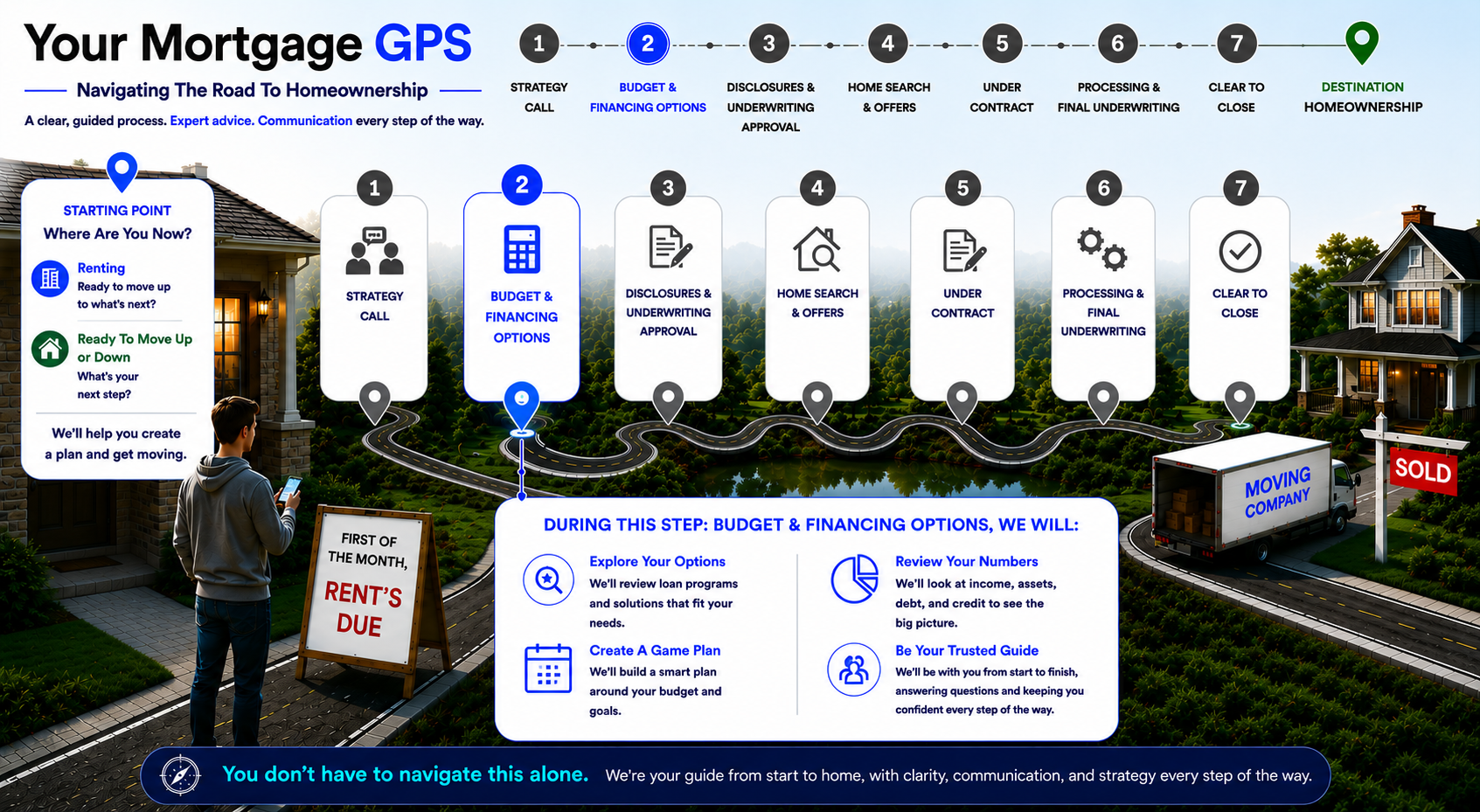
Mortgage GPS Roadmap — Core Strategy and Decision Context
What We Cover During Budget & Financing
➡️ Reviewing Your Financial Information
- We’ll review your income, assets, credit, employment, and supporting documentation as part of the pre-approval process.
➡️ Why Financing Strategy Matters
- Not all loan approvals are the same in today’s market.
- Some approvals are based primarily on estimated information and limited documentation. Our goal is to help you build the strongest possible financial foundation before you begin shopping for homes.
➡️ Why We Often Recommend TBD Underwritten Approval
- Not all approvals carry the same weight in today’s market.
- Pre-Qualification is typically the most basic level of review and is often based primarily on credit and estimated financial information.
- Pre-Approval involves reviewing income, assets, employment, and credit to help determine your financing options and purchasing power.
- TBD Underwritten Approval is the strongest level of approval because your loan has already been reviewed by an underwriter before you make an offer, helping create a smoother and more confident home-buying process.
➡️ Why This Matters
A stronger approval can help:
- Reduce surprises later in the process
- Improve confidence while shopping for homes
- Strengthen your offer position
- Create a smoother path toward closing
➡️ Exploring Your Financing Options
- We’ll walk through loan programs, down payment options, interest rates, monthly payment strategies, and financing solutions designed around your goals.
➡️ Building Your Home Buying Game Plan
- We’ll help structure a financing strategy designed around your comfort level, future plans, and desired monthly payment goals.
➡️ Understanding Your Purchasing Power
- We’ll review estimated monthly payments, closing costs, cash-to-close expectations, and the price range that may align with your financial goals.
➡️ Preparing You To Shop With Confidence
Once your financing strategy and budget are reviewed, you’ll have a clearer understanding of:
- What homes fit your budget
- What monthly payment feels comfortable
- How to move forward confidently during your home search
What Can You Expect During Budget And Financing Planning — How the Process Works in Practice

What Can You Expect During Budget And Financing Planning — How the Process Works in Practice
This Is About Creating Clarity Around Your Numbers
Buying a home is more than just getting approved.
Our goal is to help you understand your financing options, monthly payment comfort zone, and purchasing power so you can move forward with confidence and clarity.
Click On Any Step Below To Learn More About Your Mortgage Journey
➡️ Step #1 - Initial Strategy Call
➡️ Step #2 - Budget & Financing Options
➡️ Step #3 - Initial Loan Disclosures & Underwriting Approval
➡️ Step #4 - Home Search & Offers
We’re Here To Help Every Step Of The Way
Whether you’re preparing for the next stage of the process, reviewing financing options, or simply have questions along the way, my team and I are here to guide you with clarity and confidence.
Clear communication matters, and we want you to feel informed and supported throughout every step of your homeownership journey.
➡️ Have Questions? Contact Our Team Here
Best regards,
Michael Thayer, CMPS, CMA
NMLS #173264
Planet Home Lending, NMLS #17022
Explore Buyer & Seller Resources & Next Steps
+ −Market Timing vs. Market Strategy: When Is the Right Time to Buy... And More Importantly, Why?
Calculators & Loan Programs Questions Answered: Mortgage Programs & Financing Calculator
Smart Financing Strategies to Lower Your Monthly Mortgage Payment: Smart Mortgage Strategies & Financing Hacks
Homebuying Roadmap: Your Mortgage GPS
Moving To Middle Tennessee: Moving To Middle Tennessee Resource Center
Search Open Houses: View All Middle Tennessee Open Houses
Main Resource Hub: Buyers, Sellers, Realtors, and Builders Resources and Strategies
Additional Information & Reference Guides
+ −Welcome Video Transcript
+ −Video Transcript
00:00
Welcome to stop number two of your mortgage GPS, budgeting and financing options. Most buyers think getting approved is about one question. How much house can I afford? But honestly, that may be one of the wrong questions to ask. Just because you can afford a certain payment doesn't mean you always should.
00:16
I'm Michael Thayer, I'm a mortgage advisor based in Nashville, Tennessee, serving clients nationwide. And one of the biggest mistakes I see buyers make is focusing
00:24
on the maximum approval amount. Instead of building a strategy around their lifestyle, goals, and financial comfort zone. And that's why this strategy matters so much.
00:34
before you start shopping for homes, we want to help you understand what a comfortable payment looks like in your situation.
00:42
How much money do you really need up front for down payment and closing costs?
00:47
Ways to improve your affordability.
00:49
How different financing options look side by side, and how today's decision may impact your future plans. Because today's mortgage market, it's not a one-size-fits-all.
00:59
There are often multiple ways to structure financing options depending on your income, your assets, credit profile, and long-term goals. And our goal is simple, to help you understand the options.
01:10
The trade-offs.
01:11
In the bigger financial picture, so you can make a confident decision without pressure.
01:16
No confusion. And no internet hype.
01:19
Because buying a home is about so much more than just getting a rate quote or a pre-approval. The lowest rate on the wrong strategy can cost you thousands of dollars. We've seen it happen time and time again.
01:32
Buying a home is not about qualifying for the most house. It's about building a strategy that works for you.
01:38
Both now, and long after closing.
01:41
So, whether you're exploring your options, or trying to understand the numbers, or simply looking for clarity, we're here to help guide you every step of the way. And when you're ready, let's move on to step number 3, disclosures and underwriting approval. Talk to you soon.
Mortgage GPS Roadmap — Core Strategy and Decision Context Image Overview
+ −What this image communicates
“Mortgage GPS Roadmap — Core Strategy and Decision Context” establishes the visual entry point for this part of “Second Stop: Budget & Financing Options.” Its central strategy framing helps the reader understand how to state the main tension clearly and show which decision should be made before secondary details distract from it. The decision underneath the graphic is what must happen at this stage, who owns the next action, and which conditions must be resolved before the file can advance. The visual presents “Mortgage GPS Roadmap” as a sequence with dependencies. Its order matters: one confirmed input creates the next task, and an unresolved item can stop the file, listing, or purchase from advancing. By turning the process into visible stages, the graphic lets a reader identify the current position, the next handoff, and the deadline or evidence that controls progress.
Why it belongs on this page
The second Mortgage GPS stop translates the strategy into a working budget and financing comparison. The central strategy role of “Mortgage GPS Roadmap” is the reason this image belongs at this point in “Second Stop: Budget & Financing Options.”
The exact story carried by this graphic
On the budget-and-financing stop, the Mortgage GPS roadmap shows the transition from goals to numbers. The borrower is no longer discussing only the desired home; the team is defining payment comfort, available cash, reserves, loan choices, taxes, insurance, points, credits, and the financial effect of a different price. This panel should make clear that a roadmap is a decision sequence, not an approval badge: the numbers must be tested, documented, and refreshed when the property or household assumptions change.
How a reader can use it
Use “Mortgage GPS Roadmap” for its stated central strategy job on “Second Stop: Budget & Financing Options.” Name the desired outcome, identify the constraint that could block it, and decide which evidence would change the answer. The working notes for this panel should record the desired result, the assumption carrying the most risk, the fact that would disprove it, and the decision that must be made first. That record lets the reader see the sequence early enough to prevent a missing document or misunderstood responsibility from becoming a closing problem without asking this image to answer a different stage of the decision.
What still must be verified
The image is valuable because it frames the right issue, not because it proves the answer. A process graphic cannot promise an identical timeline; loan type, borrower documentation, property findings, third parties, contract terms, and underwriting can change the order or timing. “Mortgage GPS Roadmap — Core Strategy and Decision Context” remains educational until the current borrower, property, market, and transaction evidence supports a specific conclusion. On “Second Stop: Budget & Financing Options,” that safeguard applies specifically to the central strategy role assigned to “Mortgage GPS Roadmap.”
What Can You Expect During Budget And Financing Planning — How the Process Works in Practice Image Overview
+ −What this image communicates
The “What Can You Expect During Budget And Financing Planning — How the Process Works in Practice” image turns the central issue on “Second Stop: Budget & Financing Options” into a visible working sequence. It is there to show the order of operations, the handoff between people, and the checkpoint that determines whether the next step is ready, while the page supplies the evidence and explanation needed to evaluate what must happen at this stage, who owns the next action, and which conditions must be resolved before the file can advance. The visual presents “What Can You Expect During Budget And Financing Planning” as a sequence with dependencies. Its order matters: one confirmed input creates the next task, and an unresolved item can stop the file, listing, or purchase from advancing. By turning the process into visible stages, the graphic lets a reader identify the current position, the next handoff, and the deadline or evidence that controls progress.
Why it belongs on this page
The two images connect the overall roadmap with payment comfort, cash-to-close, loan structures, points or credits, taxes, insurance, reserves, and the cost of alternative choices. The working sequence role of “What Can You Expect During Budget And Financing Planning” is the reason this image belongs at this point in “Second Stop: Budget & Financing Options.”
How a reader can use it
Use “What Can You Expect During Budget And Financing Planning” for its stated working sequence job on “Second Stop: Budget & Financing Options.” Read the visual from the first confirmed fact through the next action, noting dependencies, deadlines, and the owner of each task. The working notes for this panel should record the starting condition, each dependent step, the responsible person, the handoff document, the deadline, and the condition required to advance. That record lets the reader see the sequence early enough to prevent a missing document or misunderstood responsibility from becoming a closing problem without asking this image to answer a different stage of the decision.
What still must be verified
The explanation around “What Can You Expect During Budget And Financing Planning” must remain inside the evidence available for this page. A process graphic cannot promise an identical timeline; loan type, borrower documentation, property findings, third parties, contract terms, and underwriting can change the order or timing. The “What Can You Expect During Budget And Financing Planning — How the Process Works in Practice” visual supports a better-informed conversation, while the actual decision remains tied to current evidence and the people authorized to interpret it. On “Second Stop: Budget & Financing Options,” that safeguard applies specifically to the working sequence role assigned to “What Can You Expect During Budget And Financing Planning.”