Third Stop: Initial Loan Disclosures & Underwriting Approval
Let’s Strengthen Your Financing Position Before You Begin Shopping For A Home
Now that we’ve reviewed your financial information and financing strategy, the next step is preparing your loan file for initial underwriting review.
This stage is designed to help identify any remaining financing conditions upfront, strengthen your approval position, and create additional confidence before you begin making offers on homes.
Mortgage GPS Roadmap — Core Strategy and Decision Context
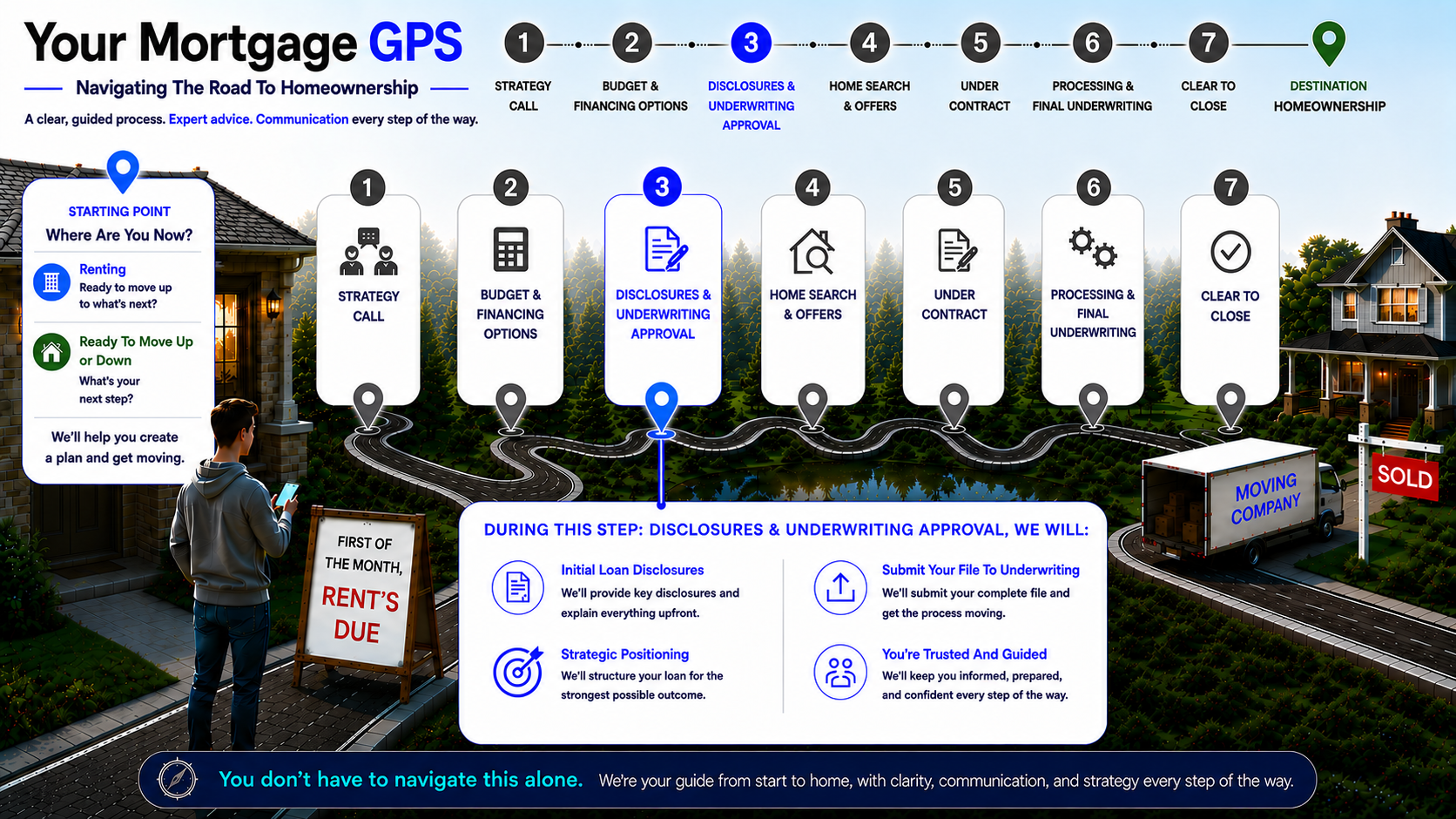
Mortgage GPS Roadmap — Core Strategy and Decision Context
What We Cover During The Initial Underwriting Process
➡️ Preparing Your Initial Loan Disclosures
- We’ll prepare and send your initial loan disclosures for electronic signature so we can move your loan into processing and underwriting review.
➡️ Submitting Your File To Underwriting
- Your loan file will be submitted to underwriting with a TBD address for an initial review of your income, assets, credit, and supporting documentation.
➡️ Identifying Remaining Conditions Upfront
- The underwriter will issue a list of any remaining items or conditions needed for final loan approval once a property is identified.
➡️ Strengthening Your Financing Position
- Completing the underwriting review upfront can help create a stronger financing position before you begin making offers on homes.
➡️ Setting You Up For A Quicker Close & Stronger Negotiating Position
- Because your loan file has already been reviewed and approved by underwriting upfront, much of the financing process is already completed before you make an offer.
- In many cases, once you have a fully executed contract, all that’s typically remaining is the appraisal, title work, proof of homeowners' insurance, and final property-related conditions, which may help position you for a faster closing timeline (15-17 Days) and stronger negotiating power with sellers.
➡️ Preparing For A Smoother Closing Process
- By working through many of the financing conditions early, we can often help simplify the process once you’re under contract.
What Can You Expect During Initial Disclosures And Underwriting — How the Process Works in Practice

What Can You Expect During Initial Disclosures And Underwriting — How the Process Works in Practice
This Is About Preparing Ahead Of Time
One of the biggest advantages of completing the initial underwriting review upfront is that it helps identify potential conditions before you find a home.
Our goal is to help create clarity, strengthen your financing position, and help make the home-buying process as smooth as possible moving forward.
Click On Any Step Below To Learn More About Your Mortgage Journey
➡️ Step #1 - Initial Strategy Call
➡️ Step #2 - Budget & Financing Options
➡️ Step #3 - Initial Loan Disclosures & Underwriting Approval
➡️ Step #4 - Home Search & Offers
We’re Here To Help Every Step Of The Way
Whether you’re preparing for the next stage of the process, reviewing financing options, or simply have questions along the way, my team and I are here to guide you with clarity and confidence.
Clear communication matters, and we want you to feel informed and supported throughout every step of your homeownership journey.
➡️ Have Questions? Contact Our Team Here
Best regards,
Michael Thayer, CMPS, CMA
NMLS #173264
Planet Home Lending, NMLS #17022
Explore Buyer & Seller Resources & Next Steps
+ −Market Timing vs. Market Strategy: When Is the Right Time to Buy... And More Importantly, Why?
Calculators & Loan Programs Questions Answered: Mortgage Programs & Financing Calculator
Smart Financing Strategies to Lower Your Monthly Mortgage Payment: Smart Mortgage Strategies & Financing Hacks
Homebuying Roadmap: Your Mortgage GPS
Moving To Middle Tennessee: Moving To Middle Tennessee Resource Center
Search Open Houses: View All Middle Tennessee Open Houses
Main Resource Hub: Buyers, Sellers, Realtors, and Builders Resources and Strategies
Additional Information & Reference Guides
+ −Welcome Video Transcript
+ −Video Transcript
00:00
Welcome to step number 3 of your mortgage GPS, the initial loan disclosures and underwriting approval. Now, during this step, I often tell buyers, these documents aren't worth the paper they're printed on. Now, I say that jokingly, but there's actually an important reason behind it.
00:13
These disclosures simply are the starting point of the loan process. And for many buyers, they assume they're their final numbers, and they're just not. Things like insurance, closing costs, prepaid items, and cash to close figures can all change as information is verified and updated throughout the loan transaction.
00:30
Case in point, if you haven't received a homeowner's insurance quote on your new property, I still have to estimate a number in there. Right now, what we're concerned about are the core pieces of information. Things like your income, your assets, your credit profile, employment, overall loan structure.
00:45
But, here's the real reason behind the stage. Our goal isn't the paperwork.
00:50
Our goal is to create confidence and strengthen you as a buyer. Now, my name is Michael Thayer. I'm a mortgage advisor based in Nashville, Tennessee, serving clients nationwide. And one of the biggest reasons we take this approach is because it's much easier to identify and solve problems now, before you're under contract.
01:07
Versus, after you've already found a home that you love, submitting an offer, and the countdown to closing has already begun.
01:13
That's when surprises become stressful. That's why, whenever possible, we submit your file to underwriting with a to-be-determined address on it. The goal is simple. Get as much of your loan file reviewed and approved and signed off by underwriting as possible before you even make an offer. So when you find the right house.
01:30
You're not scrambling to fix problems under a tight deadline. Instead, you can move forward with greater confidence.
01:37
Knowing much of the heavy lifting has already been completed, and honestly, underwriting is usually far less stressful than most people actually will imagine or fear. Underwriting is simply reviewing the file, verifying the documentation, making sure everything meets the guidelines. Think of it like a checklist. Things are simply confirmed.
01:56
that everything is properly documented before moving forward. That's it. And by doing much of this work up front.
02:02
We help create fewer surprises. You can make stronger offers, putting you on a smoother path to closing. Because our goal's simple.
02:10
Help you move forward with confidence before you start shopping for homes. And when you're ready, let's move on to step number four, the home search and offers. Talk to you soon.
Mortgage GPS Roadmap — Core Strategy and Decision Context Image Overview
+ −What this image communicates
The purpose of “Mortgage GPS Roadmap — Core Strategy and Decision Context” is to organize one part of “Third Stop: Initial Loan Disclosures & Underwriting Approval” around a central strategy. It helps the reader understand how to state the main tension clearly and show which decision should be made before secondary details distract from it and keeps the discussion centered on what must happen at this stage, who owns the next action, and which conditions must be resolved before the file can advance. The visual presents “Mortgage GPS Roadmap” as a sequence with dependencies. Its order matters: one confirmed input creates the next task, and an unresolved item can stop the file, listing, or purchase from advancing. By turning the process into visible stages, the graphic lets a reader identify the current position, the next handoff, and the deadline or evidence that controls progress.
Why it belongs on this page
The third Mortgage GPS stop covers initial loan disclosures and the first underwriting decision. The central strategy role of “Mortgage GPS Roadmap” is the reason this image belongs at this point in “Third Stop: Initial Loan Disclosures & Underwriting Approval.”
The exact story carried by this graphic
Here the Mortgage GPS roadmap marks the point where the borrower receives initial disclosures and the file enters underwriting review. The visual should distinguish acknowledging estimates from accepting final terms and distinguish an initial approval from final approval. Application facts, income, assets, credit, debts, occupancy, property information, and contract timing now become evidence the underwriter can test. Its benefit is helping the borrower understand why accurate disclosure and prompt document response matter before a home or closing deadline creates pressure.
How a reader can use it
Use “Mortgage GPS Roadmap” for its stated central strategy job on “Third Stop: Initial Loan Disclosures & Underwriting Approval.” Name the desired outcome, identify the constraint that could block it, and decide which evidence would change the answer. The working notes for this panel should record the desired result, the assumption carrying the most risk, the fact that would disprove it, and the decision that must be made first. That record lets the reader see the sequence early enough to prevent a missing document or misunderstood responsibility from becoming a closing problem without asking this image to answer a different stage of the decision.
What still must be verified
A process graphic cannot promise an identical timeline; loan type, borrower documentation, property findings, third parties, contract terms, and underwriting can change the order or timing. “Mortgage GPS Roadmap — Core Strategy and Decision Context” should therefore be treated as a central strategy, not as transaction evidence by itself. Current documents, responsible sources, and the professionals accountable for the relevant decision must control when they differ from the illustration. On “Third Stop: Initial Loan Disclosures & Underwriting Approval,” that safeguard applies specifically to the central strategy role assigned to “Mortgage GPS Roadmap.”
What Can You Expect During Initial Disclosures And Underwriting — How the Process Works in Practice Image Overview
+ −What this image communicates
“What Can You Expect During Initial Disclosures And Underwriting — How the Process Works in Practice” is not a decorative break in “Third Stop: Initial Loan Disclosures & Underwriting Approval.” It is the page's working sequence, designed to show the order of operations, the handoff between people, and the checkpoint that determines whether the next step is ready. That framing matters because the reader is evaluating what must happen at this stage, who owns the next action, and which conditions must be resolved before the file can advance. The visual presents “What Can You Expect During Initial Disclosures And Underwriting” as a sequence with dependencies. Its order matters: one confirmed input creates the next task, and an unresolved item can stop the file, listing, or purchase from advancing. By turning the process into visible stages, the graphic lets a reader identify the current position, the next handoff, and the deadline or evidence that controls progress.
Why it belongs on this page
The images should help the borrower understand what is being acknowledged, which numbers are estimates, how documents support the application, and why underwriting may add conditions. The working sequence role of “What Can You Expect During Initial Disclosures And Underwriting” is the reason this image belongs at this point in “Third Stop: Initial Loan Disclosures & Underwriting Approval.”
The initial-disclosure and underwriting process panel should distinguish three events: the lender issues estimates based on the application, the borrower reviews and acknowledges disclosures, and underwriting tests the application against documentation and program rules. The borrower should compare names, property information, loan terms, estimated costs, income, assets, debts, and occupancy for accuracy, then respond to conditions with complete records. The image helps prevent signed disclosures from being mistaken for final approval or final closing figures.
How a reader can use it
Use “What Can You Expect During Initial Disclosures And Underwriting” for its stated working sequence job on “Third Stop: Initial Loan Disclosures & Underwriting Approval.” Read the visual from the first confirmed fact through the next action, noting dependencies, deadlines, and the owner of each task. The working notes for this panel should record the starting condition, each dependent step, the responsible person, the handoff document, the deadline, and the condition required to advance. That record lets the reader see the sequence early enough to prevent a missing document or misunderstood responsibility from becoming a closing problem without asking this image to answer a different stage of the decision.
What still must be verified
The explanation around “What Can You Expect During Initial Disclosures And Underwriting” must remain inside the evidence available for this page. A process graphic cannot promise an identical timeline; loan type, borrower documentation, property findings, third parties, contract terms, and underwriting can change the order or timing. The “What Can You Expect During Initial Disclosures And Underwriting — How the Process Works in Practice” visual supports a better-informed conversation, while the actual decision remains tied to current evidence and the people authorized to interpret it. On “Third Stop: Initial Loan Disclosures & Underwriting Approval,” that safeguard applies specifically to the working sequence role assigned to “What Can You Expect During Initial Disclosures And Underwriting.”