First Stop: Strategy Call
Let’s Get To Know You, Understand Your Goals, And Build Your Homeownership Game Plan
The first step in your homeownership journey is understanding your goals, timeline, and what matters most to you.
This strategy call is designed to help create clarity, answer your questions, and prepare you for the next steps in the process.
First Stop — Core Strategy and Decision Context
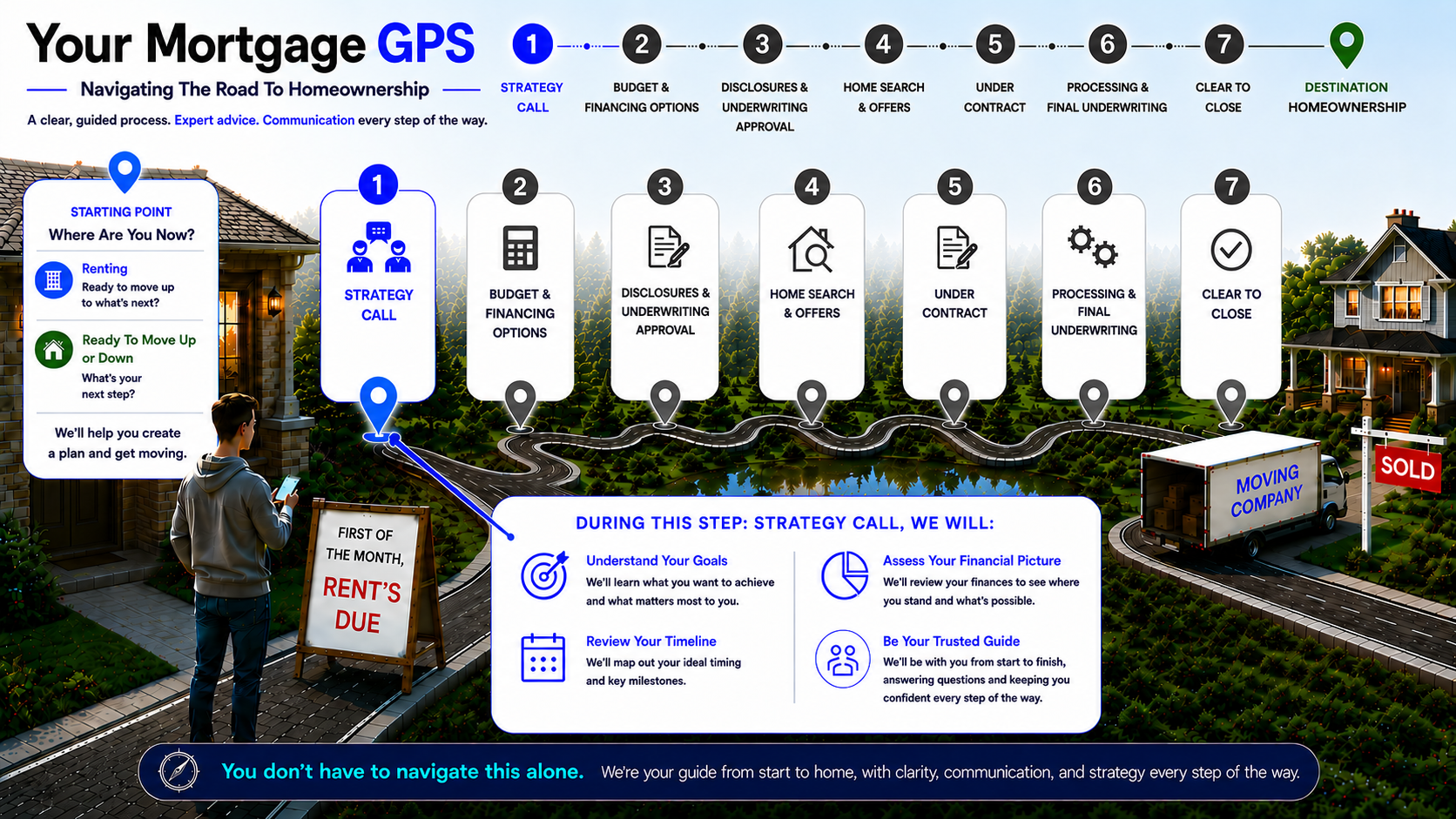
First Stop — Core Strategy and Decision Context
What We Cover During Your Strategy Call
➡️ Getting To Know You
- We’ll discuss your goals, your current situation, and what success looks like for you.
➡️ Understanding Your Timeline
- We’ll review your ideal timing, future plans, and where you are in the home-buying journey.
➡️ Assessing Your Financial Picture
- We’ll discuss your income, down payment goals, current finances, and overall purchasing power.
➡️ Preparing For Pre-Approval
- We’ll explain the financing process, provide you with the application link, and review the documentation needed for pre-approval and budgeting.
- Start Your Application Here
➡️ Understanding Your Pre-Approval Documents
- We’ll walk you through the documentation commonly required for pre-approval, explain why each item matters, and help simplify the process so you know exactly what to expect before you get started.
- Understanding The Documents Behind Your Pre-Approval
➡️ Planning Beyond Closing
- Our relationship doesn’t end at closing. We’ll continue monitoring refinance opportunities, market changes, and financing strategies that may help reduce your monthly payment, improve long-term savings, and position you to achieve future financial goals.
First Stop — How the Process Works in Practice

First Stop — How the Process Works in Practice
This Is About Clarity, Not Pressure
Buying a home is a major financial decision.
Our goal is to help you understand your options, prepare for the next steps, and move forward with confidence and clarity.
Click On Any Step Below To Learn More About Your Mortgage Journey
➡️ Step #1 - Initial Strategy Call
➡️ Step #2 - Budget & Financing Options
➡️ Step #3 - Initial Loan Disclosures & Underwriting Approval
➡️ Step #4 - Home Search & Offers
Your Homeownership Journey Starts With A Conversation
Whether you’re ready to move now or simply exploring your options, my team and I are here to help guide you through the process and help you better understand what may be possible for your situation.
We’re here to help you every step of the way, so don’t hesitate to reach out with any questions along the journey.
➡️ Have Questions or Schedule Another Strategy Call Here
Best regards,
Michael Thayer, CMPS, CMA
NMLS #173264
Planet Home Lending, NMLS #17022
Explore Buyer & Seller Resources & Next Steps
+ −Market Timing vs. Market Strategy: When Is the Right Time to Buy... And More Importantly, Why?
Calculators & Loan Programs Questions Answered: Mortgage Programs & Financing Calculator
Smart Financing Strategies to Lower Your Monthly Mortgage Payment: Smart Mortgage Strategies & Financing Hacks
Homebuying Roadmap: Your Mortgage GPS
Moving To Middle Tennessee: Moving To Middle Tennessee Resource Center
Search Open Houses: View All Middle Tennessee Open Houses
Main Resource Hub: Buyers, Sellers, Realtors, and Builders Resources and Strategies
Additional Information & Reference Guides
+ −Welcome Video Transcript
+ −Video Transcript
00:00
Welcome to your mortgage GPS. One of the biggest frustrations buyers have during the home buying process is this.
00:06
Nobody ever explains what happens next, effectively or clearly. And if they do.
00:11
They only explain it one time.
00:12
Or they expect you to remember everything, and they send you on your way to figure it out on your own.
00:16
Buyers are told, go get pre-approved, start looking at houses, and then somehow navigate one of the largest financial decisions of your life without a clear roadmap.
00:25
That's exactly why we created your Mortgage GPS. A simple step-by-step guide designed to help you understand what happens next, what to expect, and how to move forward through the home buying process with confidence. Because buying a home shouldn't feel confusing, or… and it shouldn't feel like you have to figure it out on your own.
00:45
It all starts right here, on step number one, your strategy call. So before you start looking at houses online, before you start touring homes, and absolutely, before you start making offers, you need a strategy, people. Because a rate quote, that's not a strategy.
01:00
In fact, the lowest rate on the wrong loan program will cost you thousands of dollars.
01:07
Buying a home is not one size fits all transaction, so you need to stop treating it that way. My name is Michael Thayer. I'm a mortgage advisor in Nashville, Tennessee, serving clients nationwide. And after helping buyers for more than two decades, I've learned something very important.
01:21
Most buyers are not lacking motivation.
01:24
They're lacking clarity.
01:26
They don't know exactly where they should start, or what they can truly afford comfortably, or how much cash they really need for closing, what financing options best fit their situation.
01:37
How to build a smart game plan BEFORE jumping into the market.
01:43
And when you don't have a game plan?
01:44
That's where the stress comes in. The uncertainty and costly mistakes begin.
01:49
That's exactly why we start with the strategy call. It's not a sales pitch. It's not a pressure call. It's a conversation.
01:56
We'll discuss your goals, your timeline, your financial picture, your concerns, what matters most to you. Because the right strategy for a first-time homebuyer looks completely different than a move-up buyer, a self-employed borrower, an investor, or someone just trying to relocate. And our goal is simple.
02:15
To help you understand your options, build a strategy.
02:18
To move forward with confidence.
02:21
Not based on internet hype, social media hype, news headlines, and what worked for someone else.
02:27
During the strategy call, we'll walk through your financing options, your budgeting.
02:32
Your down payment strategies, comfortable payment ranges that work best for you, documentation that we'll need for your pre-approval, and how to position you for the strongest possible outcome moving forward.
02:43
So, whether you're ready to buy now, or 6 months from now, or simply looking for clarity before making a decision, my team and I would be honored to help guide you through the process.
02:53
Now, when you're ready, move on to step number 2, budget and financing options. We'll talk to you soon.
First Stop — Core Strategy and Decision Context Image Overview
+ −What this image communicates
The image titled “First Stop — Core Strategy and Decision Context” gives “First Stop: Strategy Call” a focused central strategy. Its communication job is to state the main tension clearly and show which decision should be made before secondary details distract from it. In this page context, the underlying subject is mortgage-process roadmap: what must happen at this stage, who owns the next action, and which conditions must be resolved before the file can advance. The visual presents “First Stop” as a sequence with dependencies. Its order matters: one confirmed input creates the next task, and an unresolved item can stop the file, listing, or purchase from advancing. By turning the process into visible stages, the graphic lets a reader identify the current position, the next handoff, and the deadline or evidence that controls progress.
Why it belongs on this page
The first Mortgage GPS stop is a strategy conversation before documents and property choices take over. The central strategy role of “First Stop” is the reason this image belongs at this point in “First Stop: Strategy Call.”
How a reader can use it
Use “First Stop” for its stated central strategy job on “First Stop: Strategy Call.” Name the desired outcome, identify the constraint that could block it, and decide which evidence would change the answer. The working notes for this panel should record the desired result, the assumption carrying the most risk, the fact that would disprove it, and the decision that must be made first. That record lets the reader see the sequence early enough to prevent a missing document or misunderstood responsibility from becoming a closing problem without asking this image to answer a different stage of the decision.
What still must be verified
The graphic has a defined limit: A process graphic cannot promise an identical timeline; loan type, borrower documentation, property findings, third parties, contract terms, and underwriting can change the order or timing. Use “First Stop — Core Strategy and Decision Context” to understand and organize the issue, then rely on current source material for any number, eligibility rule, property fact, deadline, or professional conclusion. On “First Stop: Strategy Call,” that safeguard applies specifically to the central strategy role assigned to “First Stop.”
First Stop — How the Process Works in Practice Image Overview
+ −What this image communicates
The visible message in “First Stop — How the Process Works in Practice” directs attention to mortgage-process roadmap on “First Stop: Strategy Call.” The image functions as a working sequence: it should show the order of operations, the handoff between people, and the checkpoint that determines whether the next step is ready. That gives the reader a specific reason to slow down before acting. The visual presents “First Stop” as a sequence with dependencies. Its order matters: one confirmed input creates the next task, and an unresolved item can stop the file, listing, or purchase from advancing. By turning the process into visible stages, the graphic lets a reader identify the current position, the next handoff, and the deadline or evidence that controls progress.
Why it belongs on this page
The images should show how goals, timing, household priorities, anticipated obstacles, and the desired decision are defined. The working sequence role of “First Stop” is the reason this image belongs at this point in “First Stop: Strategy Call.”
The strategy-call process image should show a conversation becoming an operating brief. Begin with the reason for moving, desired timing, property needs, current housing obligations, available cash, payment comfort, and known concerns. Separate firm facts from estimates, assign the records needed to verify each estimate, and identify which decision comes next. The session is successful when the borrower can explain the goal, the main constraint, and the evidence being gathered—not when the first call produces a premature approval or property recommendation.
How a reader can use it
Use “First Stop” for its stated working sequence job on “First Stop: Strategy Call.” Read the visual from the first confirmed fact through the next action, noting dependencies, deadlines, and the owner of each task. The working notes for this panel should record the starting condition, each dependent step, the responsible person, the handoff document, the deadline, and the condition required to advance. That record lets the reader see the sequence early enough to prevent a missing document or misunderstood responsibility from becoming a closing problem without asking this image to answer a different stage of the decision.
What still must be verified
The graphic has a defined limit: A process graphic cannot promise an identical timeline; loan type, borrower documentation, property findings, third parties, contract terms, and underwriting can change the order or timing. Use “First Stop — How the Process Works in Practice” to understand and organize the issue, then rely on current source material for any number, eligibility rule, property fact, deadline, or professional conclusion. On “First Stop: Strategy Call,” that safeguard applies specifically to the working sequence role assigned to “First Stop.”
What Can You Expect During A Mortgage Strategy Call
+ −The What Can You Expect image for the Strategy Call represents the first working conversation in the Mortgage GPS process. The goal is to replace a vague idea of buying a home with a clear list of priorities, questions, documents, and next decisions.
Goals, timing, and property plans
Discuss why you are considering a purchase, the communities or property types you are exploring, the timing you hope to follow, and any sale, lease, relocation, or family considerations that could affect the plan. This context helps the financing conversation match the life decision instead of starting with a generic loan amount.
Monthly comfort and cash planning
Talk through the payment range and upfront cash level you consider workable. A productive plan considers more than principal and interest. Property taxes, homeowners insurance, mortgage insurance when applicable, association dues, closing costs, reserves, moving expenses, and expected repairs may also matter.
Mortgage pre-approval document preparation
Review the types of income, asset, identification, and supporting information that may be requested. Use the Mortgage Pre-Approval Document Checklist to organize common documents before the file moves into detailed financing and underwriting review.
Questions, options, and next actions
Identify the loan-program questions that deserve research, the information still missing, and the next action after the call. The Mortgage Programs & Financing Calculator Center and Smart Mortgage Strategies & Financing Hacks provide additional educational paths.
Questions this visual helps a homebuyer ask
What information is being reviewed now? Which items are estimates, which items are verified, and which decisions are still conditional? What documents or third-party reports are outstanding? Who is responsible for the next action, and what date or contract deadline applies? Has any change in income, employment, debt, credit, assets, occupancy, property, insurance, or contract terms been reported to the appropriate professionals? Clear questions help the team identify misunderstandings before they become last-minute problems.
How this step connects to the full Mortgage GPS
This image is one part of the seven-stop Mortgage GPS roadmap. Visitors can use the linked stages to understand what happened before this point and what should follow. For related planning tools, visit the Mortgage Programs & Financing Calculator Center and Smart Mortgage Strategies & Financing Hacks. These resources support comparison and preparation, but the figures and examples do not replace the loan documents or findings issued for a specific borrower and property.
Next step and important context
A strategy call is a planning conversation, not a guarantee of approval, rate, payment, loan terms, or closing date. Continue to Budget & Financing Options when you are ready to translate the goals into a working financial plan, and keep the Mortgage Pre-Approval Document Checklist available as documents are gathered or updated.
This image overview is educational and written to make the visual information understandable to visitors, search engines, and assistive technologies. It does not replace individualized loan disclosures, underwriting findings, a purchase agreement, an appraisal, title or insurance documents, or advice from legal, tax, insurance, real estate, or settlement professionals.