Fifth Stop: Under Contract
Let’s Navigate The Next Steps Together As We Move Your Loan From Accepted Offer To Closing Day
Congratulations, your offer has been accepted.
Now that you’re officially under contract, the next stage focuses on completing the remaining items needed to move your loan through processing, underwriting, and toward closing.
This stage is designed to help keep everything organized, on track, and moving forward as smoothly as possible.
Fifth Stop — Core Strategy and Decision Context
Fifth Stop — Core Strategy and Decision Context
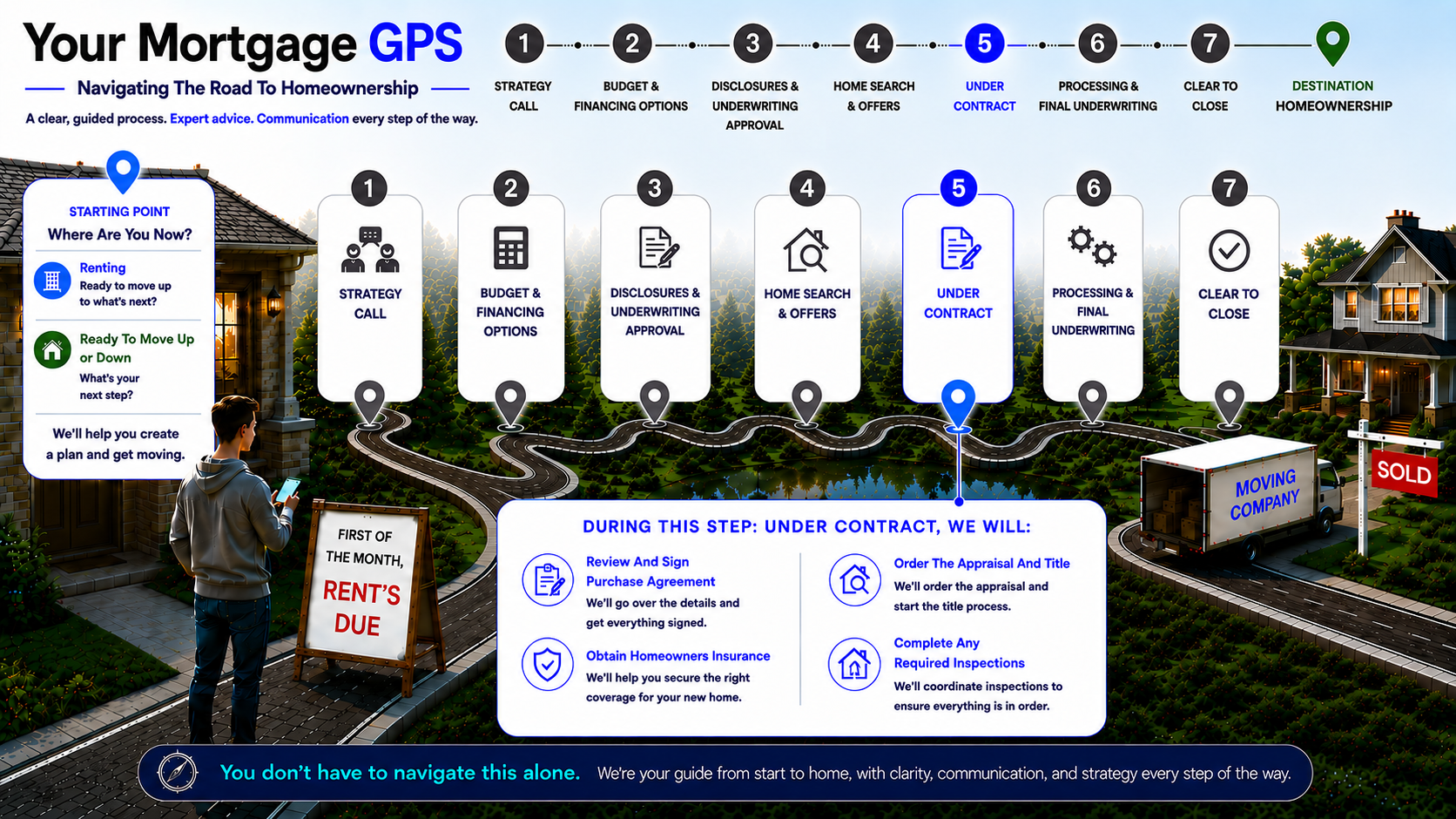
What We Cover During The Under Contract Process
➡️ Signing The Purchase Agreement
- Once your offer is accepted, all parties will sign the purchase agreement and finalize the terms of the contract.
➡️ Providing Your Earnest Money Deposit Receipt
- Once your earnest money deposit has been submitted, we’ll need a copy of the check, wire confirmation, or deposit receipt for your loan file and underwriting documentation.
➡️ Ordering The Appraisal & Title Work
- We’ll begin the appraisal and title process to help verify the property’s value, ownership records, and title status.
➡️ Obtaining Homeowners Insurance
- You’ll select and secure homeowners' insurance coverage for the property prior to closing.
➡️ Completing Required Inspections
- Your real estate agent will help coordinate any inspections needed during your inspection period so you can better evaluate the property.
➡️ Monitoring Key Contract Deadlines
- We’ll work closely with your agent and title company to help keep inspections, financing milestones, and important contract deadlines on track throughout the transaction.
Fifth Stop — How the Process Works in Practice

Fifth Stop — How the Process Works in Practice
This Is About Keeping Everything On Track
Once you’re under contract, communication and coordination become extremely important.
Our goal is to help simplify the process, reduce surprises, and guide you through the remaining steps as we move toward closing day.
Click On Any Step Below To Learn More About Your Mortgage Journey
➡️ Step #1 - Initial Strategy Call
➡️ Step #2 - Budget & Financing Options
➡️ Step #3 - Initial Loan Disclosures & Underwriting Approval
➡️ Step #4 - Home Search & Offers
We’re Here To Help Every Step Of The Way
Whether you’re preparing for the next stage of the process, reviewing financing options, or simply have questions along the way, my team and I are here to guide you with clarity and confidence.
Clear communication matters, and we want you to feel informed and supported throughout every step of your homeownership journey.
➡️ Have Questions? Contact Our Team Here
Best regards,
Michael Thayer, CMPS, CMA
NMLS #173264
Planet Home Lending, NMLS #17022
Explore Buyer & Seller Resources & Next Steps
+ −Market Timing vs. Market Strategy: When Is the Right Time to Buy... And More Importantly, Why?
Calculators & Loan Programs Questions Answered: Mortgage Programs & Financing Calculator
Smart Financing Strategies to Lower Your Monthly Mortgage Payment: Smart Mortgage Strategies & Financing Hacks
Homebuying Roadmap: Your Mortgage GPS
Moving To Middle Tennessee: Moving To Middle Tennessee Resource Center
Search Open Houses: View All Middle Tennessee Open Houses
Main Resource Hub: Buyers, Sellers, Realtors, and Builders Resources and Strategies
Additional Information & Reference Guides
+ −Welcome Video Transcript
+ −Video transcript
00:00
Welcome to stop number 5 in your mortgage GPS. You're under contract. At this stage of the process, things start getting very, very real. Because now, you're officially under contract. The home has been selected, the appraisal, title, insurance, and other timelines have started. And the countdown to closing has officially begun.
00:19
My name is Michael Thayer, I'm a mortgage advisor based in Nashville, Tennessee, serving clients nationwide.
00:23
And this stage is where many buyers suddenly feel both excited and slightly overwhelmed at the same time. Because once you go under contract, things start to move very fast. Deadlines, inspections, appraisals, title work, insurance updates, final conditions, a lot of moving pieces all happening at once. But here's the good news.
00:43
This is exactly why we've gone through all of the previous steps up front.
00:47
We've already done the heavy lifting. Your strategy's built. Underwriting has already reviewed your file. We already know you qualify.
00:53
Now it's simply about getting everything finalized and getting you to the end at the closing table, and ready to sign. At this stage, we're mainly just waiting for the appraisal to come in, the title work, your insurance, and final items needed for closing. Our job is to help keep everything organized, on track.
01:10
moving smoothly towards final approval and closing day. Because buying a home should feel exciting, not overwhelming. And while this stage can feel intense at times.
01:20
This is also where buyers begin seeing everything finally come together. When you're ready, let's move on to step 6, final processing and final underwriting, ready for closing. Talk to you soon.
Fifth Stop — Core Strategy and Decision Context Image Overview
+ −What this image communicates
The visible message in “Fifth Stop — Core Strategy and Decision Context” directs attention to mortgage-process roadmap on “Fifth Stop: Under Contract.” The image functions as a central strategy: it should state the main tension clearly and show which decision should be made before secondary details distract from it. That gives the reader a specific reason to slow down before acting. The visual presents “Fifth Stop” as a sequence with dependencies. Its order matters: one confirmed input creates the next task, and an unresolved item can stop the file, listing, or purchase from advancing. By turning the process into visible stages, the graphic lets a reader identify the current position, the next handoff, and the deadline or evidence that controls progress.
Why it belongs on this page
The fifth Mortgage GPS stop begins when a purchase contract is accepted. The central strategy role of “Fifth Stop” is the reason this image belongs at this point in “Fifth Stop: Under Contract.”
How a reader can use it
Use “Fifth Stop” for its stated central strategy job on “Fifth Stop: Under Contract.” Name the desired outcome, identify the constraint that could block it, and decide which evidence would change the answer. The working notes for this panel should record the desired result, the assumption carrying the most risk, the fact that would disprove it, and the decision that must be made first. That record lets the reader see the sequence early enough to prevent a missing document or misunderstood responsibility from becoming a closing problem without asking this image to answer a different stage of the decision.
What still must be verified
The explanation around “Fifth Stop” must remain inside the evidence available for this page. A process graphic cannot promise an identical timeline; loan type, borrower documentation, property findings, third parties, contract terms, and underwriting can change the order or timing. The “Fifth Stop — Core Strategy and Decision Context” visual supports a better-informed conversation, while the actual decision remains tied to current evidence and the people authorized to interpret it. On “Fifth Stop: Under Contract,” that safeguard applies specifically to the central strategy role assigned to “Fifth Stop.”
Fifth Stop — How the Process Works in Practice Image Overview
+ −What this image communicates
The “Fifth Stop — How the Process Works in Practice” image turns the central issue on “Fifth Stop: Under Contract” into a visible working sequence. It is there to show the order of operations, the handoff between people, and the checkpoint that determines whether the next step is ready, while the page supplies the evidence and explanation needed to evaluate what must happen at this stage, who owns the next action, and which conditions must be resolved before the file can advance. The visual presents “Fifth Stop” as a sequence with dependencies. Its order matters: one confirmed input creates the next task, and an unresolved item can stop the file, listing, or purchase from advancing. By turning the process into visible stages, the graphic lets a reader identify the current position, the next handoff, and the deadline or evidence that controls progress.
Why it belongs on this page
The images explain how contract dates, earnest money, inspection decisions, title, insurance, appraisal, lender documents, and communication become one coordinated timeline. The working sequence role of “Fifth Stop” is the reason this image belongs at this point in “Fifth Stop: Under Contract.”
The under-contract process image should read like a deadline map: deliver earnest money, schedule and evaluate inspections, secure insurance, provide the contract to the lender, complete appraisal and title work, satisfy loan conditions, and protect the agreed closing date. The parties do not own every decision in the same way, so responsibilities and notice requirements must remain visible. Its value is helping the buyer recognize which missed action creates contractual risk before the file reaches final underwriting.
How a reader can use it
Use “Fifth Stop” for its stated working sequence job on “Fifth Stop: Under Contract.” Read the visual from the first confirmed fact through the next action, noting dependencies, deadlines, and the owner of each task. The working notes for this panel should record the starting condition, each dependent step, the responsible person, the handoff document, the deadline, and the condition required to advance. That record lets the reader see the sequence early enough to prevent a missing document or misunderstood responsibility from becoming a closing problem without asking this image to answer a different stage of the decision.
What still must be verified
The boundary is important. A process graphic cannot promise an identical timeline; loan type, borrower documentation, property findings, third parties, contract terms, and underwriting can change the order or timing. The “Fifth Stop — How the Process Works in Practice” image can improve preparation and questions, but it cannot replace the records, disclosures, findings, approvals, or agreements issued for the actual borrower, property, and transaction. On “Fifth Stop: Under Contract,” that safeguard applies specifically to the working sequence role assigned to “Fifth Stop.”
What Can You Expect After Going Under Contract
+ −The What Can You Expect image for Under Contract describes the coordinated work that begins after the offer is accepted. The purchase agreement creates dates and responsibilities, while the mortgage file must be updated for the chosen property and transaction terms.
Confirm the agreement and deadlines
Make sure the lender and appropriate transaction professionals receive the complete signed contract and amendments. Track earnest money, financing, appraisal, inspection, title, insurance, and closing dates with the parties responsible for each item.
Document earnest money and available funds
Keep the deposit receipt and the account record showing the source of funds. Avoid unexplained transfers or cash deposits. Additional documentation may be requested so the lender can verify funds used in the transaction.
Coordinate appraisal and property review
The appraisal supports the lender's collateral review and is different from a buyer's inspection. Inspection decisions, repair negotiations, and contract rights should be discussed with the appropriate real estate and inspection professionals.
Complete title and insurance work
Title services address ownership and lien information, while lender's and owner's title policies protect different interests. Homeowners insurance must also be coordinated for the selected property. Ask the mortgage, title, insurance, and real estate professionals assigned to the transaction to explain requirements, options, deadlines, and property-specific concerns.
Keep the loan file stable and responsive
Continue sending requested documents promptly and discuss job, income, debt, credit, asset, occupancy, or contract changes before acting. Underwriting may need updated statements, explanations, verifications, or property documents as the file advances.
Questions this visual helps a homebuyer ask
What information is being reviewed now? Which items are estimates, which items are verified, and which decisions are still conditional? What documents or third-party reports are outstanding? Who is responsible for the next action, and what date or contract deadline applies? Has any change in income, employment, debt, credit, assets, occupancy, property, insurance, or contract terms been reported to the appropriate professionals? Clear questions help the team identify misunderstandings before they become last-minute problems.
How this step connects to the full Mortgage GPS
This image is one part of the seven-stop Mortgage GPS roadmap. Visitors can use the linked stages to understand what happened before this point and what should follow. For related planning tools, visit the Mortgage Programs & Financing Calculator Center and Smart Mortgage Strategies & Financing Hacks. These resources support comparison and preparation, but the figures and examples do not replace the loan documents or findings issued for a specific borrower and property.
Next step and important context
Contract, inspection, appraisal, title, insurance, and financing requirements vary by property and transaction. Continue to Processing & Final Underwriting Approval to see how those components are assembled for final review.
This image overview is educational and written to make the visual information understandable to visitors, search engines, and assistive technologies. It does not replace individualized loan disclosures, underwriting findings, a purchase agreement, an appraisal, title or insurance documents, or advice from legal, tax, insurance, real estate, or settlement professionals.