Your Weekly Communication Hub
Transaction Dashboard: Key Terms & Contacts
This page provides weekly updates, key milestones, important contacts, and transaction progress so everyone stays informed and aligned throughout the home-buying process.
If something requires immediate attention between scheduled updates, we'll contact you right away rather than waiting for the next update.
➡️ PURCHASE PRICE: $900,000
➡️ SELLER CONCESSIONS: $10,000
➡️ CONTRACT DATE: May 26, 2026
➡️ CLOSING DATE: July 2, 2026
➡️ CALENDAR DAYS REMAINING: 37 Days
➡️ BUSINESS DAYS REMAINING: 27 Days
➡️ MORTGAGE TEAM:
- MORTGAGE ADVISOR: Michael Thayer @ 615-585-5900 or [email protected]
- MORTGAGE PROCESSOR: Eric Smith @ 301-708-2034, Fax #301-708-2034, and Eric.Smith @PlanetHomeLending.com
➡️ REALTORS:
- BUYERS: Jane Smith @ (615) 555-3333 or [email protected]
- LISTING/SELLER: Sarah Johnson @ (615) 555-2222 or [email protected]
- TRANSACTION COORDINATOR: N/A
➡️ TITLE COMPANY:
- ABC Title Company, 1234 Title Street, Nashville, TN 37203
- CONTACT: Mary Smith @ (615) 555-1212 or [email protected]
➡️ If you receive calls, texts, emails, or requests regarding your mortgage from anyone not listed on this page, please proceed with caution and contact us directly to verify the request.
➡️ Never send money, wire funds, or share sensitive financial information without first confirming the instructions with our team by phone using a trusted phone number.
For additional transaction details, please see the "Purchase Contract Summary: Critical Dates, Terms & Contacts" PDF located on this page.
Progress Tracker & Current Status
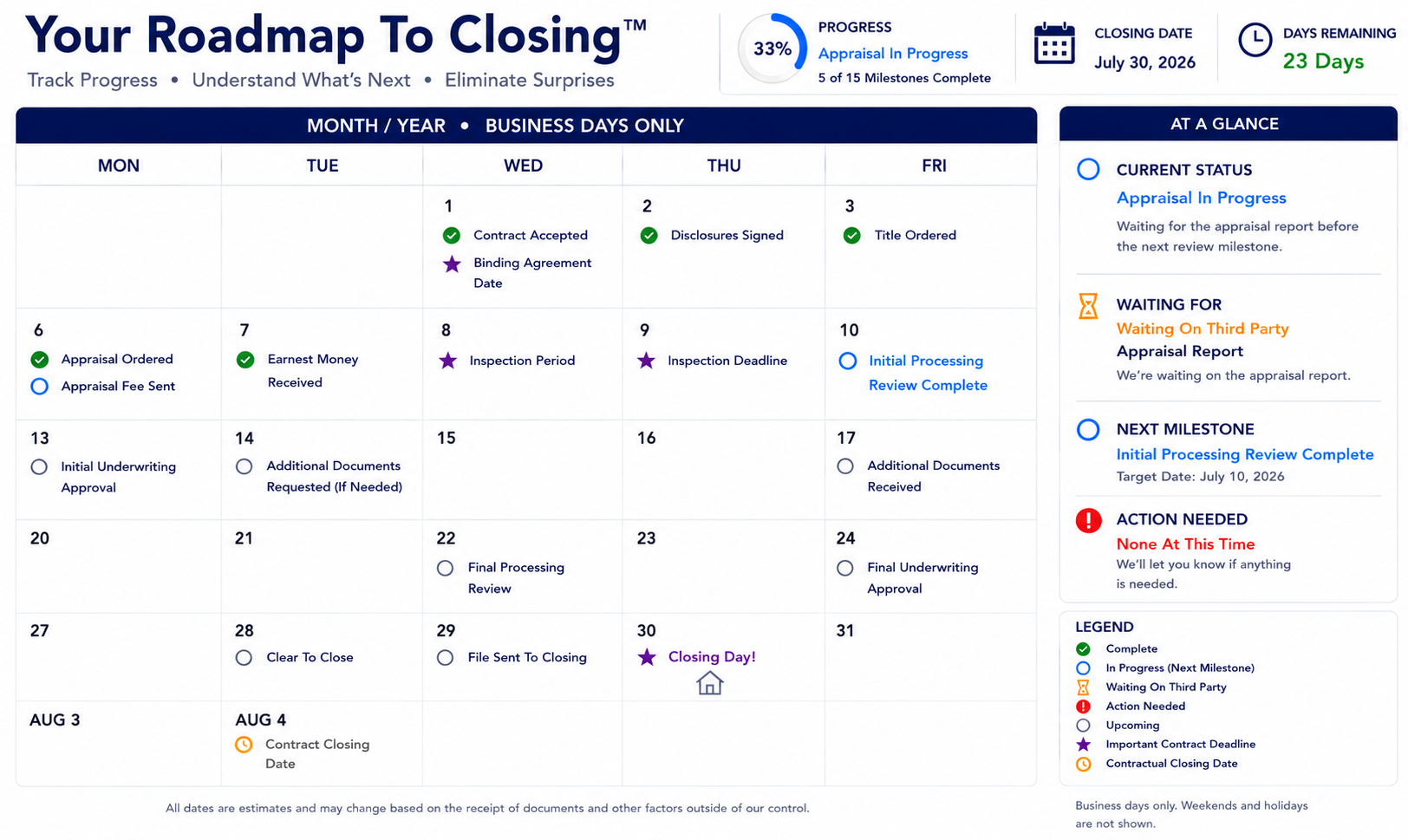
Progress Tracker & Current Status
Your Path To Closing: What To Expect Over The Coming Weeks
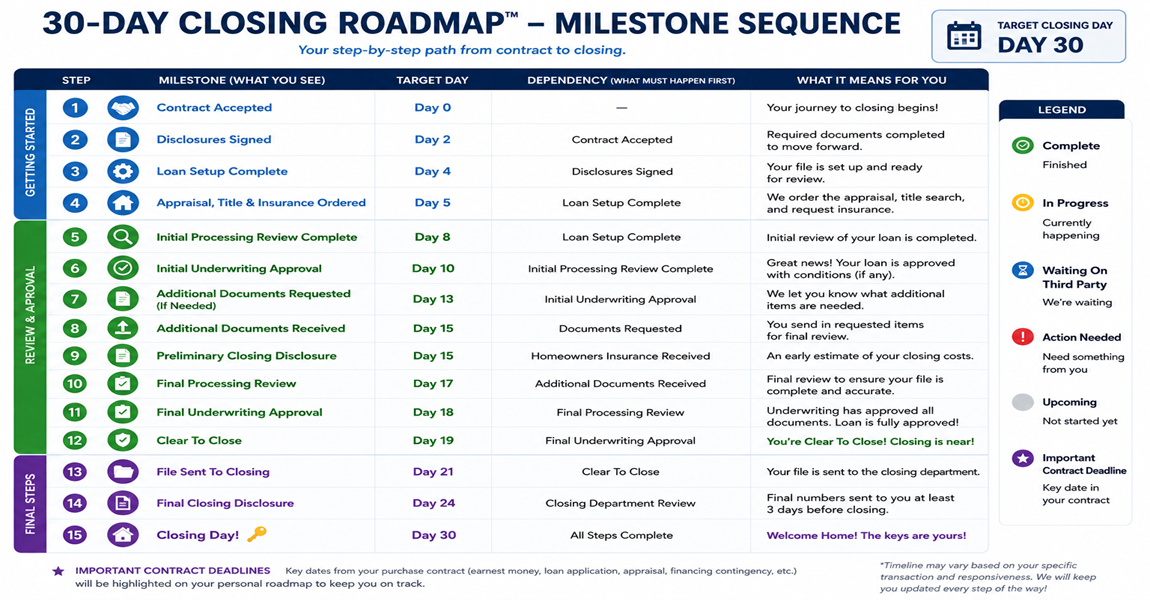
Your Path To Closing: What To Expect Over The Coming Weeks
Weekly Progress Update
➡️ Appraisal ordered and inspection completed.
➡️ Title work ordered and currently in progress.
➡️ Initial underwriting review completed.
➡️ Financing contingency requirements satisfied.
➡️ Closing remains on schedule.
Your Mortgage Roadmap: What to Expect From Start to Finish
Click any step below to learn what happens, what we'll be working on, and what to expect along the way.
➡️ Step #1 - Initial Strategy Call
➡️ Step #2 - Budget & Financing Options
➡️ Step #3 - Initial Loan Disclosures & Underwriting Approval
➡️ Step #4 - Home Search & Offers
Our Commitment To You
Buying a home is one of the biggest financial decisions most people will ever make.
You shouldn't have to wonder what's happening behind the scenes.
Our goal is to provide clear communication, proactive updates, and a transparent process from contract to closing.
➡️ No surprises.
➡️ No guessing.
➡️ No wondering what's next.
➡️ Clear communication every step of the way.
Just a clear roadmap to a successful closing.
We’re here to help you every step of the way, so don’t hesitate to Contact Us.
Best regards,
Michael Thayer, CMPS, CMA
NMLS #173264
Planet Home Lending, NMLS #17022
Explore Buyer & Seller Resources & Next Steps
Market Timing vs. Market Strategy: When Is the Right Time to Buy... And More Importantly, Why?
Calculators & Loan Programs Questions Answered: Mortgage Programs & Financing Calculator
Smart Financing Strategies to Lower Your Monthly Mortgage Payment: Smart Mortgage Strategies & Financing Hacks
Homebuying Roadmap: Your Mortgage GPS
Moving To Middle Tennessee: Moving To Middle Tennessee Resource Center
Search Open Houses: View All Middle Tennessee Open Houses
Main Resource Hub: Buyers, Sellers, Realtors, and Builders Resources and Strategies
Additional Information & Reference Guides
+ −Welcome Video Transcript
+ −Video Transcript
00:00
Congratulations again on getting your offer accepted. Now the real journey begins. I'm Michael Thayer, and whether we've already spoken or this is our first time meeting, this is the first installment of our weekly update. Instead of simply telling you where things stand with your transaction, we're going to show you where things stand, so you'll always know where we've been.
00:17
where we are today, and where we're going next. Buying a home's exciting, but it also could feel overwhelming, especially if you're wondering.
00:26
What happens next, right?
00:28
That's exactly why we built this page. Below, you're going to find visual updates, written explanations showing exactly where things stay in the day and what we expect moving forward. You'll always see how much time is allocated for each milestone, how many days remaining until closing.
00:43
and what needs to happen to keep everything on schedule. When everybody understands the timeline.
00:49
They understand why deadlines matter.
00:51
When we ask for something by a certain date, it's because every milestone affects the next. Staying on schedule today helps prevent delays tomorrow. And since this is your first weekly update, this video is about two to three minutes long, and it's designed to walk you through how everything works.
01:07
Future updates will be much shorter, focused only on what has changed since the previous week. And one of the biggest advantages of this system is that everyone involved in your transaction receives the same information, the same update, at the same time.
01:21
Keeping everyone informed, aligned, and moving towards the same goal and on-time closing. I want to encourage you to save this page to your phone, your computer, your browser, wherever. Think of it as your single source of truth throughout the transaction. Whenever you have a question, simply come back to this page. See the latest update, your current status.
01:41
And your next steps. Thank you.
01:42
And you'll always find your transaction details, your key contacts, and any additional resources, whenever you need a quick refresher. And if somebody contacts you regarding this transaction, and they're not listed on this page.
01:54
Please consider that a red flag.
01:56
Before you send personal information, financial information, documents, or send anybody money.
02:00
Please call us first so we can verify the request. And one last thing for the buyers.
02:06
Please take a minute to review the section titled, Small Financial Changes Can Delay Your Closing.
02:12
Please do not open any new credit accounts, purchase furniture, appliances, or move large amounts of money, or make financial decisions without talking to us first. A quick conversation today can prevent a closing delay tomorrow.
02:25
Our commitment to you is simple.
02:27
No surprises, no guessing, no wondering what comes next. Just clear communication, proactive updates and a process that keeps everybody informed, keeps everybody aligned and keeps us all moving towards the same goal and on time closing.
02:42
We're excited to help you guide you to your journey, and if you have any questions, please do not hesitate to reach out to us. We're here to help. Let's go.
Progress Tracker & Current Status — Core Strategy and Decision Context Image Overview
+ −Within Template – Your Weekly Communication Hub, the visual labeled “Progress Tracker & Current Status — Core Strategy and Decision Context” serves as an interpretive guide. Its job is to slow down a complicated housing question, isolate the central decision, and give the reader a recognizable way to connect the page's explanation with a real situation.
Why it matters: important housing decisions combine timing, financial capacity, property facts, personal priorities, and professional coordination, while a short headline or isolated image can leave the essential reasoning unstated. The image therefore works as a reminder that clarity comes from connecting the visible message with the complete facts, not from relying on a slogan. It gives the reader a reason to pause, identify the decision being made, and recognize which assumptions could materially change the result.
The image becomes actionable when the reader uses it to explain what the image represents, connect it to the page's central decision, identify the evidence a reader should gather, and convert the visual message into an orderly set of questions and next steps. That means moving in order: understand the visual claim, gather the exact facts of the reader's situation, current property and market information, verified financial documents, the page's educational guidance, and input from the appropriate licensed professionals, compare realistic alternatives, and verify the items that influence eligibility, value, timing, or risk. The result is a disciplined path from awareness to informed action.
The intended audience includes homebuyers, sellers, homeowners, real estate professionals, and Middle Tennessee households using this resource to make a more informed housing decision. For a first-time reader, the visual reduces complexity and shows where to begin. For someone already in motion, it can reveal a missing verification step or a tradeoff that deserves another look. For a professional, it provides a structured way to explain the topic without implying that every household or property receives the same result. A complete conversation should also address the reader's priority, the pressure behind the decision, the acceptable tradeoffs, the available time, and the evidence required for confidence. This richer description is intentionally specific to the visual and page topic so the image contributes meaningful context instead of repeating a generic caption used elsewhere. A useful review should record what is known today, what remains uncertain, who is responsible for verifying each item, and when the information must be refreshed. Readers should preserve the distinction between a planning example and a transaction-specific conclusion, especially when dates, values, program rules, inventory, or personal circumstances can change.
Ultimately, the visual serves a practical interpretation of the visual that helps the reader understand why the subject matters, how to act on it, who benefits, and what must still be confirmed. Its description gives the page meaningful context around the exact image and clarifies the relationship between the illustration, the educational content, and the reader's decision. The overview provides educational context and does not replace individualized mortgage, real estate, legal, tax, appraisal, inspection, insurance, or title advice. Current facts should be verified before a binding decision. That combination of relevance, explanation, and restraint is what makes the overview useful for people, accessible navigation, and natural search discovery.
Your Path To Closing: What To Expect Over The Coming Weeks — How the Process Works in Practice Image Overview
+ −This section of Template – Your Weekly Communication Hub is represented by the image “Your Path To Closing: What To Expect Over The Coming Weeks — How the Process Works in Practice.” The visual emphasizes the page's central planning issue and helps translate an abstract concept into a decision a buyer, seller, homeowner, or real estate professional can examine carefully.
The reason this visual deserves a detailed explanation is that important housing decisions combine timing, financial capacity, property facts, personal priorities, and professional coordination, while a short headline or isolated image can leave the essential reasoning unstated. By naming the subject directly, the image creates a useful checkpoint between initial interest and action. It helps prevent a reader from skipping the questions that determine whether the strategy is appropriate, timely, and supported by reliable evidence.
How to use it: explain what the image represents, connect it to the page's central decision, identify the evidence a reader should gather, and convert the visual message into an orderly set of questions and next steps. The reader should treat the image as the opening frame of a process rather than the conclusion. Begin with the page's stated purpose, connect it with the exact facts of the reader's situation, current property and market information, verified financial documents, the page's educational guidance, and input from the appropriate licensed professionals, and then identify the unanswered questions. This sequence turns visual interest into organized preparation and makes the next professional conversation more specific and useful.
This visual is useful to homebuyers, sellers, homeowners, real estate professionals, and Middle Tennessee households using this resource to make a more informed housing decision. It helps each audience move from a broad question toward the details that apply to a particular transaction. The image is especially valuable when several people must coordinate, because it keeps the discussion centered on the same subject while allowing each participant to verify the facts within their role. Readers should preserve the distinction between a planning example and a transaction-specific conclusion, especially when dates, values, program rules, inventory, or personal circumstances can change. The page is most valuable when its guidance is paired with a direct review of current facts, documented assumptions, realistic alternatives, and the consequences of waiting or moving forward. A complete conversation should also address the reader's priority, the pressure behind the decision, the acceptable tradeoffs, the available time, and the evidence required for confidence. This richer description is intentionally specific to the visual and page topic so the image contributes meaningful context instead of repeating a generic caption used elsewhere.
Ultimately, the visual serves a practical interpretation of the visual that helps the reader understand why the subject matters, how to act on it, who benefits, and what must still be confirmed. Its description gives the page meaningful context around the exact image and clarifies the relationship between the illustration, the educational content, and the reader's decision. The overview provides educational context and does not replace individualized mortgage, real estate, legal, tax, appraisal, inspection, insurance, or title advice. Current facts should be verified before a binding decision. That combination of relevance, explanation, and restraint is what makes the overview useful for people, accessible navigation, and natural search discovery.
Understanding Your Calendar Updates — Who This Resource Helps and Why Image Overview
+ −Within Template – Your Weekly Communication Hub, the visual labeled “Understanding Your Calendar Updates — Who This Resource Helps and Why” serves as an interpretive guide. Its job is to slow down a complicated housing question, isolate the central decision, and give the reader a recognizable way to connect the page's explanation with a real situation.
Why it matters: important housing decisions combine timing, financial capacity, property facts, personal priorities, and professional coordination, while a short headline or isolated image can leave the essential reasoning unstated. The image therefore works as a reminder that clarity comes from connecting the visible message with the complete facts, not from relying on a slogan. It gives the reader a reason to pause, identify the decision being made, and recognize which assumptions could materially change the result.
In practice, the visual supports a four-part approach: explain what the image represents, connect it to the page's central decision, identify the evidence a reader should gather, and convert the visual message into an orderly set of questions and next steps. Each step should be tied to the exact facts of the reader's situation, current property and market information, verified financial documents, the page's educational guidance, and input from the appropriate licensed professionals. Doing so gives the image a clear role in the page rather than allowing it to stand as an unsupported promise, and it helps readers carry accurate questions into a mortgage or real estate discussion.
Who it helps: homebuyers, sellers, homeowners, real estate professionals, and Middle Tennessee households using this resource to make a more informed housing decision. Different readers will use the image differently. One person may need a starting point for gathering documents; another may be comparing timing or property options; a professional may use it to explain the sequence and expose a hidden obstacle early. The common benefit is a shared vocabulary for discussing the exact issue represented by “Understanding Your Calendar Updates — Who This Resource Helps and Why.” A complete conversation should also address the reader's priority, the pressure behind the decision, the acceptable tradeoffs, the available time, and the evidence required for confidence. This richer description is intentionally specific to the visual and page topic so the image contributes meaningful context instead of repeating a generic caption used elsewhere. A useful review should record what is known today, what remains uncertain, who is responsible for verifying each item, and when the information must be refreshed.
What it serves: a practical interpretation of the visual that helps the reader understand why the subject matters, how to act on it, who benefits, and what must still be confirmed. It also adds crawlable context by describing the visual in the language a person would naturally use when researching the topic, while keeping the explanation tied to the page itself. The overview provides educational context and does not replace individualized mortgage, real estate, legal, tax, appraisal, inspection, insurance, or title advice. Current facts should be verified before a binding decision. Used correctly, “Understanding Your Calendar Updates — Who This Resource Helps and Why” becomes a durable educational asset: it explains the purpose of this part of Template – Your Weekly Communication Hub, supports better questions, and directs attention to evidence before action.
Small Financial Changes Can Delay Your Closing — Documentation Calculations and Planning Details Image Overview
+ −The image titled “Small Financial Changes Can Delay Your Closing — Documentation Calculations and Planning Details” gives the Template – Your Weekly Communication Hub resource a concrete visual starting point. It is meant to do more than decorate the page: it identifies the exact idea the reader should notice before evaluating the guidance that follows.
Why it matters: important housing decisions combine timing, financial capacity, property facts, personal priorities, and professional coordination, while a short headline or isolated image can leave the essential reasoning unstated. The image therefore works as a reminder that clarity comes from connecting the visible message with the complete facts, not from relying on a slogan. It gives the reader a reason to pause, identify the decision being made, and recognize which assumptions could materially change the result.
How to use it: explain what the image represents, connect it to the page's central decision, identify the evidence a reader should gather, and convert the visual message into an orderly set of questions and next steps. The reader should treat the image as the opening frame of a process rather than the conclusion. Begin with the page's stated purpose, connect it with the exact facts of the reader's situation, current property and market information, verified financial documents, the page's educational guidance, and input from the appropriate licensed professionals, and then identify the unanswered questions. This sequence turns visual interest into organized preparation and makes the next professional conversation more specific and useful.
Who it helps: homebuyers, sellers, homeowners, real estate professionals, and Middle Tennessee households using this resource to make a more informed housing decision. Different readers will use the image differently. One person may need a starting point for gathering documents; another may be comparing timing or property options; a professional may use it to explain the sequence and expose a hidden obstacle early. The common benefit is a shared vocabulary for discussing the exact issue represented by “Small Financial Changes Can Delay Your Closing — Documentation Calculations and Planning Details.” A complete conversation should also address the reader's priority, the pressure behind the decision, the acceptable tradeoffs, the available time, and the evidence required for confidence. This richer description is intentionally specific to the visual and page topic so the image contributes meaningful context instead of repeating a generic caption used elsewhere.
What it serves: a practical interpretation of the visual that helps the reader understand why the subject matters, how to act on it, who benefits, and what must still be confirmed. It also adds crawlable context by describing the visual in the language a person would naturally use when researching the topic, while keeping the explanation tied to the page itself. The overview provides educational context and does not replace individualized mortgage, real estate, legal, tax, appraisal, inspection, insurance, or title advice. Current facts should be verified before a binding decision. Used correctly, “Small Financial Changes Can Delay Your Closing — Documentation Calculations and Planning Details” becomes a durable educational asset: it explains the purpose of this part of Template – Your Weekly Communication Hub, supports better questions, and directs attention to evidence before action.
Your Mortgage GPS Homebuying Roadmap Presentation Overview
+ −Your Mortgage GPS™ roadmap infographic illustrates the complete homebuying and mortgage process from initial consultation to closing. The visual timeline outlines key milestones, including strategy call, budgeting and financing options, pre-approval, disclosures, underwriting approval, home search, making offers, contract acceptance, processing, appraisal, final underwriting, clear to close, and closing day. The graphic emphasizes a guided, step-by-step mortgage experience designed to help homebuyers navigate the loan process with confidence. An educational resource from Michael Thayer, Mortgage Advisor, focused on mortgage planning, home financing, first-time homebuyers, real estate transactions, and successful homeownership.
Understanding Your Calendar Updates — Who This Resource Helps and Why
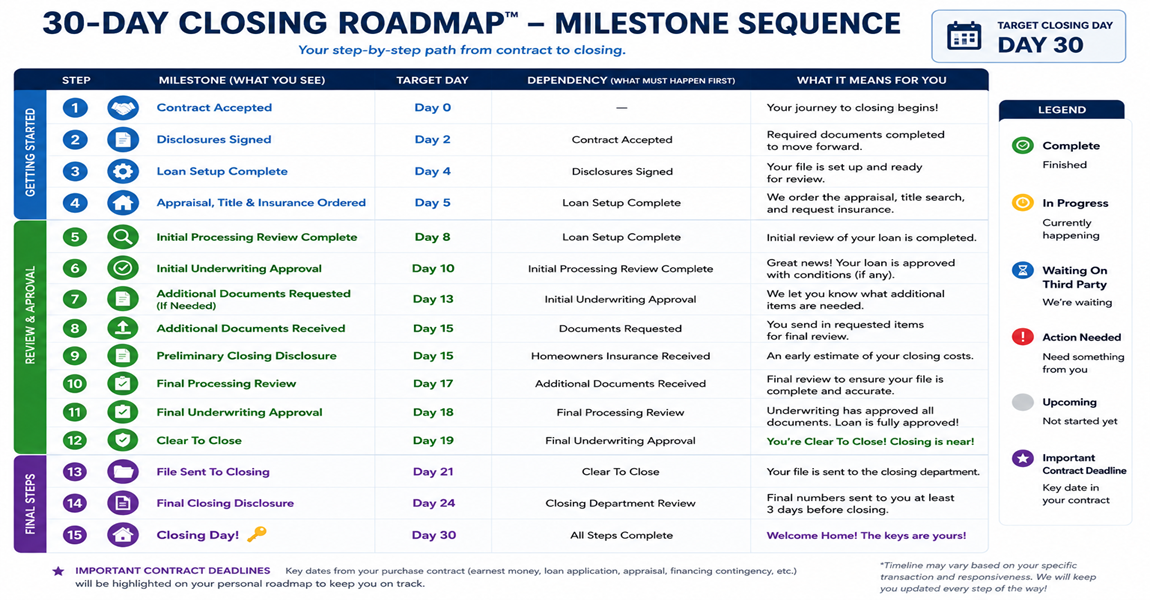
Understanding Your Calendar Updates — Who This Resource Helps and Why
Small Financial Changes Can Delay Your Closing — Documentation Calculations and Planning Details

Small Financial Changes Can Delay Your Closing — Documentation Calculations and Planning Details